 Qazi Forex Tips
In this lesson
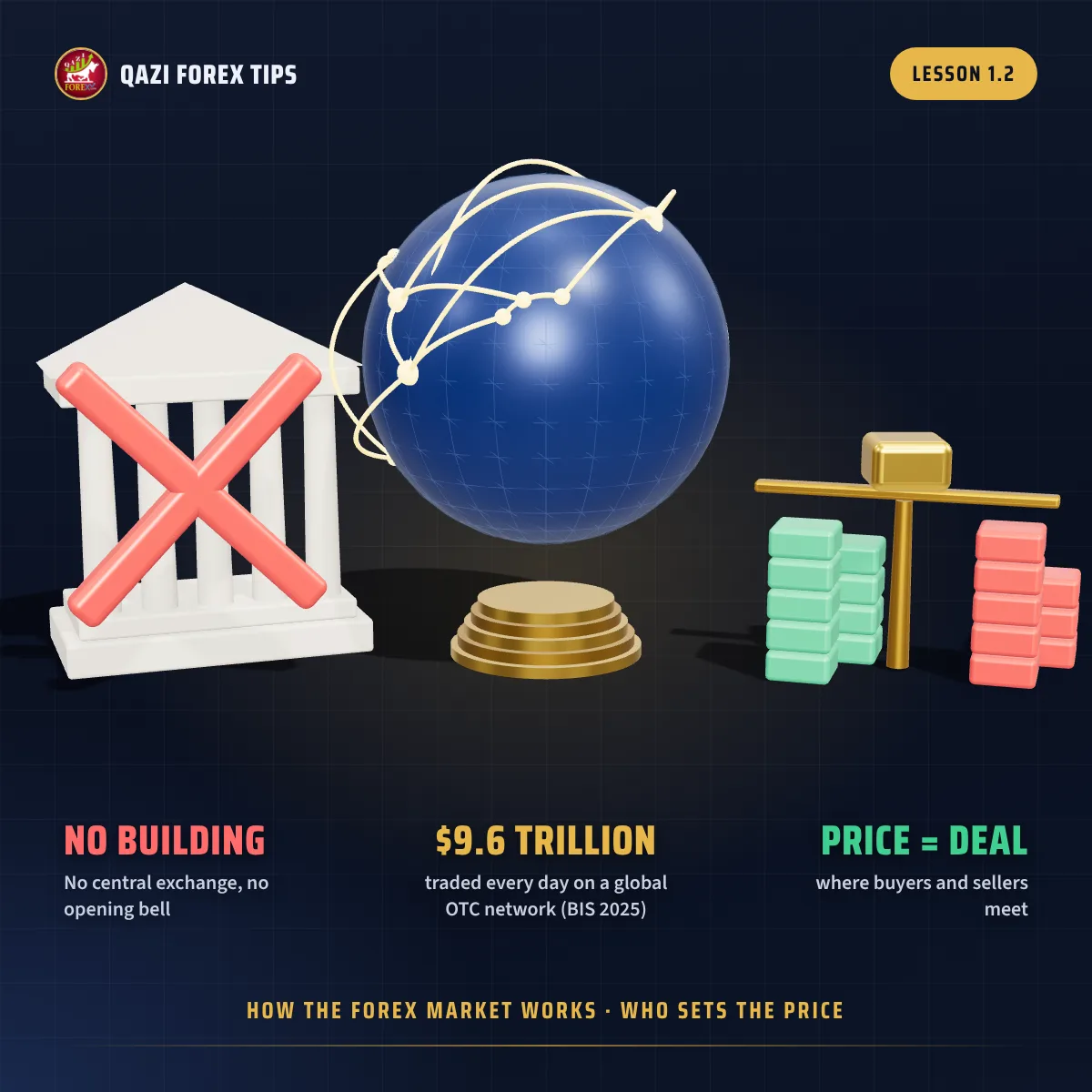
- Forex market size: $9.6 trillion a day (BIS 2025)
- What is traded: swaps 42%, spot 31%, forwards 19%
- The US dollar is on one side of 89% of trades
- Why forex has no building: the OTC market
- The 4 hubs: London, New York, Singapore, Hong Kong
- Who trades forex: the market pyramid
- Hedging vs speculation
- How the price is made by buyers and sellers
- Pakistan: interbank rate vs open market rate
- A 2-minute practical task
Forex is the biggest market in the world, about $9.6 trillion a day, and most of it moves real payments and manages risk.
From this lesson
It has no building: forex is an OTC network of banks and institutions, so there is no single official price.
From this lesson
No one sets the price: it is where buyers and sellers meet. Your trade does not move it; you follow the big players.
From this lesson
Video chapters
- 0:00 The forex market: $9.6 trillion a day
- 0:42 Forex Basics Lesson 1.2 intro
- 1:20 How big is the forex market? (BIS 2025)
- 2:57 Where forex trades: the OTC market
- 4:18 Who trades forex: market participants
- 5:28 Why they trade: hedging vs speculation
- 6:34 How forex prices are made
- 7:28 Pakistan: interbank vs open market rate
- 8:32 Summary and practical task
Lesson notes
How big is the forex market?
The Bank for International Settlements (BIS), the bank of the world's central banks, counts global currency trading every three years. Its April 2025 Triennial Survey found about $9.6 trillion traded every day, around 28% more than in 2022. To feel that number: counting one dollar every second, just one trillion would take more than 31,000 years.
That figure is not just people trading on mobile apps. It has three big parts:
| Part | Share of daily turnover | What it is |
|---|---|---|
| FX swaps | about 42% | Banks and institutions exchange one currency for another for a period, for their own funding needs |
| Spot | about 31% (around $3 trillion a day) | Exchange right now, at today's price. The price on your chart comes from the spot market |
| Outright forwards | about 19% | Companies fix today a rate for a future date |
So most of the market exists to move real payments and to manage currency risk. Not every deal is a trader's bet. One currency is everywhere: the US dollar is on one side of about 89% of all trades, and EUR/USD alone is about 21% of the market.
Where does forex trade? No building: the OTC market
Shares are easy to picture. The Pakistan Stock Exchange has a building in Karachi: like one big vegetable market, everyone goes there and everyone gets one rate. Forex is the opposite. Picture thousands of shops across a city, all connected by phone. You can buy from any of them, and each shop's rate is very close to the others, but not exactly the same.
This is called an OTC (over-the-counter) market: deals happen directly between two parties, not through one central exchange. Banks, institutions and companies are linked by computer networks. That is why forex has no single official price, and no one country or person can close it.
Some cities are still the heart of the network. According to the BIS, London handles about 38% of global FX trading, New York 19%, Singapore about 12% and Hong Kong 7%: together about 75%. They sit in different time zones, so the market keeps running through the working week (see the market timings in Pakistan and India).
Who trades forex? The market pyramid
- Central banks such as the State Bank of Pakistan and the US Federal Reserve. They do not trade for profit: they manage reserves and the currency, and one decision can move the whole market.
- Big dealer banks: about 47% of turnover is between these banks. They quote buy and sell prices all day.
- Other financial institutions: smaller banks, hedge funds, pension funds, investment companies and brokers, about 48%.
- Companies that import and export: surprisingly, only about 5%.
- Retail traders, you and me, reaching the market through a broker. In this ocean our trade is one drop.
Why do they trade? Payments, hedging and speculation
Every player has a different reason. A Pakistani company importing a machine from Japan must pay in yen, so it sells rupees to buy yen. A textile exporter paid in dollars sells those dollars for rupees. A Pakistani working abroad sends money home, and his dollars become rupees.
A company afraid that the rate will move against it in three months fixes the rate today. That is hedging: not profit, protection. A trader who buys or sells only to profit from the price difference is doing speculation, which is what most retail traders do. Remember that the people on the other side usually have far more money, information and technology than you. The smart way is to swim with the big fish, not against them.
How is the price made?
No one person and no one bank sets the price. Every moment thousands of buyers and sellers make their offers, and the price at which a buyer and a seller agree becomes the price of that moment. If importers need more dollars and sellers are few, sellers ask more and the dollar rises. If remittances and exports bring plenty of dollars and buyers are few, the dollar gets cheaper. These buying and selling decisions change with news: interest rates, inflation, jobs data and central bank decisions. Each candle on your chart is a picture of this tug of war. The small gap between the buy and sell price is the spread.
Pakistan: interbank rate vs open market rate
Pakistan has followed a market-based, flexible exchange rate since 1999. The dollar's rate is formed by demand and supply in the market between banks, the interbank market, while the State Bank manages reserves and supervises. When you buy dollars from an exchange company in the bazaar you get a second rate, the open market rate. In July 2026, for example, the open market dollar was around Rs 279 while the interbank rate was about Rs 1.5 lower.
| Interbank | Open market | |
|---|---|---|
| Who trades | Banks, large transactions | Exchange companies, cash, small deals |
| Example (July 2026) | about Rs 277.7 to 278.1 | about Rs 278.8 to 279.7 |
When this gap grows too wide people look for illegal channels, which is why both the State Bank and the IMF want it kept small. One currency, two places, two rates: that is the real face of the forex market.
Practical task
Find today's interbank and open market dollar rates, write down the difference, and share it in the YouTube comments. Then think about one question: when you press Buy on MT5, where does your trade actually go? Lesson 1.3 answers it.
Sources: BIS Triennial Central Bank Survey 2025; State Bank of Pakistan and ECAP published rates for the July 2026 example. Rates are only an example and change every day. This lesson is education only, not financial advice.
Khulasa (Roman Urdu / Hindi)
- Forex duniya ki sab se bari market hai: roz taqreeban 9.6 trillion dollar (BIS 2025), 2022 se 28% zyada.
- Is ka bara hissa asal payments aur risk sambhalne ke liye hai: swaps taqreeban 42%, spot 31%, forwards 19%. Har sauda trader ka daao nahi.
- Taqreeban 89% saudon mein aik taraf US dollar hota hai, aur EUR/USD akela taqreeban 21% hai.
- Forex ki koi building nahi. Yeh OTC (over the counter) network hai: sauda seedha do parties ke beech, is liye koi aik official price nahi.
- London 38%, New York 19%, Singapore taqreeban 12%, Hong Kong 7%: yeh chaar shehar mil kar taqreeban 75%.
- Pyramid: oopar central banks (SBP, Fed), phir bare dealer banks (taqreeban 47%), doosre financial idare (48%), companies (sirf 5%), aur sab se neeche retail traders.
- Hedging = hifazat, speculation = price ke farq se munafa. Retail traders zyada tar speculation karte hain.
- Price koi aik banda nahi banata: jahan khareedne aur bechne wale mil jayein, wohi price hai.
- Pakistan mein interbank aur open market do alag rate hain; farq bahut barhe to log ghair qanooni raaste dhoondte hain.
Questions
Forex market kaise kaam karti hai?
Forex market ki koi aik building ya exchange nahi. Duniya bhar ke banks, idare aur companies computer networks se jure hain aur aapas mein seedha currency khareedte bechte hain. Ise OTC market kehte hain. Price wahan banti hai jahan khareedne aur bechne wale mil jayein.
فاریکس مارکیٹ میں روزانہ کتنا لین دین ہوتا ہے؟
بی آئی ایس کے اپریل 2025 کے سروے کے مطابق روزانہ تقریباً 9.6 ٹریلین ڈالر، جو 2022 سے تقریباً 28 فیصد زیادہ ہے۔
How does the forex market work?
The forex market is a decentralised, over-the-counter (OTC) network. Banks, financial institutions, companies and brokers trade currencies directly with each other through computer networks instead of on one central exchange. Prices are set continuously by the meeting of buyers and sellers, so there is no single official price.
Who controls the forex market?
No single person, bank or country controls it. Central banks such as the State Bank of Pakistan and the US Federal Reserve have the biggest influence through interest rates and reserves, and large dealer banks quote most prices, but the price itself comes from millions of buy and sell decisions.
Who are the main participants in the forex market?
Central banks, large dealer banks (about 47% of turnover), other financial institutions such as hedge funds, pension funds and brokers (about 48%), non-financial companies (about 5%), and retail traders who reach the market through brokers.
What is the difference between the interbank rate and the open market rate in Pakistan?
The interbank rate is the dollar rate in the market between banks, formed by demand and supply on large transactions. The open market rate is what exchange companies charge for cash dollars in small deals. The open market rate is usually a little higher; the State Bank and the IMF want the gap kept small.
Related lessons
 Forex trading for beginners: risk, demo or real account, and your brokerPrice Action Basics
 Forex trading myths vs reality
Education only, not financial advice. Trading forex, Gold and CFDs carries a high risk of loss. Examples are for learning; check the rules of your country and practise on a demo account before using real money.