 Qazi Forex Tips
In this lesson
- Can $100 make 10% a day? The compounding maths
- The 6 players in the forex market and the 2015 Swiss franc shock
- Where winners' money comes from
- Where losers' money goes: fees, the broker, better traders, scams
- Islamic / swap-free accounts and admin fees
- Why the total of all traders is negative after fees
- The $50 and $100 account reality and how much to risk
- 10 losing trades: 1% vs 3% vs 20% risk

Your profit is not a gift from the market; it came out of someone's pocket.
From this lesson
A small account is not for earning, it's for learning.
From this lesson
In the market, the one who earns is the one who survives first. Protect first, then earn.
From this lesson
Video chapters
- 0:00 Can $100 make 10% a day?
- 0:44 How to earn money from forex trading
- 1:12 Who is in the forex market?
- 1:41 Swiss franc shock 2015
- 2:37 Where winners' money comes from
- 3:41 Where losers' money goes: 4 places
- 5:22 Why the total is negative
- 6:03 $50 and $100 account reality
- 6:47 How much to risk: small vs big account
- 7:22 10 losing trades: 1% vs 3% vs 20%
- 7:40 When forex profit is possible
- 8:03 Practical task
- 8:26 Next lesson: scams & signal groups
Lesson notes
Can $100 really make 10% a day?
You have probably seen the claim: invest $100 and earn 10% profit every day. Let's do the maths. If $100 grew by 10% a day and you reinvested the profit every day, after 30 days it would be about $1,744.94. After a full year the number would be bigger than all the personal wealth in the world. This is only a maths illustration, not a possible trading result. If it were that easy, everyone would be rich. So how is money really made in forex, and how is it lost?
Who is in the forex market?
About $9.6 trillion of currency changes hands every day (BIS Triennial Survey 2025). Six kinds of players share that market:
| Player | Who they are | Why they trade |
|---|---|---|
| Big banks | The heart of the market. They quote buy and sell prices all day. | Profit from the spread and their own trading |
| Central banks | For example the State Bank of Pakistan or the Bank of Japan. | Manage their own currency, not profit |
| Big institutions | Hedge funds, investment funds and smaller banks; roughly half of all trading. | Profit |
| Import and export companies | Buy and sell currency to pay for goods. | Protect their business (hedging), not profit |
| Brokers and liquidity providers | Connect ordinary traders to the big market. | Spread, commission, swap, and sometimes your loss |
| Retail traders (us) | Only a few percent of the whole market. | Profit, but we are the smallest fish |
How powerful is a central bank? On 15 January 2015 the Swiss National Bank removed its cap on the franc with one announcement. Within minutes the Swiss franc jumped about 30%. Many retail accounts were wiped out in a single day, and a London broker went bankrupt. Retail traders like us are the smallest fish in this ocean, which is why we learn to protect ourselves first.
How to earn money from forex trading: where profit comes from
In forex, money is made from the price difference. You buy EUR/USD and the price goes up: profit. It goes down: loss. If you sell, it is the opposite. (Lesson 1.1: What is forex trading? explains buy and sell from zero.)
On the other side of every trade there is someone: another trader, a bank or liquidity provider, or your own broker. One single person does not lose exactly what you win every time, but across the whole market money is not created out of thin air; it moves from one hand to another. So a winner's money comes from two places:
- The losses of traders who lose.
- Players who trade for their needs, not for profit, such as companies and central banks.
Your profit is not a gift from the market. It came out of someone's pocket, so to win you must make better decisions than others.
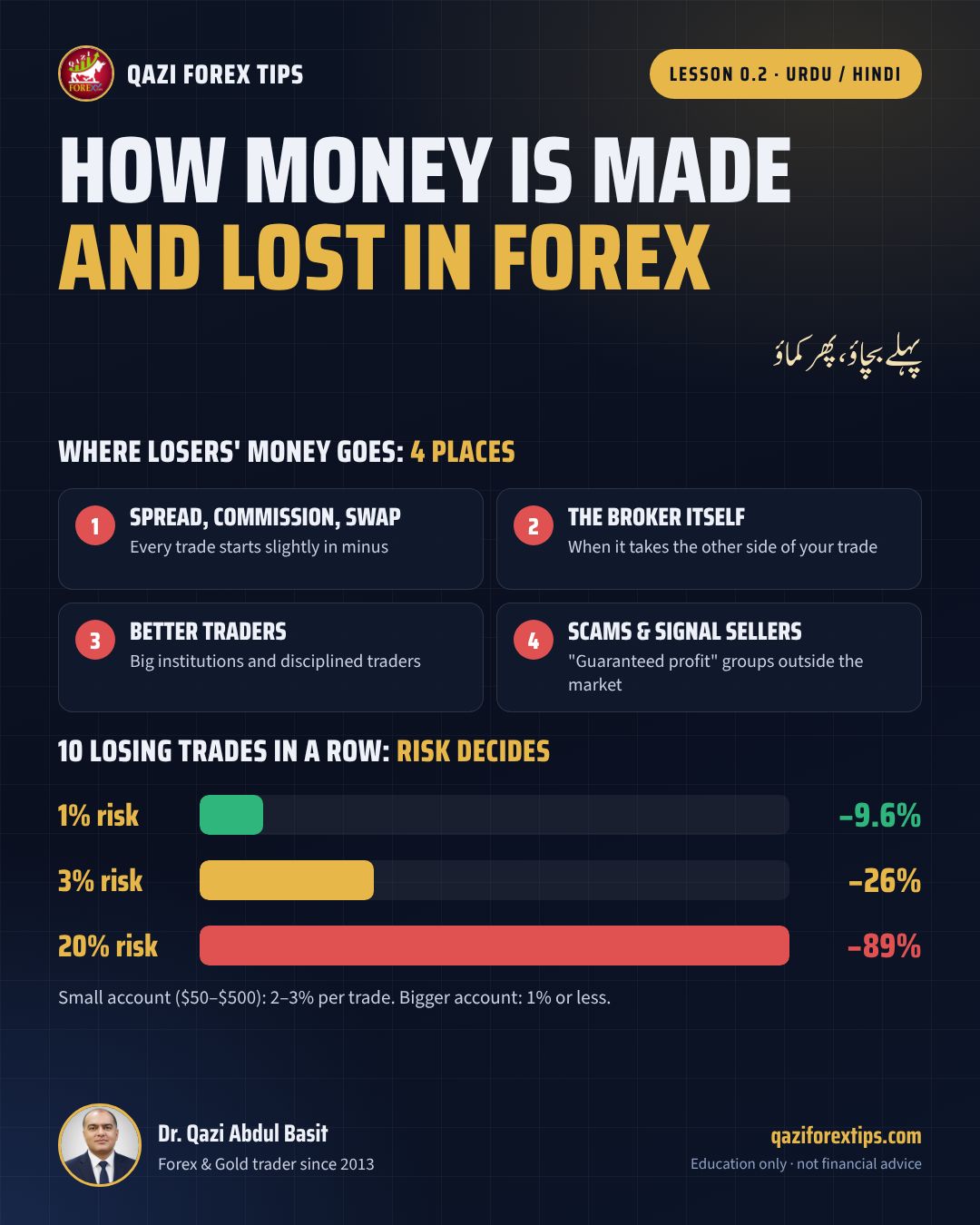
Where losers' money goes: 4 places
| Where it goes | How | Read more |
|---|---|---|
| 1. Fees: spread, commission, swap | The spread puts every trade slightly in minus the moment it opens. Commission applies on some account types. Swap is charged (or sometimes paid) for holding a trade overnight. | What is spread · What is swap |
| 2. The broker itself | Many brokers do not send every trade to the big market; they take the other side themselves (often called a B-book). Then your loss becomes the broker's profit. This does not mean every broker cheats, but you should know it. | Forex brokers guide |
| 3. Better traders and institutions | Banks, funds and disciplined traders with better information, tools and risk control. | Risk management |
| 4. Outside the market: scams and signal sellers | Paid signal groups, account managers and "guaranteed profit" schemes take money before a single trade is placed. | Signal groups · Is forex a scam? |
Islamic (swap-free) accounts
Many brokers offer an Islamic or swap-free account with no swap. But most of them charge a fixed admin fee for holding a trade overnight, either after a few days or from the first day. Some widen the spread a little, and some charge no admin fee at all. Not every broker works the same way, so read your broker's terms before opening an account. Module 4 covers broker and account types in detail.
Why the total is negative (the shovel sellers)
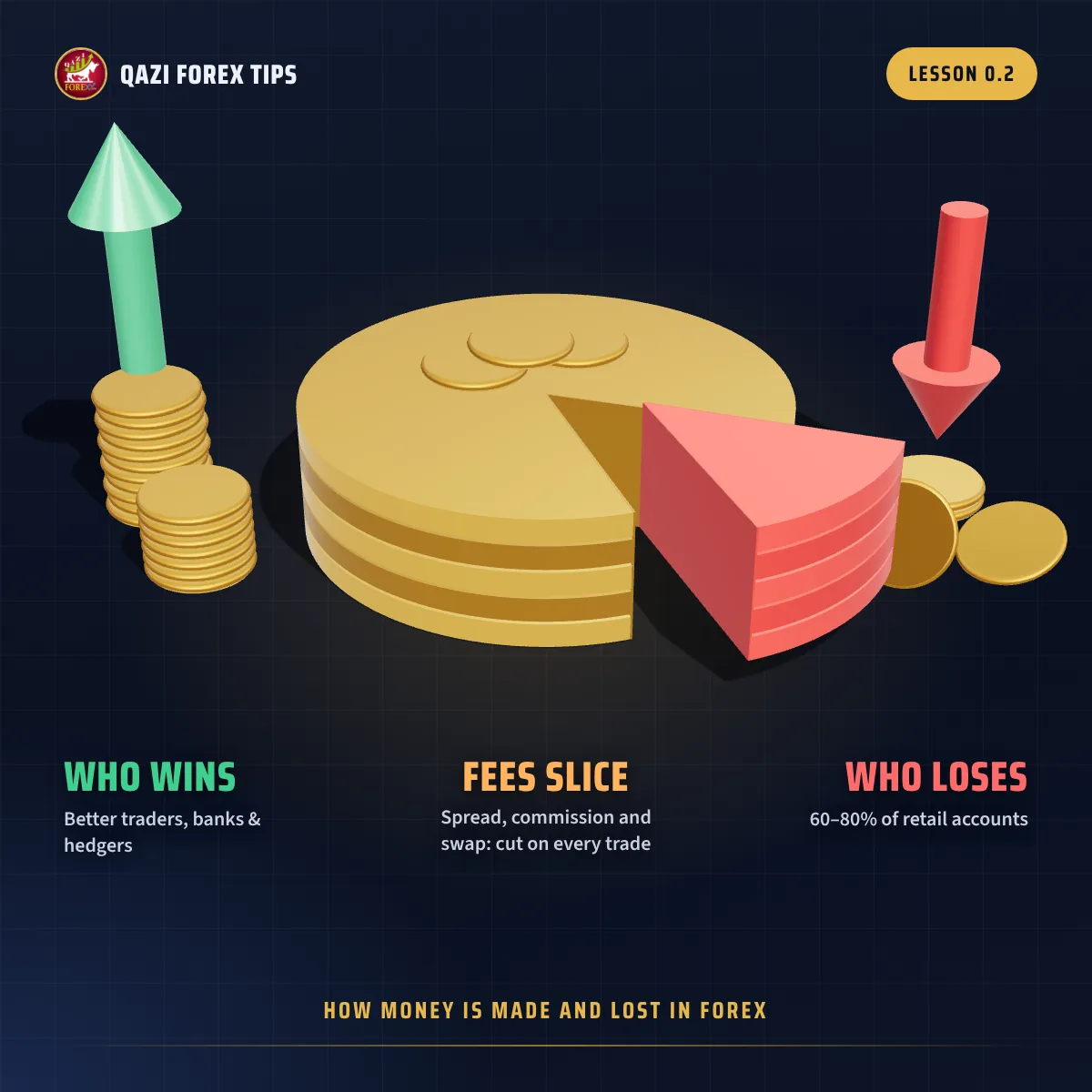
A fee is cut on every trade. So if you add up the profit and loss of all traders, the total is not zero: it is minus. Think of a cake where one slice is always cut away as a fee before anyone eats. The people who earn whether the market goes up or down are brokers, banks and signal sellers. In a gold rush, the one who earns most is the one selling shovels.
That is why regulated brokers in Europe and the UK must publish a risk warning on their own websites, and those warnings typically say about 60% to 80% of their retail accounts lose money trading CFDs.
The truth about a $50 or $100 account
Say you risk 2% of your account on each trade. On $100 that is $2, on $50 just $1. If a good trader makes 5% in a whole month, which is a very good result and not guaranteed, that is $5 on $100 and $2.50 on $50.
| Account | Risk per trade | Most you lose on one trade | A very good month (+5%) |
|---|---|---|---|
| $50 | 2% | $1.00 | $2.50 |
| $100 | 2% | $2.00 | $5.00 |
| $500 | 3% | $15.00 | $25.00 |
| $1,000 | 1% | $10.00 | $50.00 |
| $10,000 | 1% | $100.00 | $500.00 |
Can this run a household? No. This is where people go wrong: $5 feels too small, so they put 20% or 30% on one trade, and a few trades later the account is gone. A small account is for learning, not for earning.
How much should you risk per trade?
Risk means: if this trade goes wrong, how much of your account goes. You control it with a stop loss and the right lot size (Module 8 covers it fully; you can already try the free lot size calculator). A practical rule:
- Small account ($50–$500): 2–3% per trade is acceptable, because the amount is small anyway and it is a learning account.
- Bigger account: 1% or less, because every percent is now a big amount. 1% of $10,000 is $100.
10 losing trades in a row: 1% vs 3% vs 20% risk
Ten losses in a row can happen to any trader. Here is what it does to the account:
| Risk per trade | Account after 10 losses | Total drawdown |
|---|---|---|
| 1% | $904.38 | −9.6% |
| 3% | $737.42 | −26.3% |
| 20% | $107.37 | −89.3% |
At 1% you can recover. At 20% the account is practically finished (read more about drawdown and recovery).
Is forex trading profitable?
Yes, but only for traders who manage risk. That means three things: before every trade you decide the most you can lose, you have a daily and weekly loss limit, and you trade a tested plan. In the market, the one who earns is the one who survives first. Protect first, then earn.
Today's practical task (10 minutes)
- Open your broker's website and find the line that says what percentage of retail accounts lose money.
- Write down your account amount and work out 1% and 3% of it.
Write your answer in the YouTube comments. Next lesson: the biggest traps in the forex world, scams, signal groups and guaranteed-profit promises, and how to spot them from far away. If you missed it, start with Lesson 0.1: the course roadmap, or see the full syllabus.
Khulasa (Roman Urdu / Hindi)
- $100 par roz 10% ka daawa sirf hisaab ka khel hai: 30 din mein yeh $1,745 ban jata. Agar itna aasaan hota to sab ameer hote.
- Market mein roz taqreeban $9.6 trillion ka len den hota hai. Banks, central banks, institutions, companies aur brokers ke muqable mein hum retail traders sab se chhoti machhli hain.
- 15 January 2015 ko Swiss central bank ke aik elaan se franc minton mein 30% upar gaya aur London ka aik broker diwalia ho gaya.
- Jeetne wale ka paisa haarne walon ke nuqsan se aur un players se aata hai jo profit ke liye nahi, zaroorat ke liye trade karte hain.
- Haarne walon ka paisa 4 jagah jata hai: spread/commission/swap, khud broker, behtar traders, aur scams/signal sellers.
- Fees ki wajah se sab traders ka total minus hai. Sab se zyada woh kamata hai jo belche bechta hai: broker, bank, signal seller.
- Chhota account seekhne ke liye hai, kamane ke liye nahi. $50–$500 par 2–3% risk, bare account par 1% ya kam.
- 10 losses lagatar: 1% risk par −9.6%, 3% par −26%, 20% par −89%. Pehle bachao, phir kamao.
Questions
Forex trading se paise kaise kamaye?
Forex mein paisa qeemat ke farq se banta hai: pair khareedein aur qeemat upar jaye, ya bechein aur neeche aaye. Lekin fees ki wajah se sab traders ka total minus hai, is liye sirf woh kamata hai jo har trade par risk fix rakhe (chhote account par 2-3%, bare par 1% ya kam), daily aur weekly limit rakhe aur tested plan par trade kare. Pehle bachao, phir kamao.
How do you make money from forex trading?
From the price difference: you buy a pair and it rises, or sell and it falls. The money comes from the losses of other traders and from players who trade for their needs, such as companies and central banks. After fees the total of all traders is negative, so only traders with better decisions and strict risk control end up in profit.
Is forex trading profitable?
It can be, but most retail traders lose. Regulated brokers' own risk warnings typically say about 60% to 80% of retail CFD accounts lose money. Profit is possible only with a tested plan, a fixed risk per trade and daily and weekly loss limits.
Can I make money in forex with $100?
You can learn with $100, but not earn a living. At 2% risk you lose at most $2 per trade, and a very good month of +5% is about $5. A small account is a learning account.
Where does the money lost in forex go?
To four places: fees (spread, commission and swap), the broker itself when it takes the other side of your trade, better traders and institutions, and, outside the market, scams and paid signal sellers.
How much should I risk per trade?
On a small learning account of about $50 to $500, 2–3% per trade is acceptable. On a bigger account keep it at 1% or less. After 10 losses in a row, 1% risk costs about 9.6% of the account, 20% risk costs about 89%.
Is forex a zero-sum game?
Before costs, roughly yes: money moves from one hand to another. After the spread, commission and swap are taken out, the total of all traders is negative, which is why brokers, banks and signal sellers earn whichever way the market moves.
Do Islamic swap-free accounts have no cost?
They have no swap, but most brokers charge a fixed admin fee for holding trades overnight, either after a few days or from the first day, and some widen the spread. Terms differ, so read your broker's conditions.
What students said about this lecture
Public comments on this video, shown as written. Updated automatically.
use your own voice brother. i would suggest strongly, it has greater imppact maa shaa Allah
Thkank you sir ....10 din se Kisi achi course ki talsha may ta laken ap jaise details may Kisi ki video nhi meli...ap sir deliy is tara ak video upload Kiya karo
Sir mujhe 1.5 saal ho gya hai aur Maine price action bhi seekh li hai but mujhe koi EMA strategy chahie to please ap koi EMA + price action strategy Par Video bana de please
Laken sir ap apni voice may video bana Liya karo os tara hamy zyda Samaj ha ta hy... clearance zyda ho ta hy
Related lessons
 Forex trading for beginners: risk, demo or real account, and your brokerPrice Action Basics
 Forex trading myths vs reality
Education only, not financial advice. Trading forex, Gold and CFDs carries a high risk of loss. Examples are for learning; check the rules of your country and practise on a demo account before using real money.