 Qazi Forex Tips

A fixed risk on every trade and a stop loss you place first. Protecting the account comes before everything else.
How Dr. Qazi teaches
What risk management means
Risk management decides how much you can lose on each trade, each day and in total, before you look at any entry. Money management is the same idea seen from the account: how you grow it and protect it. In practice it comes down to a few levers:
- How much of the account you risk per trade.
- Where the stop loss goes.
- The lot size that turns those two into money.
- The reward you aim for compared with the risk.
- Daily and weekly loss limits.
Get these right and a normal losing streak is only a dent. Get them wrong and even a good strategy blows the account.
Rule 1: risk a small, fixed percentage per trade
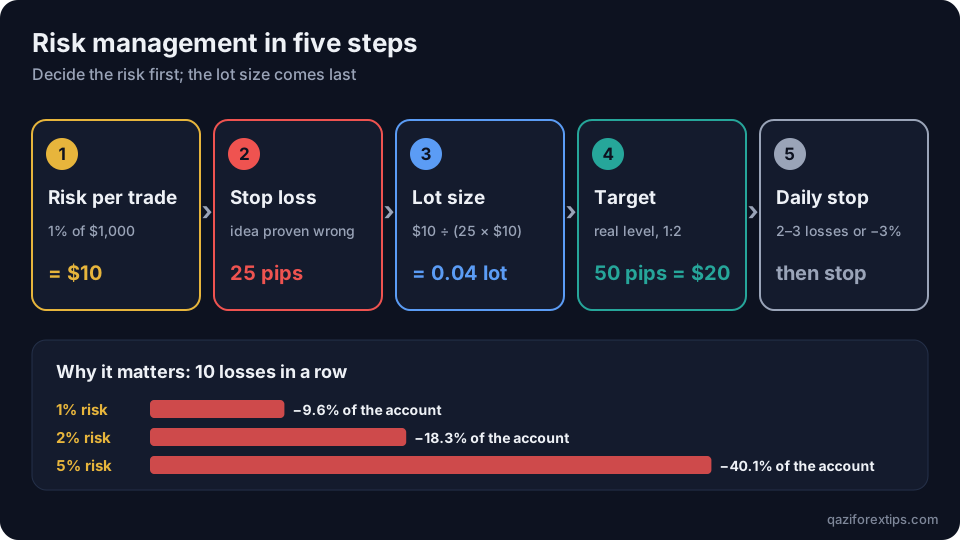
Decide a fixed risk per trade, usually 0.5% to 2% of the account, and keep it the same on every trade. On a $1,000 account, 1% is $10.
Why so small? Because losing streaks are normal, even for a good strategy. Ten losses in a row, each taking a fixed percentage of what is left:
| Risk per trade | Account after 10 losses in a row |
|---|---|
| 1% | down about 9.6% |
| 2% | down about 18.3% |
| 5% | down about 40.1% |
At 1% you can recover; at 5% you need a 67% gain just to get back to where you started. Build the full rules in the money management plan lesson.
Rule 2: place the stop loss first
The stop loss goes where your trade idea is proven wrong: beyond the swing low for a buy, beyond the swing high for a sell, with a small buffer. It is a chart decision, not a money decision.
Never move the stop further away to avoid a loss, and never trade without one. If the right stop is too far for your risk, the answer is a smaller lot or no trade. More in stop loss and take profit.
Rule 3: let the lot size come from the risk and the stop
Lot size is the last thing you decide, not the first:
Lot size = money at risk ÷ (stop distance × value per lot)
- EURUSD: risk $10, stop 25 pips, a standard lot is worth about $10 per pip. $10 ÷ (25 × $10) = 0.04 lot.
- Gold (XAUUSD): risk $10, stop $5, 1.00 lot is 100 ounces, so $5 × 100 = $500 per lot. $10 ÷ $500 = 0.02 lot.
Same $10 risk, very different lots, because the stops and the instruments are different. Use the free lot size calculator, and see what a pip is and the lot size lesson for the details.
Rule 4: know your risk:reward and win rate
Risk:reward compares what you can win with what you can lose. Together with your win rate it decides whether a strategy makes money:
| Risk:reward | Break-even win rate |
|---|---|
| 1:1 | 50% |
| 1:2 | 33.3% |
| 1:3 | 25% |
Example: a strategy that wins 40% of trades at 1:2 earns 0.4 × 2 − 0.6 × 1 = +0.2R per trade on average. The target must be a real level on the chart, not a number picked to make the ratio look good. Full guide: risk reward ratio.
Rule 5: respect drawdown
Losses and gains are not symmetrical. The deeper the drawdown, the bigger the gain you need to recover:
| Loss | Gain needed to recover |
|---|---|
| 10% | 11.1% |
| 20% | 25% |
| 30% | 42.9% |
| 50% | 100% |
That is why the first job is to keep drawdowns small. Read drawdown in forex.
Rule 6: set daily and weekly limits
Decide in advance when you stop: for example after two or three losses in a day, or when the day is down 2–3%. Stop for the week at a larger number. Limits protect you on the days when you are tired, angry or chasing losses.
Prop firms enforce the same idea with a daily loss and a maximum loss rule. If you want to trade a funded account, practise with those limits first: how to pass a prop firm challenge.
Leverage, news and costs
- Leverage only changes the margin your broker holds. Your risk per pip comes from the lot size, so high leverage is dangerous only when it tempts you into a big lot. See leverage and margin.
- News: high-impact releases such as NFP can jump past your stop. Stay flat or reduce size around them: trading NFP news.
- Costs: spread, commission and swap are part of the risk on every trade, more so for scalpers. See spread and swap.
The human side
Most rule breaks happen after a loss: doubling the lot to win it back, removing the stop, or taking a trade that is not in the plan. Write your rules, keep a journal, and stop for the day when you notice it. More in trading psychology.
Your one-page risk plan
Write this down before your next trade and keep it next to your screen:
- Risk per trade: ___% (the same every trade).
- Stop loss: at the level that proves the idea wrong, never moved further away.
- Lot size: from the calculator, rounded down.
- Minimum risk:reward: 1:___ to a real level.
- Daily stop: ___ losses or ___%. Weekly stop: ___%.
- News: no new trades ___ minutes before and after high-impact news.
- After a losing streak: lower the risk, never raise it.
Then test the plan with your strategy on past data before you use it live: how to backtest.
Tools that do the maths for you
- Lot size calculator: free, in the browser, for forex and Gold.
- QFT Trade Assistant: a manual MT5 and MT4 panel that sizes the lot from your risk as you drag the stop, turns the risk box yellow above 2% and red above 5% of the balance, and has a Prop Firm Guard for daily and maximum loss.
- QFT Replay Simulator: practise your risk plan and a prop firm challenge on past data without risking money.
Khulasa (Roman Urdu / Hindi)
- Risk management: har trade, har din aur kul kitna nuqsan bardasht hai, yeh entry se pehle tay karein.
- Har trade par account ka chhota aur fixed hissa risk karein, aam tor par 0.5% se 2%. $1,000 par 1% = $10.
- Lagatar 10 losses: 1% risk par account taqreeban 9.6% neeche, 5% risk par 40% neeche.
- Stop loss pehle: wahan jahan aap ka idea ghalat sabit ho. SL kabhi door na karein.
- Lot size aakhir mein: risk ÷ (SL distance × value per lot). EURUSD 25 pips, $10 risk = 0.04 lot. Gold $5 SL, $10 risk = 0.02 lot.
- Risk:reward 1:2 par break-even win rate 33.3%, 1:3 par 25%. Target asal level par ho.
- Drawdown: 20% loss ke baad 25% aur 50% loss ke baad 100% profit chahiye wapas aane ke liye.
- Rozana aur hafte ki had: 2–3 losses ya 2–3% loss par us din trading band.
- Leverage risk nahi badhata, lot size badhata hai. Bari news (NFP) par trade na karein ya size kam karein.
- Loss ke baad lot double karna, SL hatana ya plan se bahar trade sab se bari ghaltiyan hain.
- Apna ek page ka risk plan likhein, backtest karein, phir calculator ya Trade Assistant se lot nikaalein.
Questions
What is risk management in forex?
The rules that limit how much you can lose per trade, per day and in total: a fixed risk per trade, a stop loss, a lot size calculated from them, a sensible risk:reward and loss limits.
How much should I risk per trade?
Most traders risk 0.5% to 2% of the account per trade. Beginners should stay near 1% or lower until their results are proven.
What is the 1% rule in forex?
Never risk more than 1% of your account on one trade. On a $1,000 account that is $10, so a stop loss hit costs at most $10.
What is the difference between risk management and money management?
They overlap. Risk management limits losses on each trade and day; money management covers the whole account plan, including how risk changes as the account grows or falls.
How do I calculate lot size from my risk?
Lot size = money at risk ÷ (stop distance × value per lot). The free lot size calculator does it for forex pairs and Gold.
What is a good risk reward ratio?
At least 1:2 for most strategies, but only if the target is a real level. With 1:2 you break even at a 33.3% win rate.
Should I increase my lot after a loss?
No. Raising the lot to win back a loss is how small drawdowns become blown accounts. Keep the same percentage risk, or lower it during a losing streak.
Can I learn risk management in Urdu or Hindi?
Yes. This guide has a Roman Urdu / Hindi summary, and our free Urdu / Hindi video lessons on lot size, money management and stop loss teach each rule step by step.
Watch the video lessons
 Lot size in forex: how to choose the right lot size on every tradeVideo lesson · 33:42
 Money management plan: grow a small account step by stepVideo lesson · 18:38
 Where to set stop loss and take profit, and when to close halfVideo lesson · 12:19
 Forex trading myths vs realityVideo lesson · 13:10
 How to read and analyse NFP news dataVideo lesson · 24:00
 How to backtest a trading strategy like a pro
Education only, not financial advice. Trading forex, Gold and CFDs carries a high risk of loss. Contract sizes, spreads and leverage differ by broker; check your own broker's specifications.