 Qazi Forex Tips

A fixed risk on every trade and a stop loss you place first. Protecting the account comes before everything else.
How Dr. Qazi teaches
What drawdown is
Drawdown is the fall of your account from its highest point to a later low, in money or in percent. Maximum drawdown is the largest such fall over a period.
Example: the account grows from $1,000 to $1,200, then falls to $960 before making a new high. The drawdown is $240, or 20% of the $1,200 peak, even though the account is only 4% below where it started.
Balance and equity drawdown
- Balance drawdown counts only closed trades.
- Equity drawdown also counts the floating loss of open trades. It is the true picture, and it is what prop firms and margin calls use.
The MT5 strategy tester report shows both, as "Balance Drawdown Maximal" and "Equity Drawdown Maximal".
The recovery maths
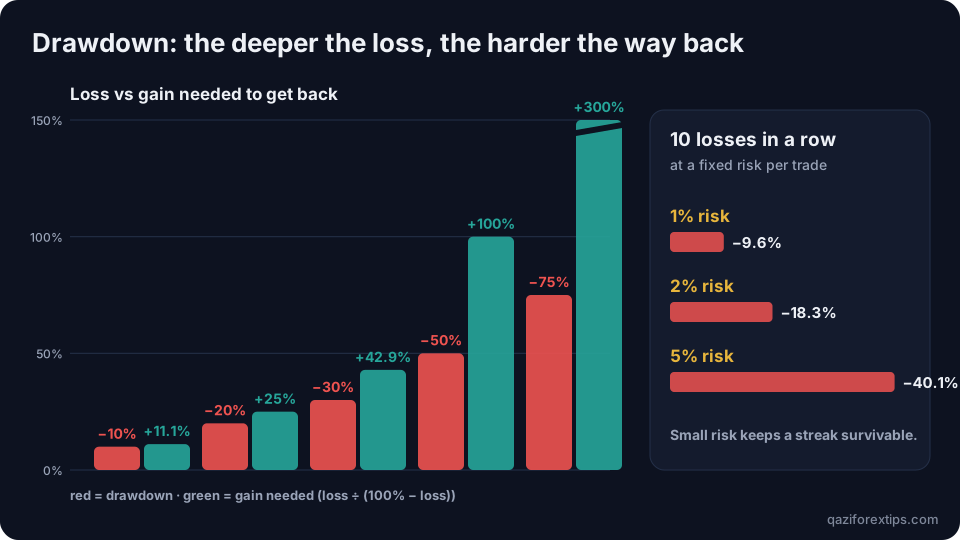
After a loss you need a bigger percentage gain to get back to the peak: gain needed = loss ÷ (100% − loss).
- 10% drawdown → 11.1% gain to recover
- 20% → 25%
- 30% → 42.9%
- 50% → 100%
- 75% → 300%
This is why protecting the account comes first: small drawdowns are easy to recover from, deep ones can take years.
Losing streaks are normal
Even a good strategy has long losing runs. Over 100 trades with a 50% win rate, the chance of at least one run of 6 losses in a row is about 55%. With a 40% win rate (a typical 1:2 strategy), the chance of 8 losses in a row is about 49%.
What a streak of 10 losses does to the account depends only on the risk per trade:
- 1% per trade → about −9.6%
- 2% per trade → about −18.3%
- 5% per trade → about −40.1%
How to control drawdown
- Fixed small risk on every trade, for example 1%; work out the lot with a lot size calculator.
- A daily stop: stop for the day after a set loss, for example 2–3% or three losing trades.
- Cut risk in a drawdown: for example halve the risk after a 10% drawdown, and return to normal at a new high.
- Review, don't revenge: check your journal for rule breaks before changing the strategy.
- Let the panel watch it: the Prop Firm Guard in QFT Trade Assistant shows your daily loss and drawdown live and can stop new trades at your limit.
- Know your limit in advance: prop firms fail you at a set drawdown; read how to pass a prop firm challenge.
Khulasa (Roman Urdu / Hindi)
- Drawdown: account ke sab se ooche point se baad ke low tak girawat.
- Equity drawdown mein khuli trades ka loss bhi shamil hota hai.
- 50% loss wapas lane ke liye 100% profit chahiye; 20% ke liye 25%.
- 10 losses lagatar: 1% risk par ~−9.6%, 5% risk par ~−40%.
- Har trade par chhota fixed risk, daily stop, aur drawdown mein risk aadha karein.
Questions
What is drawdown in forex?
The fall of an account from its peak to a later low, measured in money or percent.
What is a good maximum drawdown?
It depends on your goals, but many traders aim to keep maximum drawdown under about 10–20%; prop firms usually allow around 10% in total.
What is the difference between drawdown and loss?
A loss is the result of one trade; drawdown measures how far the whole account has fallen from its highest point, across many trades.
How much do I need to gain to recover a 50% drawdown?
100%. The formula is loss ÷ (100% − loss).
What is equity drawdown?
Drawdown that includes the floating profit or loss of open trades, not just closed ones.
How do I recover from a drawdown?
Reduce your risk per trade, stop trading for the day after a set loss, check your journal for rule breaks, and let the edge work again before returning to normal risk.
Watch the video lessons
 Money management plan: grow a small account step by stepVideo lesson · 9:39
 Lot size in forex: how to choose the right lot size on every tradeVideo lesson · 24:00
 How to backtest a trading strategy like a pro
Education only, not financial advice. Trading forex, Gold and CFDs carries a high risk of loss. Contract sizes, spreads and leverage differ by broker; check your own broker's specifications.