 Qazi Forex Tips

No method is profitable if there are no rules of entry and exit. Follow the rules, control your emotions and have a money management plan.
From the lecture
A written plan you follow, and the patience to skip a trade when the setup is not there.
How Dr. Qazi teaches
Why good plans fail
A loss hurts more than a win of the same size feels good, so traders hold losers too long and close winners too early. After a loss many want to win it back at once; after a winning streak many feel unbeatable and increase the lot. None of these are strategy problems; they are behaviour problems.
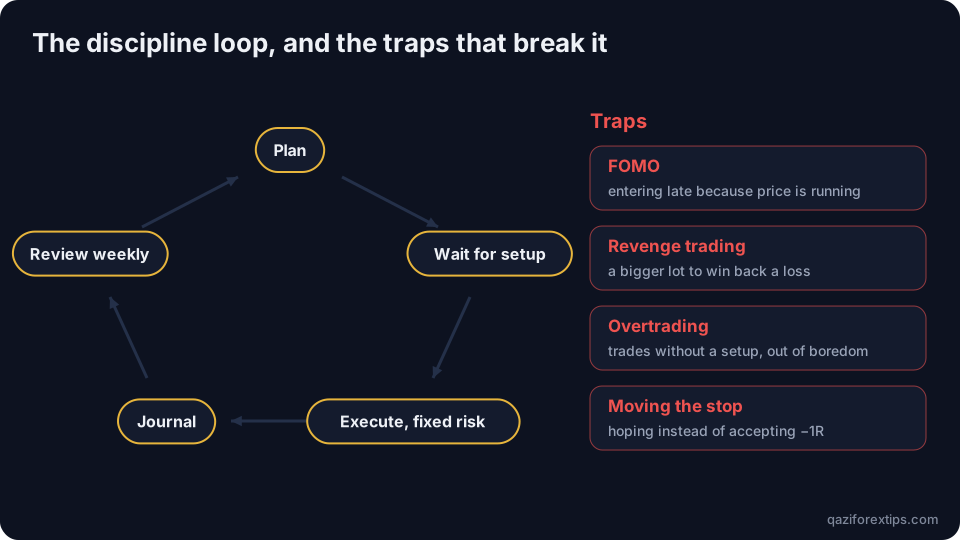
The four common traps
- FOMO: entering late because price is already running, usually far from your level and with a bad stop.
- Revenge trading: a bigger lot or an unplanned trade straight after a loss.
- Overtrading: taking trades without your setup, out of boredom or to “make the day”.
- Moving the stop: pushing the stop loss further away instead of accepting a −1R loss.
Rules that remove the decision
- Fixed risk per trade, for example 1% or less, set before the entry.
- Daily loss limit, for example 2–3 losses or 3% of the account: stop for the day when it is hit.
- A written checklist for your setup; no tick, no trade.
- No trading in the minutes around high-impact news unless news trading is your plan.
A trade panel that calculates the lot from your risk and blocks trading after a daily loss takes the emotion out of these rules.
The routine
Plan the levels before the session, wait for the setup, execute with fixed risk, write every trade in a journal (screenshot, reason, result, emotion) and review the journal every week. The review shows which mistakes cost the most money, which is the fastest way to fix them.
Practise without pressure
Practising a strategy on past data in a replay simulator builds confidence in the rules before real money is on the line, so you are less tempted to override them live.
Khulasa (Roman Urdu / Hindi)
- Zyada tar account strategy se nahi, rules todne se doobte hain.
- 4 jaal: FOMO, revenge trading, overtrading, SL door karna.
- Fixed risk, daily loss limit aur checklist faisla aasaan banate hain.
- Har trade journal mein likhein aur har hafte review karein.
Questions
How do I control emotions in trading?
Decide everything before the trade: risk, entry, stop and target. Then use fixed rules such as a daily loss limit so emotions have less to decide.
What is revenge trading?
Taking an unplanned or bigger trade straight after a loss to win the money back; it usually leads to larger losses.
How do I stop overtrading?
Write your setup as a checklist, set a maximum number of trades per day and stop after your daily loss limit.
Why do I close winning trades too early?
Fear of giving back profit. A pre-set target and a rule for partial closes or trailing stops helps.
Should I keep a trading journal?
Yes. Record the setup, screenshot, result and how you felt; weekly reviews show which mistakes cost the most.
How long does it take to become a disciplined trader?
It differs for everyone; the habits build faster when you practise the same rules on a demo or simulator first.
Watch the video lessons
 Facts about forex trading every trader should knowVideo lesson · 33:42
 Money management plan: grow a small account step by stepVideo lesson · 12:19
 Forex trading myths vs reality
Education only, not financial advice. Trading forex, Gold and CFDs carries a high risk of loss. Contract sizes, spreads and leverage differ by broker; check your own broker's specifications.