 Qazi Forex Tips

Read what the chart is doing now, on several timeframes, before any indicator or signal.
How Dr. Qazi teaches
Start with the swings
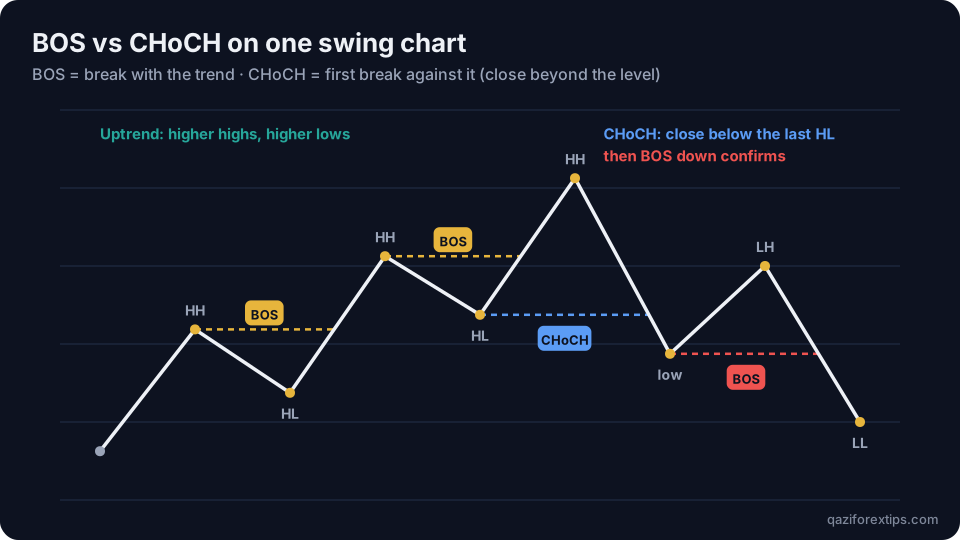
Both terms are built on swing highs and lows. An uptrend makes higher highs (HH) and higher lows (HL); a downtrend makes lower highs (LH) and lower lows (LL). Mark the swings first, then the breaks.
BOS: break of structure
A BOS is a break in the direction of the trend: in an uptrend, price closes above the last higher high; in a downtrend, it closes below the last lower low. It confirms the trend is still in control.
After a bullish BOS, traders wait for a pullback into the area that caused the break, often an order block or fair value gap, rather than buying the breakout itself.
CHoCH: change of character
A CHoCH is the first break against the trend. In an uptrend, it is a close below the last higher low, the low that started the move to the latest high. In a downtrend, it is a close above the last lower high.
A CHoCH is an early warning, not a confirmed reversal. Many traders wait for the first BOS in the new direction after it. ICT calls a similar break with a strong, fast candle a market structure shift (MSS).
Close or wick?
A break is cleaner when a candle body closes beyond the level. If only a wick pokes through and the candle closes back inside, that is more often a liquidity sweep than a real break. Decide your rule (close only, or wick allowed) and use it every time.
Internal and swing structure
Not every small swing matters. Swing (external) structure is made of the major highs and lows that define the trend on your timeframe; internal structure is the smaller swings inside a pullback. A CHoCH on internal structure inside a higher-timeframe uptrend often only marks the end of a pullback, which is a buying opportunity rather than a reversal.
Mark structure on the higher timeframe first, then use the lower timeframe for the entry; see multi-timeframe analysis.
Common mistakes
- Marking every tiny swing, so there is a "BOS" every few candles.
- Treating a wick through a level as a break.
- Trading a lower-timeframe CHoCH against a strong higher-timeframe trend.
- Looking for structure in the middle of a range, where breaks mean little.
QFT Trade Assistant marks BOS and CHoCH on closed candles only (no repainting) in its Signals tab, with a history score for your chart: see the Trade Assistant.
Khulasa (Roman Urdu / Hindi)
- BOS: trend ki simat mein break (uptrend mein last high ke oopar close).
- CHoCH: trend ke khilaf pehla break (uptrend mein last higher low ke neeche close).
- CHoCH sirf warning hai; nayi simat mein pehla BOS confirmation deta hai.
- Sirf wick bahar jaye aur close andar ho to aksar liquidity sweep hai.
- Pehle bare timeframe ka structure, phir chhote timeframe par entry.
Questions
What is the difference between BOS and CHoCH?
A BOS breaks structure in the direction of the trend and confirms it; a CHoCH is the first break against the trend and warns of a possible reversal.
What does BOS mean in forex?
Break of structure: price closes beyond the last swing high in an uptrend, or the last swing low in a downtrend.
What does CHoCH mean in trading?
Change of character: the first time price breaks the opposite swing point, such as a close below the last higher low in an uptrend.
Is CHoCH the same as MSS?
They are closely related. ICT uses market structure shift (MSS) for a break against the trend, usually with a strong displacement candle.
Should a BOS be confirmed by a candle close?
Many traders require a body close beyond the level, because a wick-only break is often a liquidity sweep.
Which timeframe is best for BOS and CHoCH?
Use a higher timeframe such as H4 or H1 for direction and swing structure, and M15 to M1 for entries.
Watch the video lessons
 Market structure explained: the key to direction and entriesVideo lesson · 17:36
 How to identify swing highs and swing lowsVideo lesson · 55:21
 How to spot a trend reversal early
Education only, not financial advice. Trading forex, Gold and CFDs carries a high risk of loss. Contract sizes, spreads and leverage differ by broker; check your own broker's specifications.