 Qazi Forex Tips

A fixed risk on every trade and a stop loss you place first. Protecting the account comes before everything else.
How Dr. Qazi teaches
The usual rules
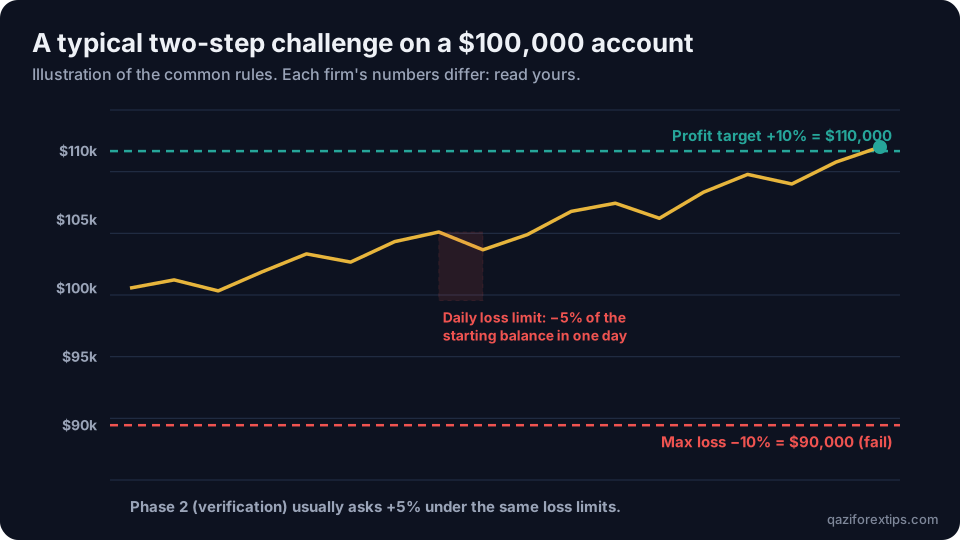
Rules differ by firm and change over time, so read your firm's current terms. A common two-step model on a $100,000 account looks like this:
- Phase 1: profit target about +10% ($10,000).
- Phase 2 (verification): about +5%.
- Daily loss limit: often 5% of the starting balance in one day ($5,000), counting open trades.
- Maximum loss: often 10% ($90,000 floor); some firms trail it.
- Extras at some firms: minimum trading days, news-trading limits and consistency rules.
Do the maths first
Risking 1% per trade, 5 losses in a row cost about 5% and break a 5% daily limit. Risking 0.5%, the same streak costs 2.5%. At 1:2 risk:reward with 0.5% risk, each winner adds 1%, so +10% needs about 10 more winners than losers.
This is why passing is about small, steady risk, not big lots.
A simple risk plan
- Risk 0.25–0.5% per trade during the challenge.
- Your own daily stop at about half the firm's daily limit (for example 2–2.5%).
- Stop for the day after 2 losses; stop for the week if you are down 4–5%.
- Lower the risk after a losing streak and when you are close to the target.
- Avoid opening trades just before high-impact news unless the firm and your plan allow it.
Common mistakes
- Trying to pass in two days with large lots.
- Forgetting that open floating losses count toward the daily limit.
- Changing strategy mid-challenge after a few losses.
- Not knowing the firm's reset time for the daily limit.
Practise the challenge first
Run the same rules on past data before you pay the fee. A replay simulator with a prop firm challenge mode shows the daily and maximum loss live, so you can see whether your strategy survives a bad week. On the live challenge, a panel with a prop firm guard, such as QFT Trade Assistant, shows the daily loss and maximum drawdown used so far and can lock trading before a limit is broken.
Khulasa (Roman Urdu / Hindi)
- Aam rules: Phase 1 +10%, Phase 2 +5%, daily loss 5%, max loss 10% (firm ke mutabiq).
- 1% risk par 5 losses = 5% (daily limit khatam). 0.5% risk behtar.
- Apna daily stop firm ki limit ka aadha rakhein.
- Fee dene se pehle simulator mein challenge practice karein.
Questions
What is a prop firm challenge?
An evaluation where you trade a demo account under set rules; if you reach the profit target without breaking the loss limits, the firm funds you and shares the profit.
What is the daily loss limit in a prop firm?
A maximum loss allowed in one day, often 5% of the starting balance and including open trades. Check your firm's exact rule and reset time.
How much should I risk per trade in a prop challenge?
Many traders use 0.25–0.5% per trade so that a losing streak cannot break the daily limit.
How long does it take to pass a prop firm challenge?
Many firms no longer set a time limit; at small risk per trade it usually takes a few weeks of steady trading.
Can I trade Gold in a prop firm challenge?
Most firms allow Gold (XAUUSD); size the lot carefully because Gold moves fast.
Why do most traders fail prop firm challenges?
Too much risk per trade, breaking the daily loss limit, and trading news or overtrading to hit the target quickly.
Watch the video lessons
 Money management plan: grow a small account step by stepVideo lesson · 9:39
 Lot size in forex: how to choose the right lot size on every tradeVideo lesson · 24:00
 How to backtest a trading strategy like a pro
Education only, not financial advice. Trading forex, Gold and CFDs carries a high risk of loss. Contract sizes, spreads and leverage differ by broker; check your own broker's specifications.