 Qazi Forex Tips

What is a breaker block?
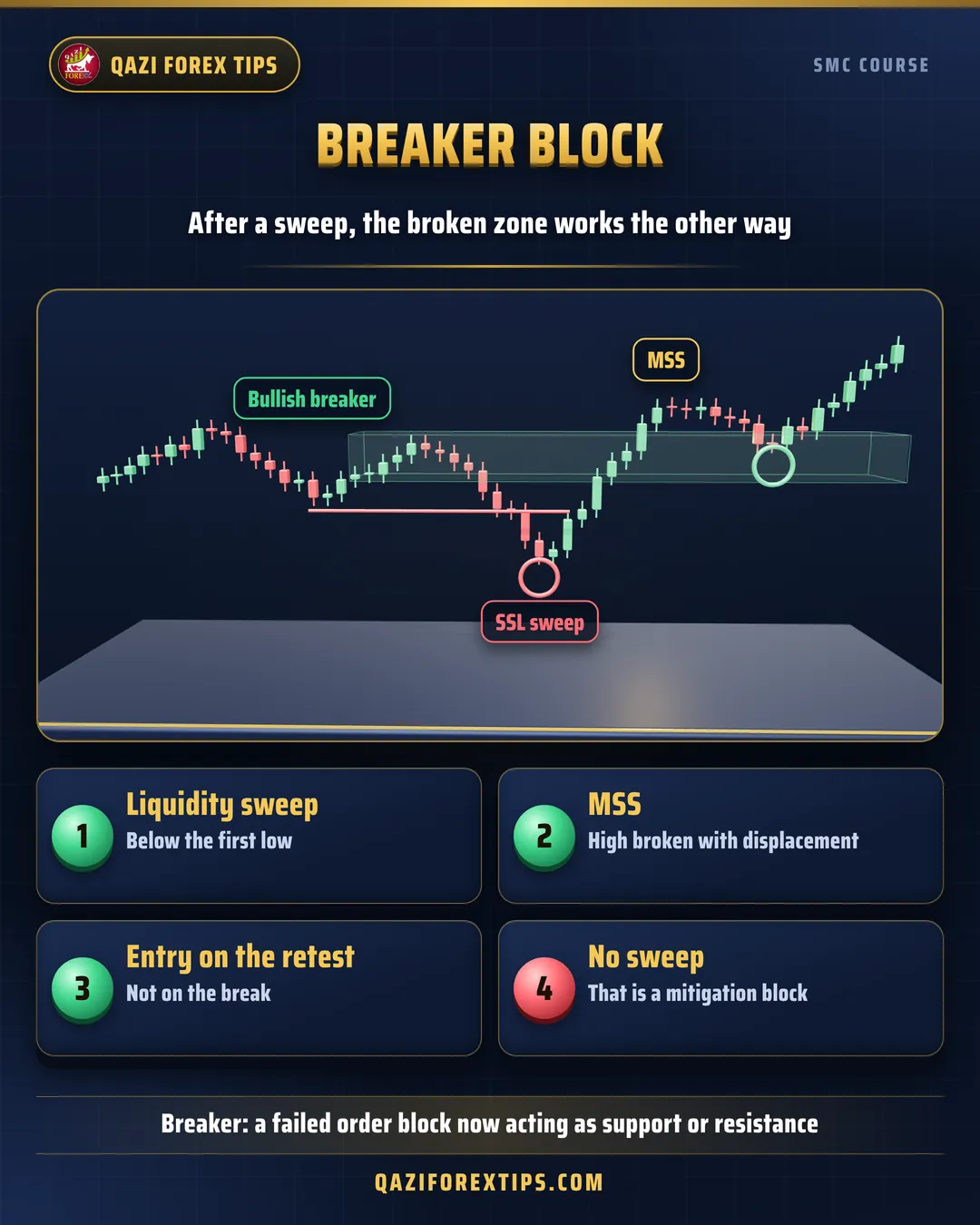
A breaker block is a failed order block that broke after a liquidity sweep. Once broken, the same zone works in reverse:
- Bullish breaker: a high formed, then price fell and swept the previous low (a lower low), then rallied hard and broke that high. The zone of green candles that built the high (formerly a bearish order block) is now support.
- Bearish breaker: a low formed, then price rose and swept the previous high (a higher high), then fell hard and broke that low. The zone of red candles that built the low is now resistance.
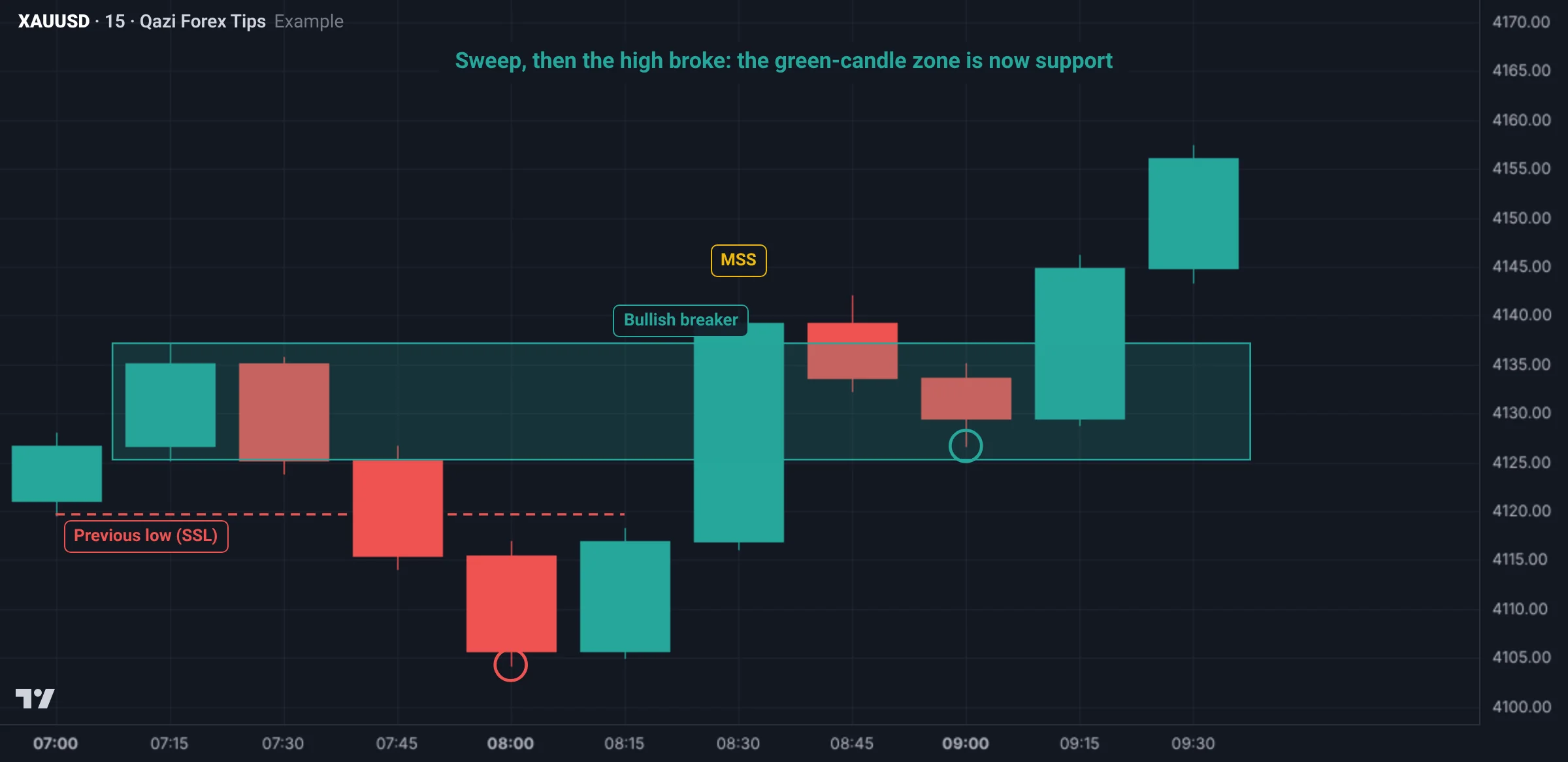
The breaker structure: low, high, lower low, break up
Learn the order of a bullish breaker:
- A low forms.
- A high forms: its last green candles were a bearish order block that sent price down.
- Lower low: price drops below the first low and sweeps the SSL. Retail sells, thinking it is a breakout.
- Break above the high: price rallies with displacement and breaks the high from point 2. This is the MSS: structure has shifted.
- Retest: price returns into the point 2 zone and moves up from there. That is the breaker block.
Bearish breaker
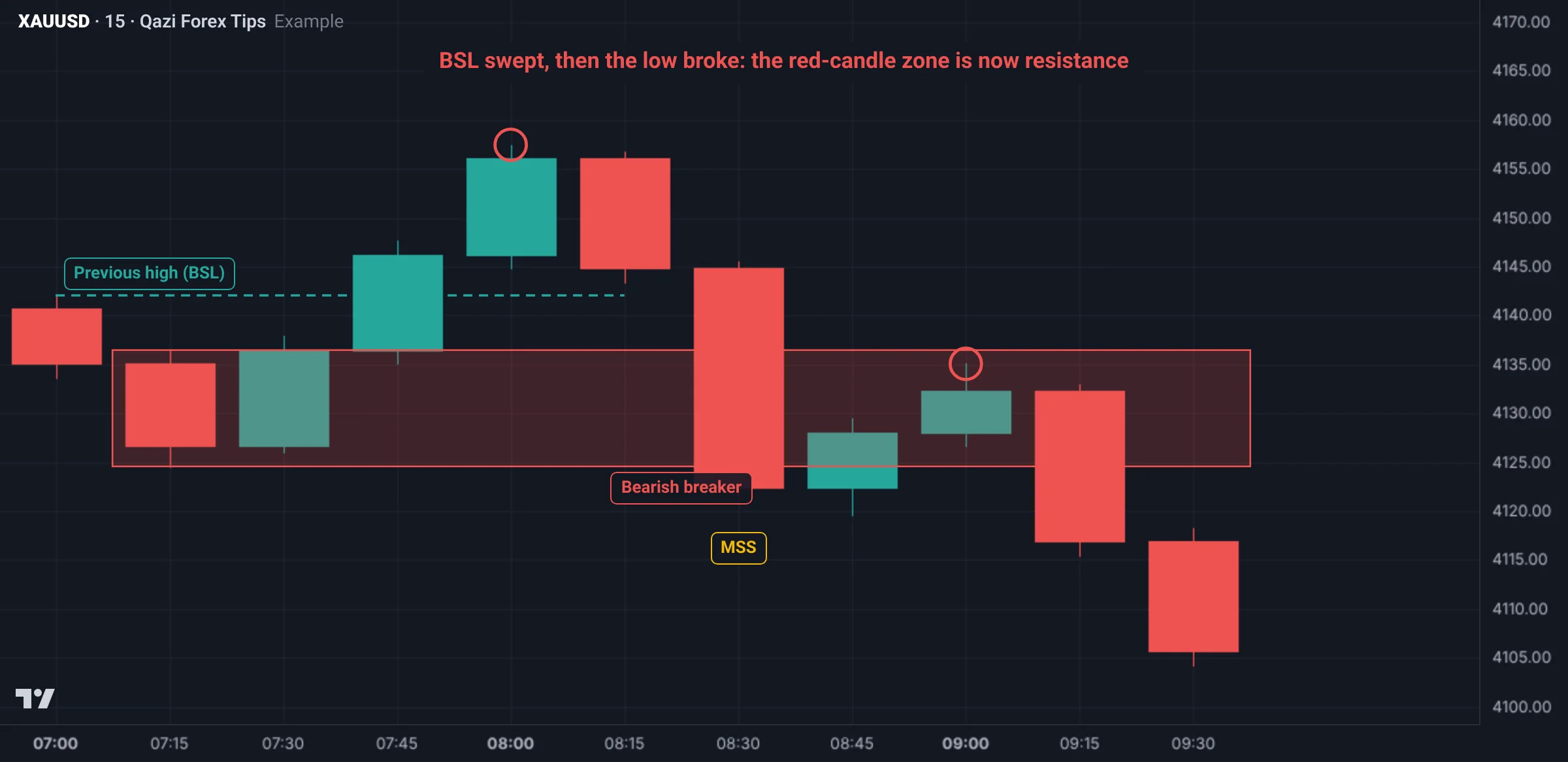
The order is reversed: high, low, higher high (BSL sweep), then a strong break below the low, and a sell from the red-candle zone on the return.
How to mark a breaker
- First find the sweep: a clear low (or high) that a wick or brief move went beyond.
- Then look for the MSS: after the sweep, a strong body broke the previous swing high (or low).
- Mark the last opposite candles that built the broken swing: in a bullish breaker, the last green candle or candles before the drop.
- Add the 50% of the zone and extend it to the right.
- Wait for price to return into the zone. Trade the retest, not the break.
Breaker vs order block
| Point | Order block | Breaker block |
|---|---|---|
| Type of zone | A successful zone where a move started | A failed zone that broke |
| Direction | Works in the direction it formed | Works in the opposite direction |
| Key condition | BOS and displacement | Liquidity sweep, then MSS |
| Where it appears most | In the middle of a trend | At a trend change |
Trading a breaker step by step
- Higher timeframe: on H4 or H1, price is in a big POI or in discount. Otherwise a small breaker may just be a pullback.
- Sweep: a clear SSL sweep on M15 or M5.
- MSS: after the sweep, the high breaks with displacement, ideally leaving an FVG.
- Entry: a limit at the top edge or 50% of the breaker, or M1 confirmation inside it.
- Stop loss: below the breaker zone, or, safer, below the swept low.
- Target: the first buy-side liquidity above, then the bigger liquidity.
Gold example
Before the London open, the Asian low on Gold M15 was 4,112. Price rallied to 4,124 (green-candle zone 4,116 to 4,124), then fell to 4,104 at the London open and swept the Asian low.
- Two large green candles then broke the 4,124 high and closed at 4,128: MSS.
- Bullish breaker: 4,116 to 4,124, with 50% at 4,120.
- Price ran to 4,131, then came back to 4,119. Entry 4,120, stop 4,111 (below the zone), risk $9.
- Target: the previous day's high at 4,142, $22, about 1:2.4.
- If price had closed with a body below 4,116 and stayed there, the breaker would have failed.
Real Gold chart examples
Gold H1 on 5 and 6 Oct 2026 (data: Dukascopy, bid price; Pakistan time):
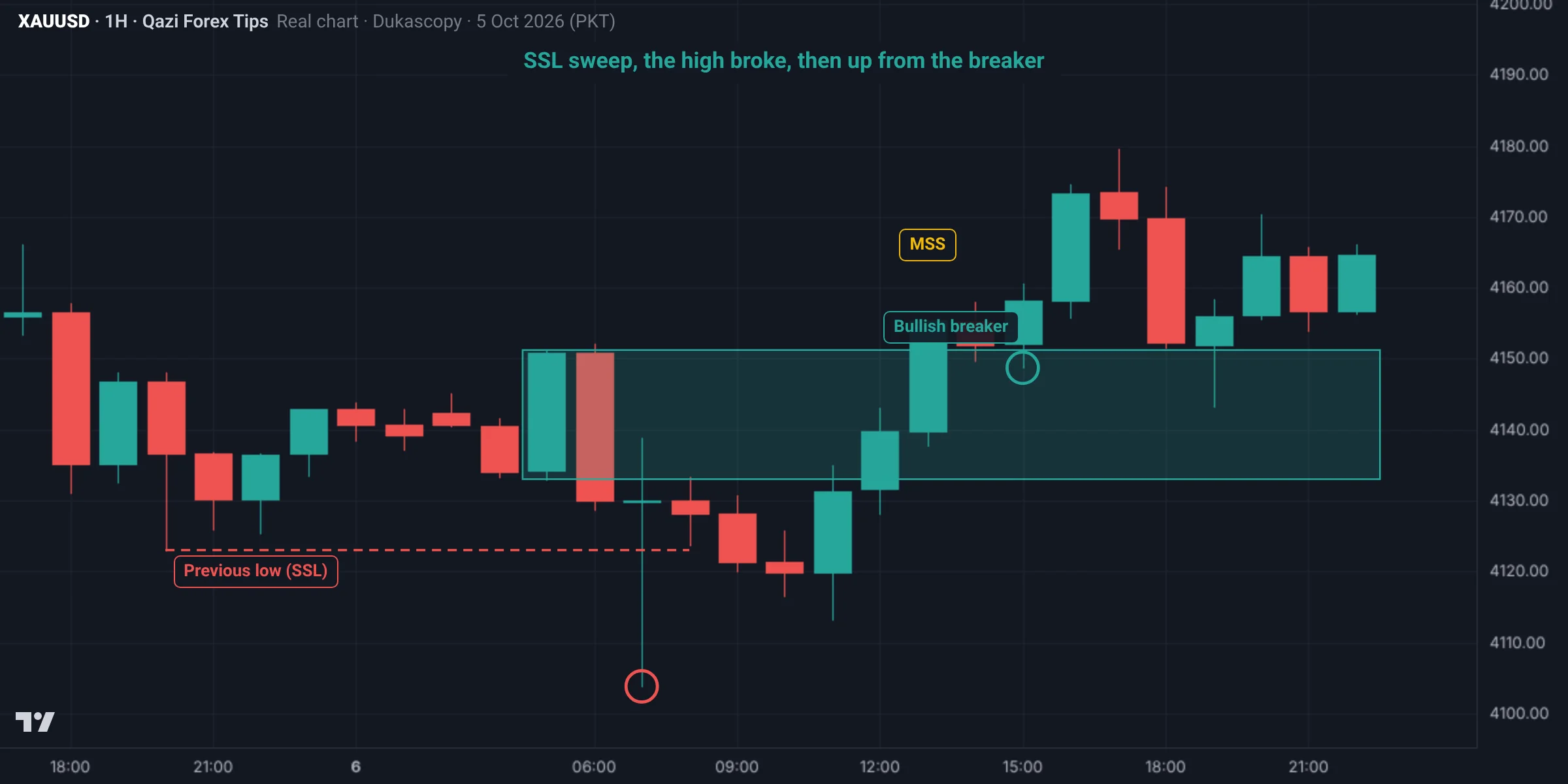
- The low at 20:00 on 5 Oct was 4,123.0. On 6 Oct the green 05:00 candle (4,133.0 to 4,151.2) led to a high of 4,152.1 at 06:00.
- At 07:00 price dropped to 4,103.8: a sweep of the 4,123.0 low (the candle closed back at 4,130.1).
- The 13:00 candle closed at 4,155.3, above 4,152.1: an MSS. The zone of the 05:00 green candle became a breaker.
- At 14:00 and 15:00 price returned into that zone (lows 4,149.8 and 4,148.7) and then rallied to 4,179.5.
Second example: a bearish breaker (29 Oct)
Gold H1 on 28 and 29 Oct 2026 (data: Dukascopy, bid price; Pakistan time). The first example was a bullish breaker; this is a bearish breaker:
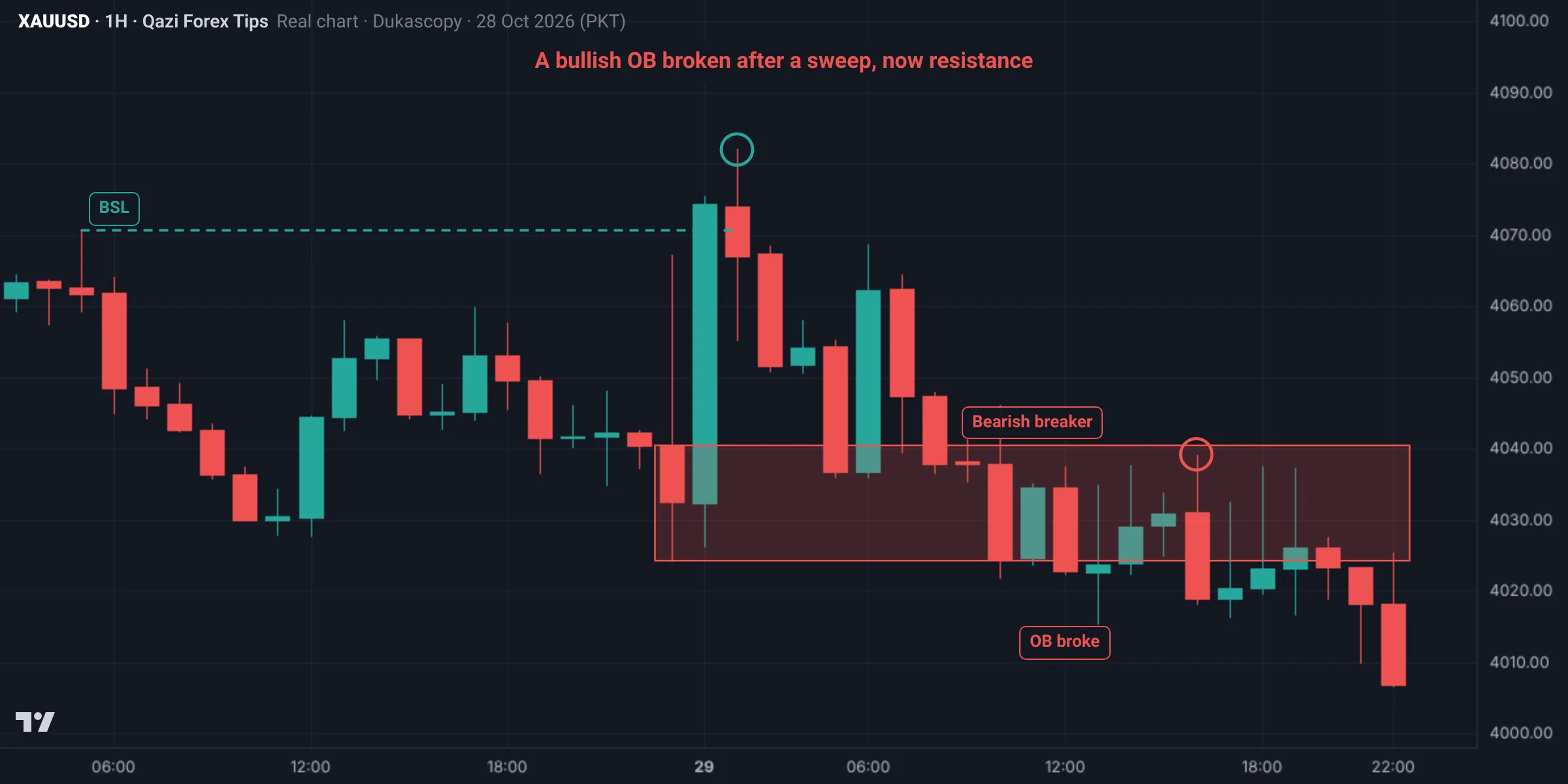
- The red 23:00 candle on 28 Oct was the last red candle before the move up: a bullish order block, zone 4,024.3 to 4,040.4 (low to open).
- That move took the 05:00 high at 4,070.6 and reached 4,082.0: a BSL sweep.
- Price then turned, and the 12:00 candle on 29 Oct closed at 4,022.7, below the OB: an OB broken after a sweep = a breaker.
- From midday to evening price kept returning into the zone from below (highest 4,039.2), but never closed above 4,040.4: old support was now resistance.
- The next day Gold fell to 3,876.1.
Common mistakes
Summary
- A breaker block is an order block that broke after a liquidity sweep and now works in reverse.
- Bullish order: low, high, lower low (sweep), break of the high, retest of the zone.
- Trade the retest, stop beyond the zone or the sweep, target the next liquidity.
- Without a sweep it is a mitigation block.
Spot it on the chart: practice
This is a real Gold chart (Dukascopy data, Pakistan time). Study it and pick an answer. After you answer, the fully marked chart and the explanation appear.
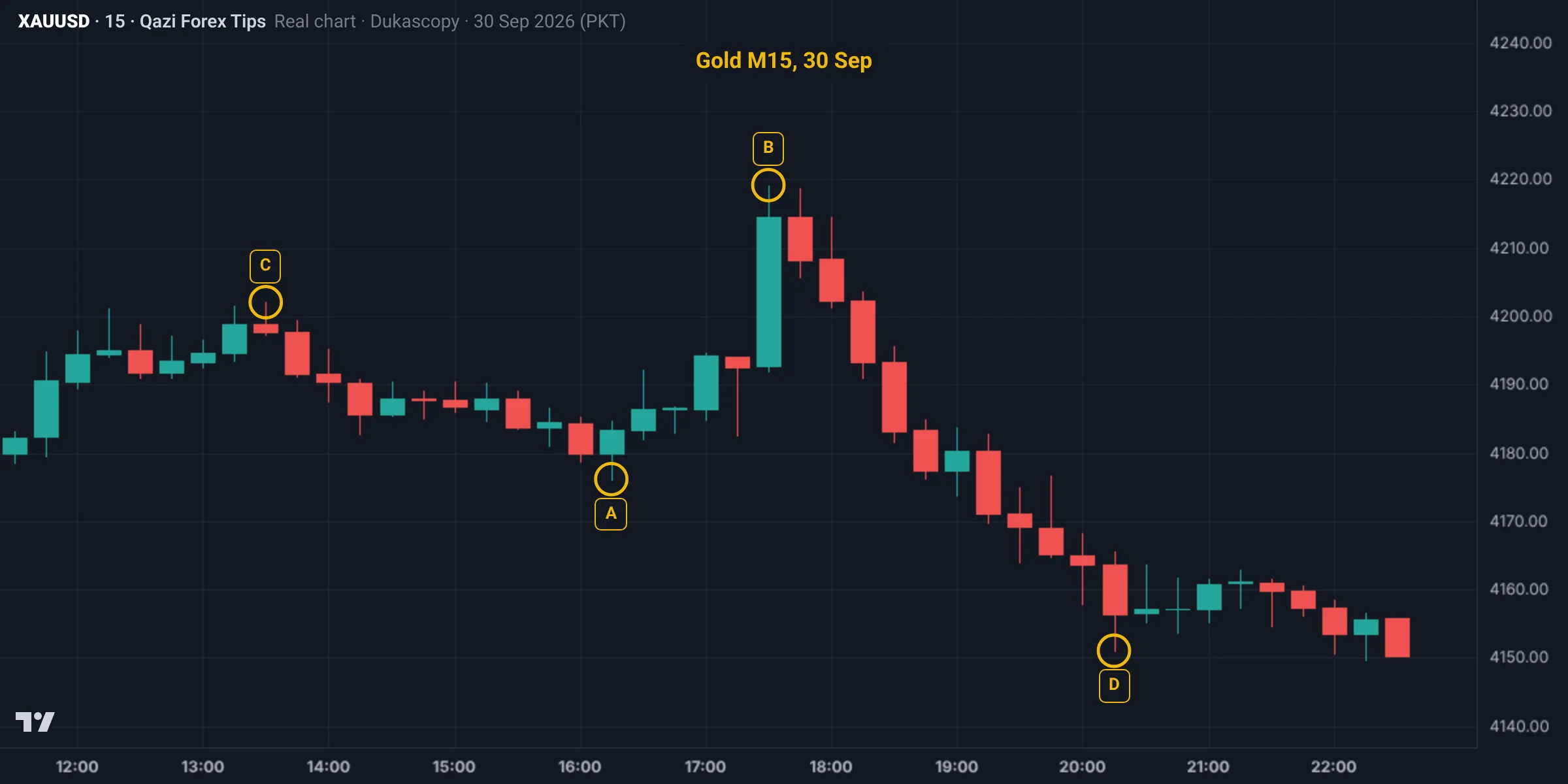
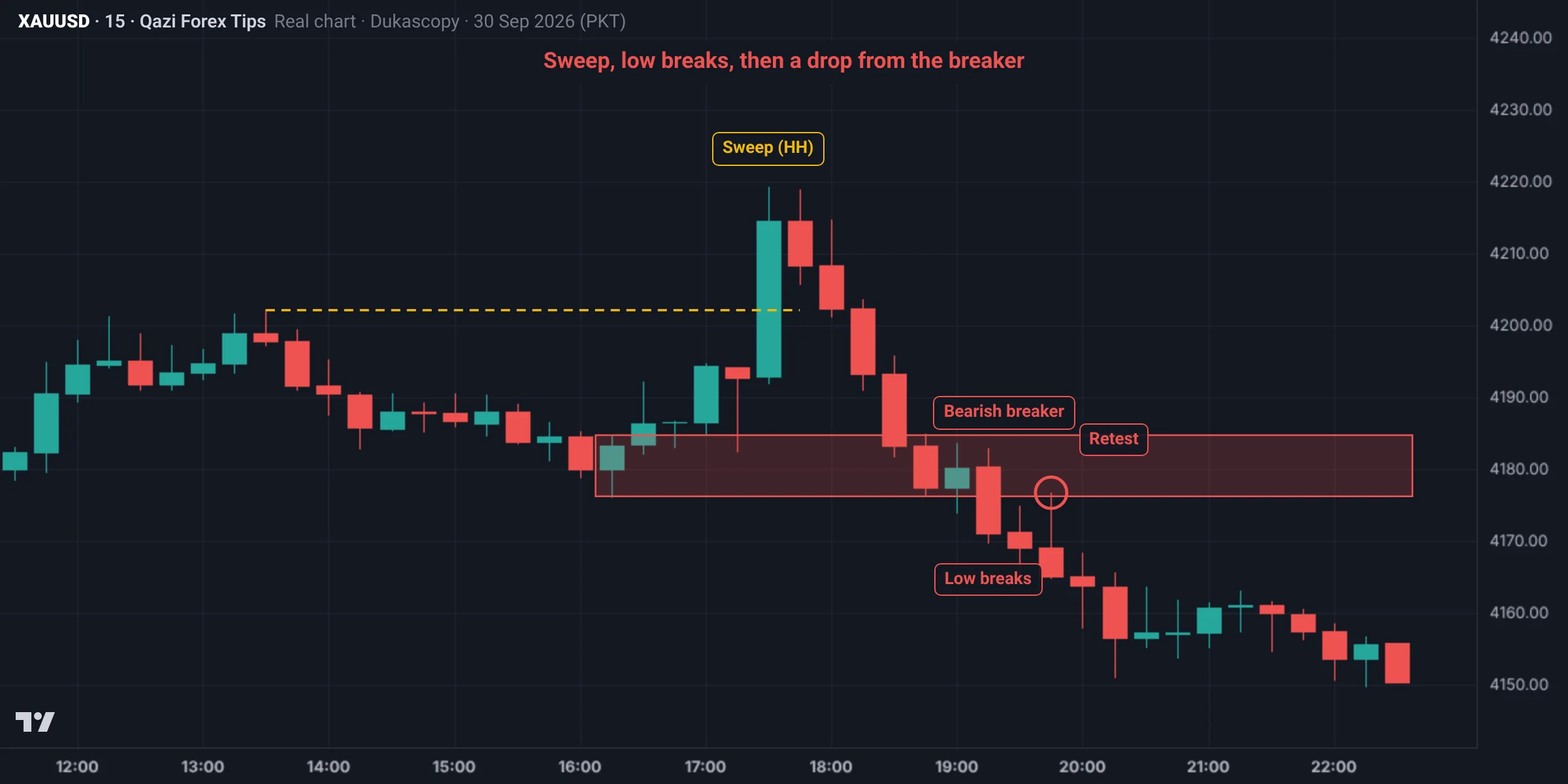
At 17:30 price swept the London high (an HH), then at 19:15 broke the low that came before that move. Which zone is the bearish breaker?
A (16:15) is the bullish candle where the up-move into the sweep began: a zone from 4,176.2 to 4,184.7. After the sweep this zone broke, so it now works in reverse (resistance). At 19:45 price came back to 4,176.7, touched the zone and fell to 4,149.7. B is the sweep candle, C the London high and D part of the drop.
The marked chart
Test yourself: Lesson 3.3 quiz
8 questions. Pick one answer for each and you will see at once whether it is right and why. Your score and grade appear at the end. You need 70% to pass.
0 correct · 0 / 8
Question 1What is a breaker block?
In a bullish breaker the green-candle zone that built the high is now support.
Question 2What is the correct sequence of a bullish breaker?
At the lower low retail sells thinking it is a breakout, and gets trapped.
Question 3What is the real power of a breaker?
The trapped sellers' stops sit above and give price more fuel.
Question 4When do you trade a breaker?
At the break price is expensive and the stop is large.
Question 5What is the main difference between an order block and a breaker?
Breakers appear mostly at trend changes; order blocks mid-trend.
Question 6A zone broke without a sweep (a higher low formed). What is it?
Without a prior sweep it is not a breaker (lesson 3.4).
Question 7A bullish breaker forms in H4 premium. What happens to it?
Check the higher timeframe; otherwise a small breaker may just be a pullback.
Question 8Gold M15: Asian low 4,112, green zone 4,116 to 4,124, London sweeps to 4,104, then 4,124 breaks. Entry and stop?
Target the previous day's high at 4,142; 9 dollars risk for 22, about 1:2.4.
Lesson checklist
Tick each point once you understand it. Your ticks are saved in this browser.
Assignment
- Look at the last 10 London opens on Gold M15 and find breaker blocks.
- Write the sequence for each: which low was swept, which high broke, where the zone is.
- See how many breakers reacted on the retest.
- Make 3 bullish and 3 bearish breaker examples.
- Write the entry, stop loss, target and RR for the best one.
- Post your chart in the group.
Post your assignment screenshots with your reasons in our free Facebook group, where your charts will be checked.
Join the free group
Who wrote this lesson
Dr. Qazi Abdul Basit, Ph.D
Ph.D in Business Administration and a forex and Gold trader since 2013. Founder of Qazi Forex Tips, which teaches traders in Pakistan and India price action, risk management and trading psychology in their own language: 65 student batches so far, free courses on YouTube, and MT5 tools for traders (QFT Replay Simulator, QFT Trade Assistant).
- 2013 trading since
- 75K+ Facebook group members
- 65 student batches
- 15K+ YouTube subscribers
How this lesson was made: the content follows Dr. Qazi's teaching method and years of trading. Real charts are built from Dukascopy Gold (XAUUSD) data, and backtest results are shown as they came out, even when negative. We do not sell signals, manage accounts or take money from any broker. Last updated: 19 November 2026.
Questions
What is a breaker block?
An order block that broke after a liquidity sweep and then acts as support or resistance in the opposite direction.
What is the difference between a breaker and a mitigation block?
A breaker comes after a liquidity sweep (lower low or higher high); a mitigation block has no sweep (higher low or lower high).
When should I enter a breaker?
After the break, when price returns into the zone, on the retest.
Where is the stop loss on a breaker trade?
Below the breaker zone, or more safely below the swept low.
What is a bearish breaker block?
A bullish order block that breaks down after its move swept the liquidity above. When price returns into the zone from below, it acts as resistance.
How do I identify a breaker block?
Ask three questions: was a high or low swept first? Did the order block of that sweep move break with a body close? Is price now testing it from the other side? Three yeses mean a breaker.
Read more
Education only, not financial advice. Trading forex, Gold and CFDs carries a high risk of loss. SMC concepts describe tendencies, not guarantees. Lesson 19 of 38.