 Qazi Forex Tips

What happens on a release?
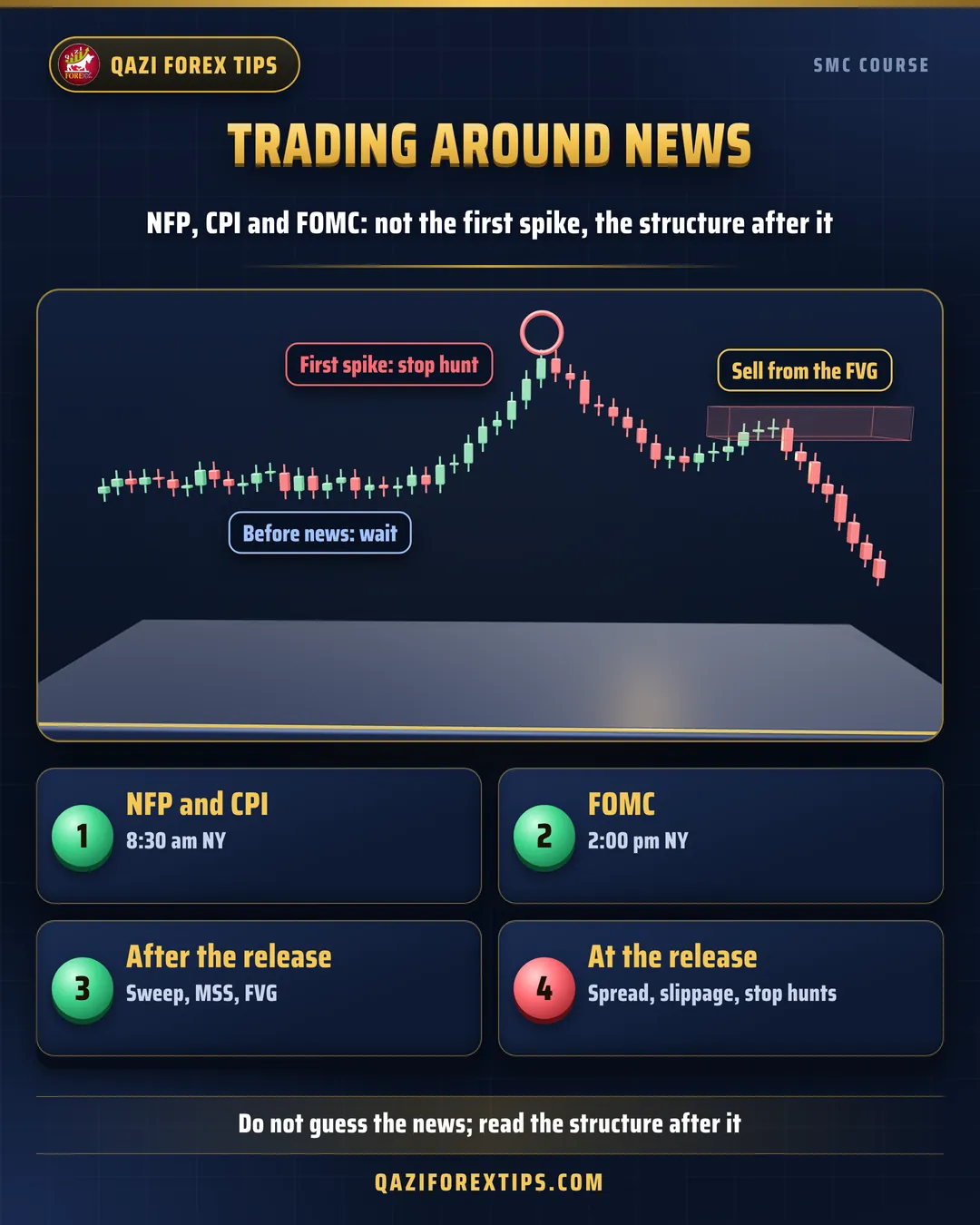
Within seconds of a major release (NFP, CPI or FOMC) three things happen:
- Spreads widen: brokers and liquidity providers protect themselves by widening the gap between bid and ask many times. A normal Gold spread of 20 to 30 cents can reach several dollars.
- Slippage: your order does not fill at the price you set but further away.
- Stop hunts on both sides: the first spike often takes one side's liquidity, then price runs the other way.
So trading exactly at the release is guessing, however good your analysis.
The key releases for Gold
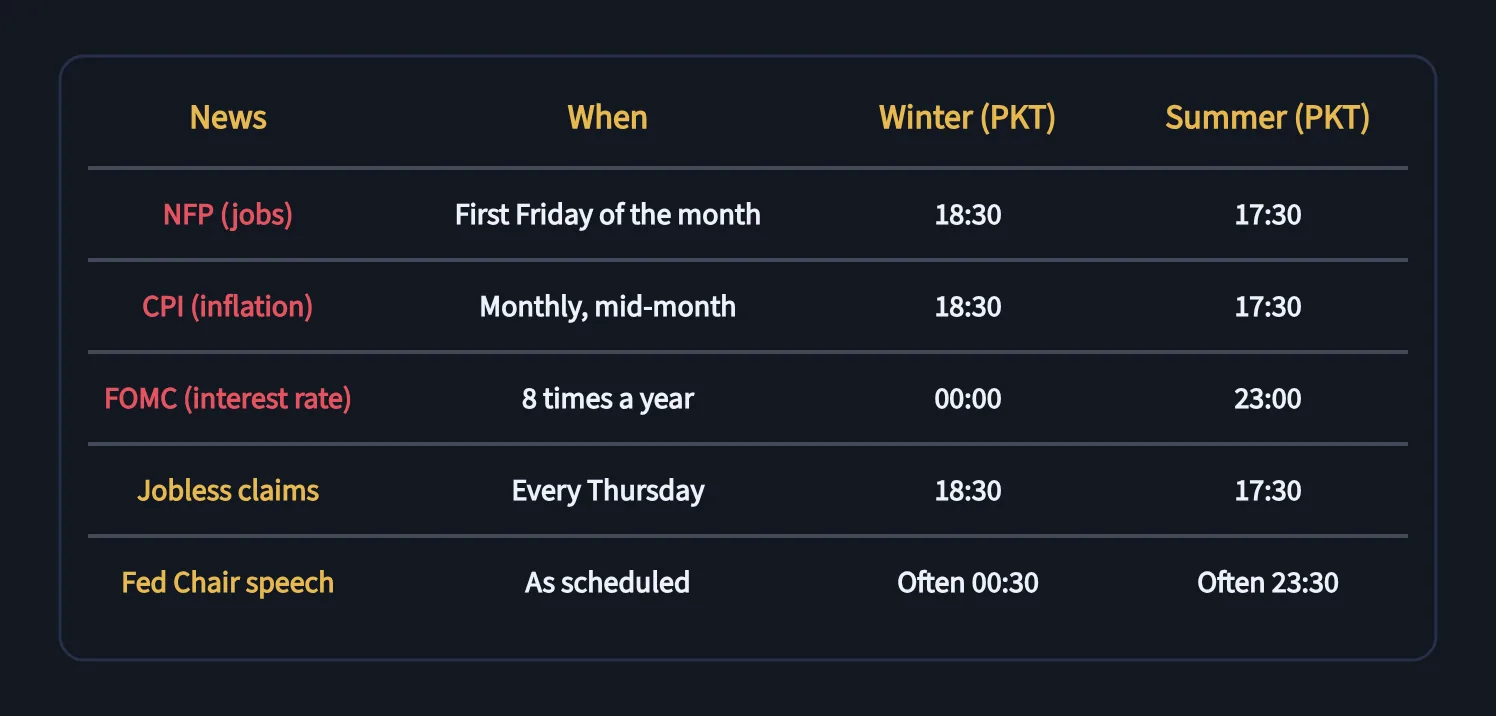
| Release | New York time | What it measures | Typical Gold reaction |
|---|---|---|---|
| NFP (non-farm payrolls) | 8:30 am, first Friday | New US jobs | More jobs: stronger dollar, Gold usually down |
| CPI (inflation) | 8:30 am, mid-month | Price growth | Hot inflation: rates stay high, pressure on Gold |
| FOMC (rate decision) | 2:00 pm, 8 times a year | The Fed's decision and statement | Cuts or a soft tone: Gold up; hawkish: down |
| Fed Chair press conference | 2:30 pm on FOMC days | Policy outlook | Sharp moves on single sentences |
| Jobless claims, PPI, retail sales | 8:30 am | Economic health | Medium moves |
These are typical tendencies, not laws. Sometimes Gold rises on "good" news because the market had already priced in the expectation. That is why an SMC trader does not guess the news; they read the structure after it.
Before, during and after: three rules
1. Before the release (30 minutes)
- Do not open new trades.
- If an open trade is in profit, take partial profit and move the stop to break-even, or close it.
- Remove pending orders (limits or stops) that could trigger at the release.
- If you trade a prop firm account, read its news rules; many firms do not allow trades within two minutes of a release.
2. During the release (first 5 to 15 minutes)
- Do nothing. Do not chase the first candle.
- Watch which liquidity the first spike takes: the pre-news high or low, the Asian or London edge?
3. After the release
- After 15 to 30 minutes, once spreads are normal, start the usual SMC process: was there a sweep? A CHoCH? Where is the FVG or order block?
- The news displacement often leaves a very clean FVG. A return into that FVG is often the best entry.
The post-news SMC setup
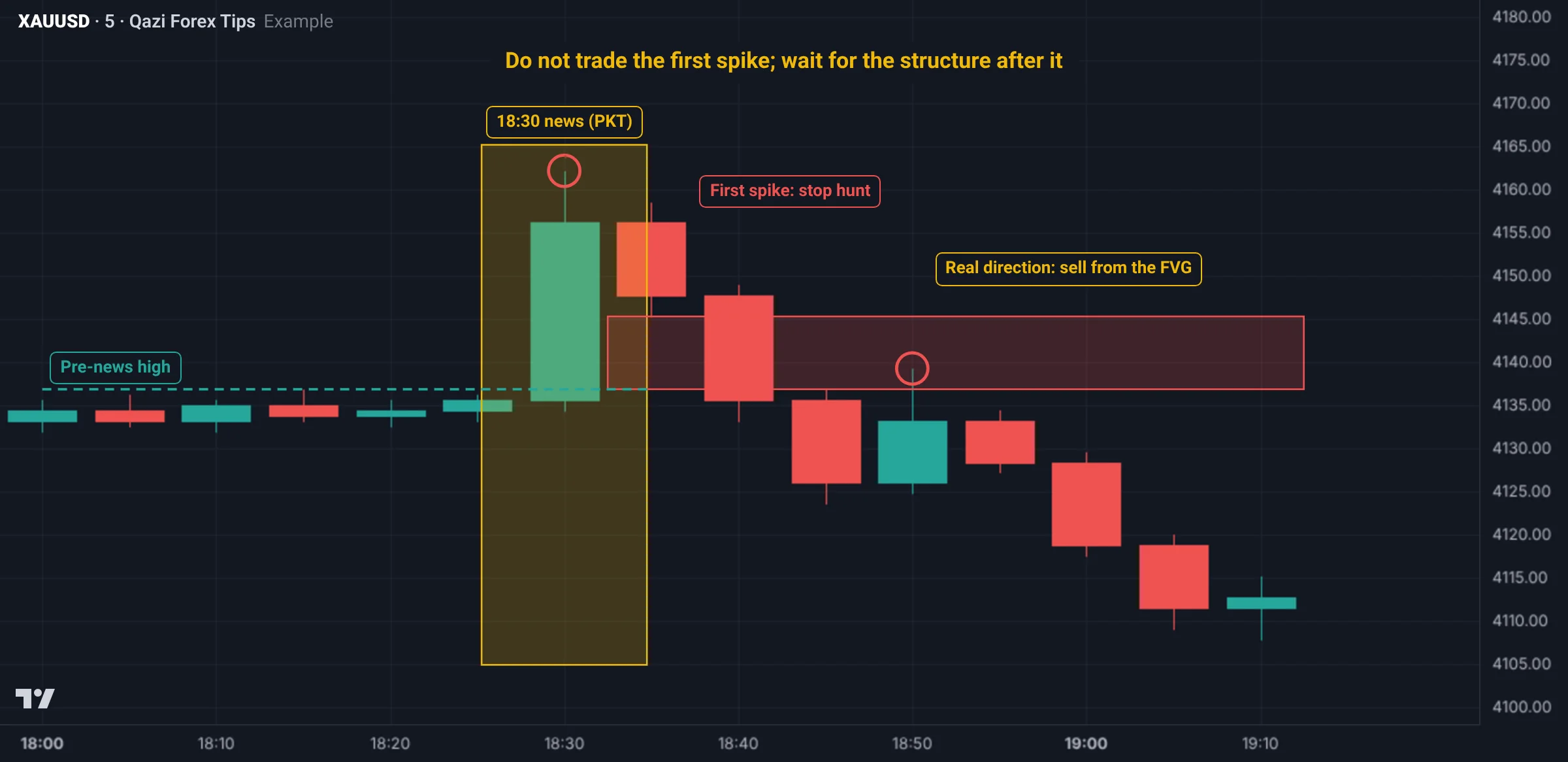
- Mark the pre-news high and low (this is liquidity).
- The first spike takes one side's liquidity (for example the high above).
- If price then reverses strongly and also breaks the pre-news low, that is an MSS: the real direction is down.
- Enter on the return into the displacement FVG, with the stop above the spike high (or above the FVG once spreads have normalised).
- Target: the next liquidity below, such as the London or Asian low.
If price does not reverse after the spike but keeps building structure in the same direction, the first move was the real direction; then look for an entry on a pullback in that direction.
FOMC day is special
The FOMC decision comes at 2:00 pm New York time (midnight in Pakistan in winter) with the press conference at 2:30 pm. On that day:
- Gold often stays in a tight range all day as everyone waits, so the usual London and New York setups are weaker.
- The decision causes a spike one way, and the press conference often another.
- For newer traders the best plan: no trades on FOMC night. Trade the next day's London session with the new bias.
Gold example: NFP Friday
The first Friday of December. NFP at 8:30 am New York time (18:30 in Pakistan).
- Before: Gold held a tight range of 4,133 to 4,136. The pre-news high was 4,136.
- 8:30 am: NFP came in below expectations. The first M5 candle reached 4,162 ($26). The spread was over $2 at that moment. Many who bought the breakout were filled around 4,150.
- 8:35 to 8:45 am: a fast reversal broke the 4,133 low: MSS down. A bearish FVG formed from 4,140 to 4,147.
- 8:50 am: price returned to 4,144. Entry 4,143, stop 4,152 (above the FVG, halfway up the spike), risk $9.
- Target: the London low at 4,118, $25, about 1:2.8. Price reached it by 9:30 am.
Anyone who bought emotionally at 8:30 suffered the wide spread, the slippage and the stop hunt all at once.
Real Gold chart examples
Gold M5 on Friday 6 Nov 2026 (data: Dukascopy, bid price; Pakistan time). That day the US October NFP report came out at 18:30 Pakistan time: 165,000 jobs against an expectation of about 65,000.
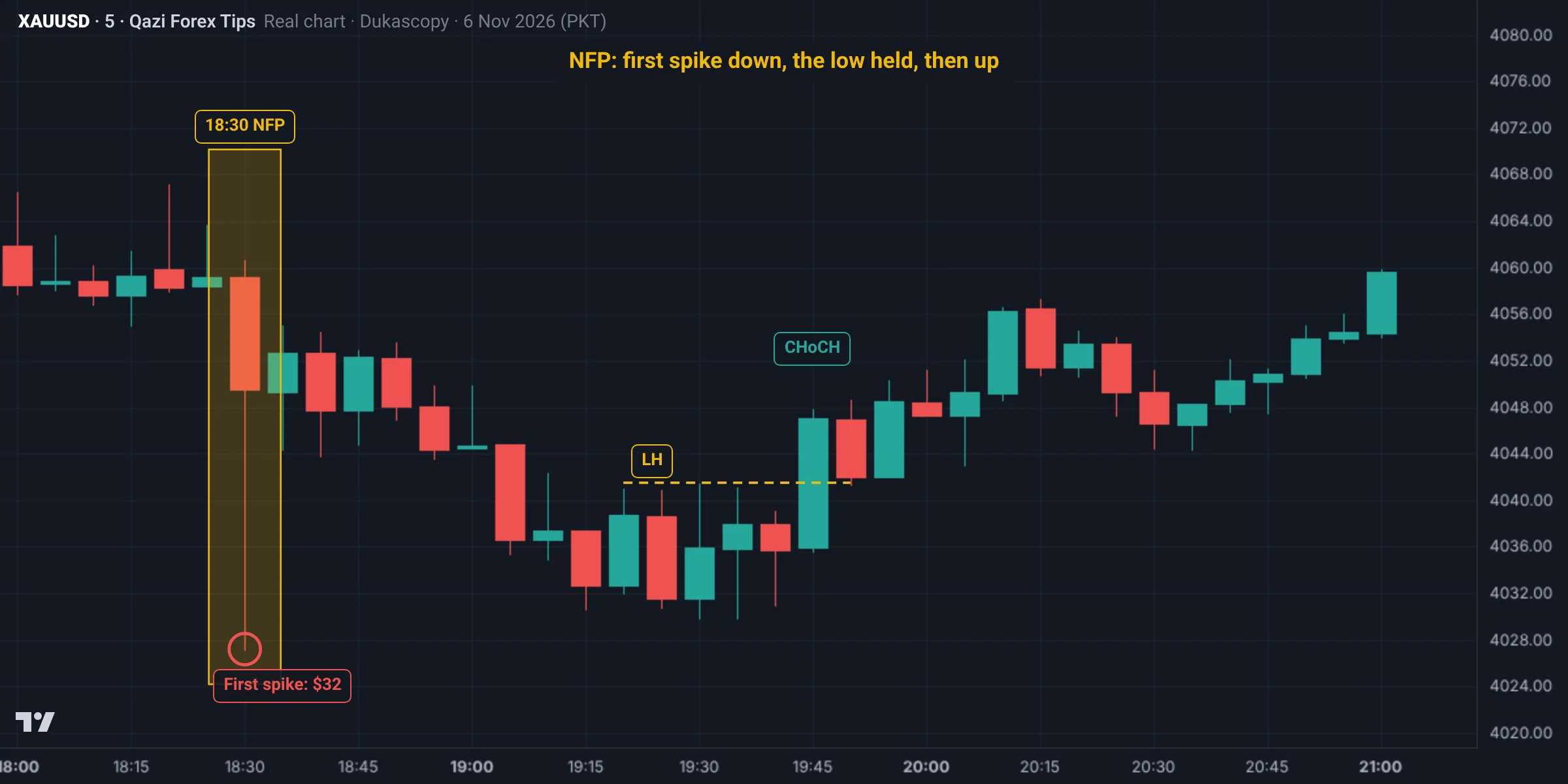
- The 18:30 candle: fell from 4,059.2 to 4,027.2 (about $32 in five minutes) and closed at 4,049.5: a long lower wick. Spreads were very wide at that moment.
- 19:00 to 19:40: price came back down to 4,029.8 but the 18:30 low at 4,027.2 did not break.
- 19:45: a candle closed at 4,047.1, breaking the 19:30 LH at 4,041.5: a CHoCH up.
- That night price reached 4,078.5. Anyone who sold emotionally at 18:30 suffered the spread, the slippage and the reversal.
Second example: the CPI release (10 Nov)
Gold M5 on Tuesday 10 Nov 2026 (data: Dukascopy, bid price; Pakistan time). That day the US October CPI (inflation) report came out at 8:30 New York time, 18:30 in Pakistan (per the official BLS schedule):
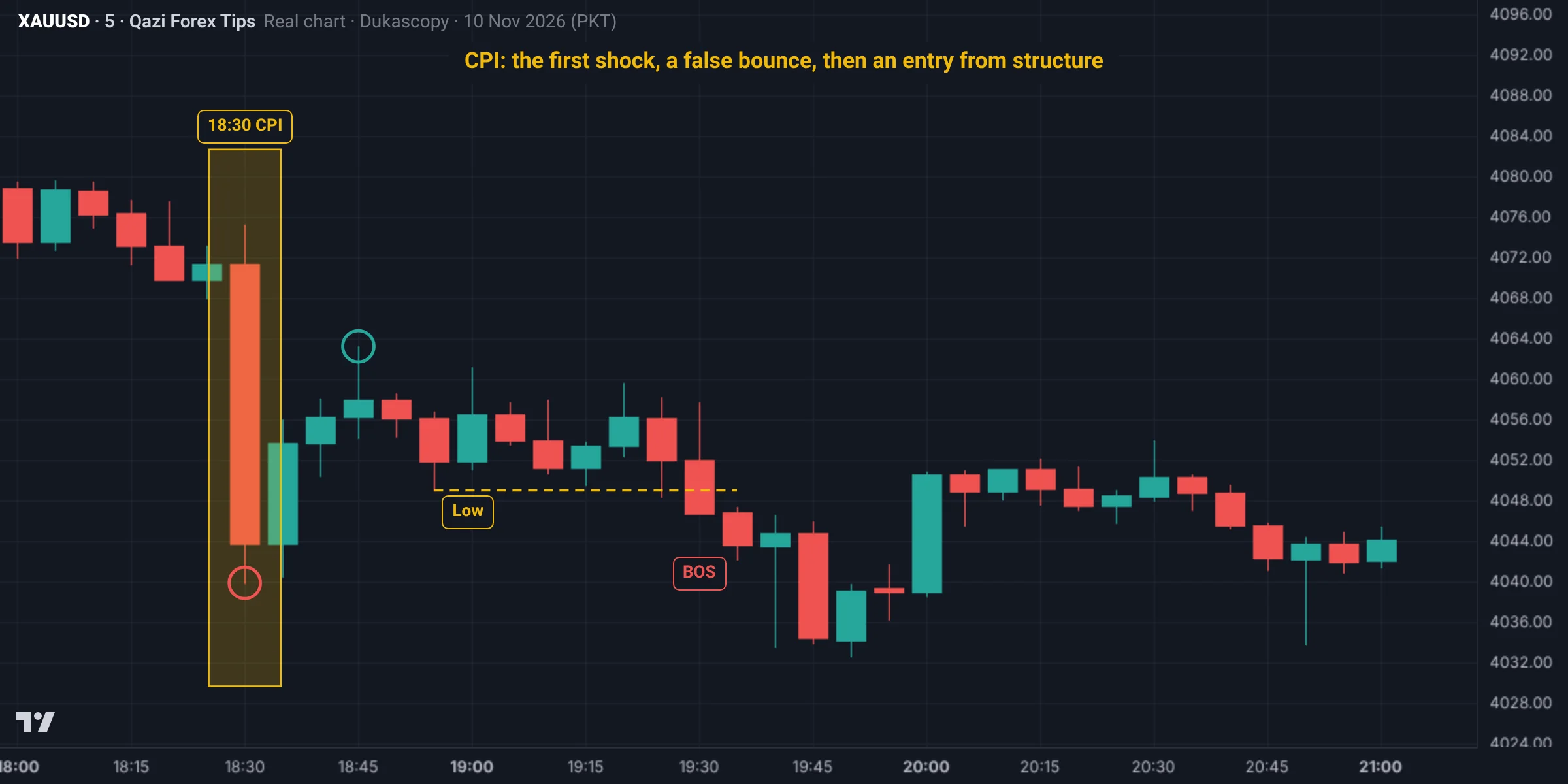
- The 18:30 candle: fell from 4,071.3 to 4,039.9, about $31 in five minutes, and closed at 4,043.8.
- 18:35 to 18:55: price bounced back up to 4,063.2: anyone who sold emotionally at 18:30 with a tight stop could have been stopped by that bounce.
- 19:30: an hour after the news a candle closed at 4,046.8, breaking the 18:55 low at 4,049.0: a BOS down. That was the moment for a structure-based entry, not the news spike.
- That night Gold reached 4,013.4.
Even when the direction is right, entering at the exact release is dangerous: spread, slippage and false bounces. Our rule stays: no new trade from 30 minutes before to 15 minutes after.
Common mistakes
Phase 4 gate: before moving on
Before Phase 5 (entry models) you should be able to:
- Recite the four killzones and three Silver Bullet windows in New York and local time (winter and summer).
- Mark the midnight open, Asian range, PDH and PDL every morning.
- Write the week's high-impact news in your time zone every Sunday.
- Backtest 20 days of killzones, AMD and the Silver Bullet and record the results in your journal.
- Avoid new trades from 30 minutes before to 15 minutes after a release.
When this is complete, the next phase is entry models, where bias, liquidity, POI and time combine into complete setups.
Summary
- News brings wide spreads, slippage and stop hunts; do not trade at the exact release.
- NFP and CPI at 8:30 am New York time (18:30 in Pakistan in winter); FOMC at 2:00 pm (midnight in Pakistan in winter).
- Protect before, wait during, apply SMC after: sweep, MSS, entry from the FVG.
- Do not guess the news; read the structure after it.
Try this lesson on your own chart
Qazi Forex Tips' own tools that make this lesson easier. A tool helps; your rules make the decision.
QFT Trade Assistant panel
Free demo · MT5 & MT4Calculates the lot from your risk, lets you drag SL and TP on the chart and place one-click orders, with partial close, break-even, trailing stop, a news lock and a Prop Firm Guard.
Details and downloadQFT Sessions & Killzones indicator
100% free · MT5 & MT4Asia, London and New York sessions, the four ICT killzones and the previous day high and low on your chart, with a Pakistan or India time clock and automatic daylight saving.
Details and downloadSpot it on the chart: practice
This is a real Gold chart (Dukascopy data, Pakistan time). Study it and pick an answer. After you answer, the fully marked chart and the explanation appear.
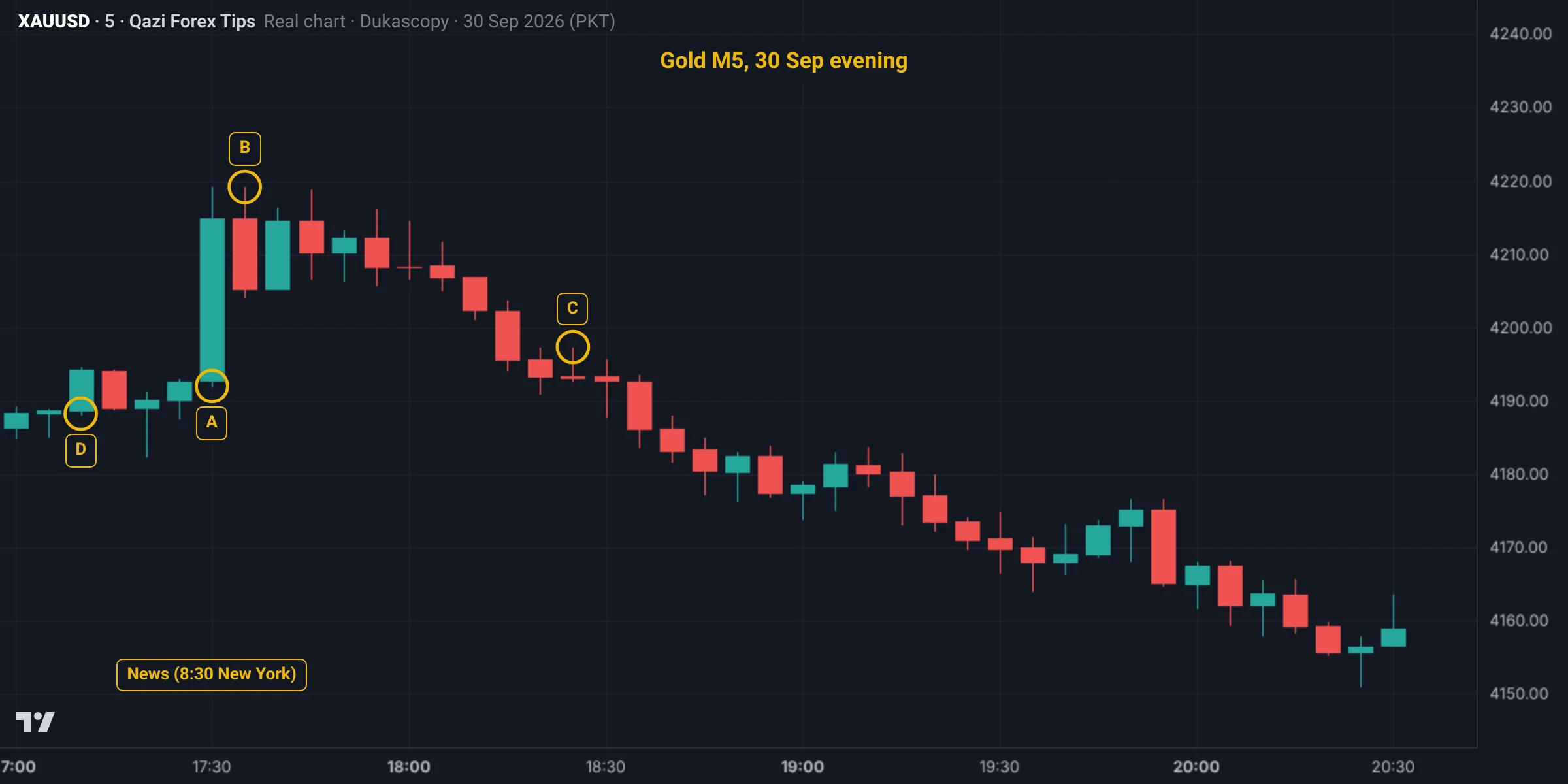
News came out at 17:30 (8:30 New York). Of these four points, which was the safest SMC entry?
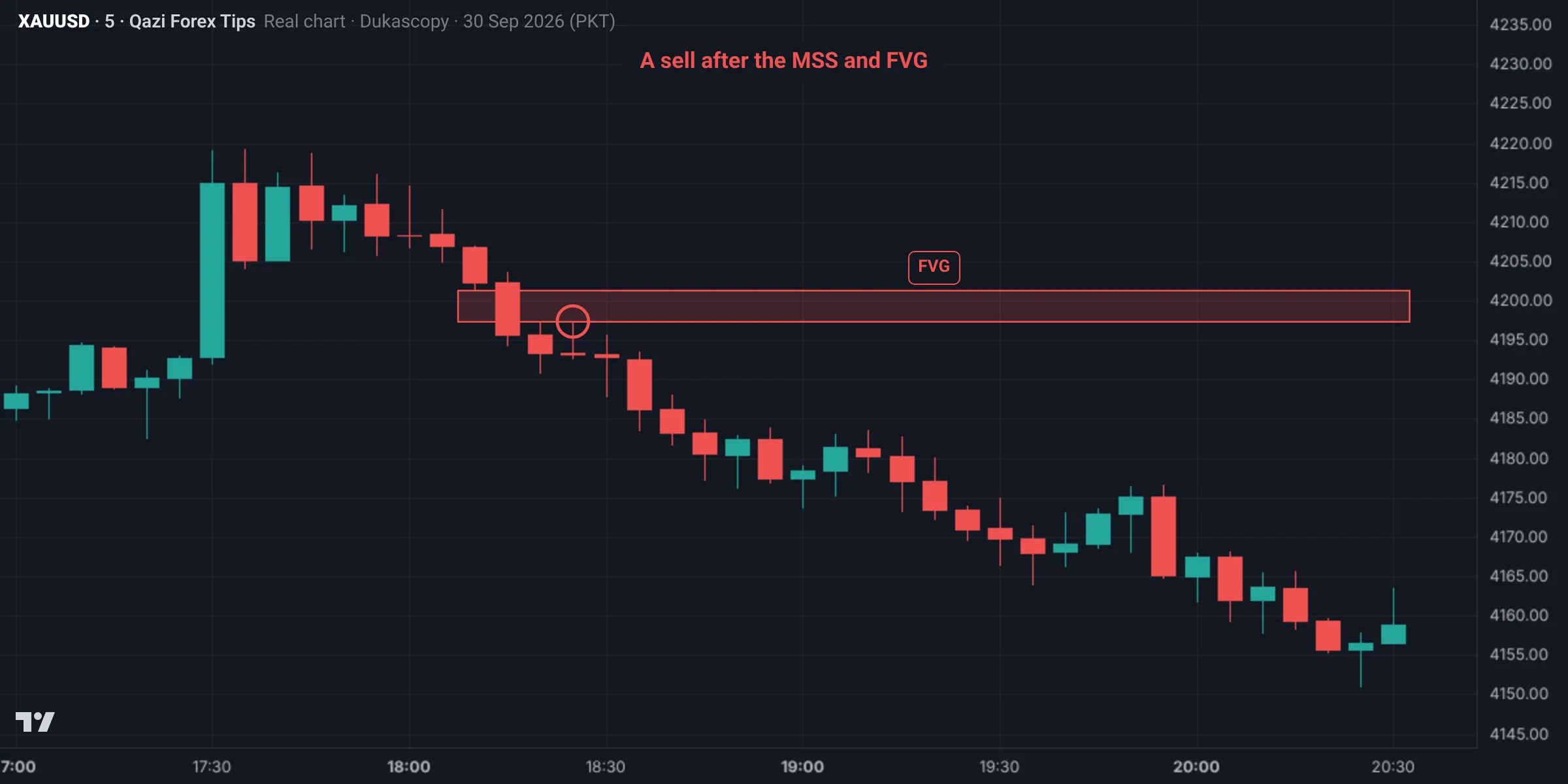
C (18:25): the news spike reached 4,219.2 and took liquidity, then price broke structure down and left an FVG from 4,197.3 to 4,201.3 at 18:15. The return into it was the sell, and price fell to 4,151.0. A chases the first news candle, B guesses the top of the spike, and D gambles before the release.
The marked chart
Test yourself: Lesson 4.4 quiz
10 questions. Pick one answer for each and you will see at once whether it is right and why. Your score and grade appear at the end. You need 70% to pass.
0 correct · 0 / 10
Question 1What three things happen within seconds of a big release?
That is why trading exactly at the release is guessing, however good your analysis.
Question 2When does NFP come out?
More jobs = a stronger dollar, Gold usually down.
Question 3When does the FOMC decision come out in New York time?
Midnight in Pakistan in winter; the press conference is at 2:30 pm.
Question 4What should you do in the 30 minutes before a release?
On a prop firm account, read its news rules.
Question 5What do you do in the first 5 to 15 minutes of a release?
After 15 to 30 minutes, once spreads are normal, start the usual SMC process.
Question 6Where is the post-news SMC entry often best?
The first spike takes one side; if price then makes an MSS the other way, that is the real direction.
Question 7What is the best plan for newer traders on FOMC night?
On FOMC day price often stays in a tight range; the decision and the press conference both spike.
Question 8NFP example: pre-news range 4,133 to 4,136, the first candle hits 4,162, then 4,133 breaks and an FVG forms at 4,140 to 4,147. The trade?
9 dollars risk for 25, about 1:2.8; emotional buyers at 8:30 got the spread, slippage and stop hunt all at once.
Question 9Why is holding a trade with a tight stop through news dangerous?
Positioning before a release on a guess about the number is gambling, not trading.
Question 10According to the Phase 4 gate, how many days should you backtest?
Also: know the killzone and Silver Bullet times, mark the midnight open and Asian range daily, and list the week's news every Sunday.
Lesson checklist
Tick each point once you understand it. Your ticks are saved in this browser.
Assignment
- Open the economic calendar, set your time zone and write this week's USD high-impact events.
- Look at the last 3 NFP and 3 CPI releases on Gold M5.
- For each, note which way the first spike went, which liquidity it took and the real direction 30 minutes later.
- Where an MSS and FVG formed, write the entry, stop, target and RR.
- Check your broker's spread at news time (tick chart or a spread indicator in MT5).
- Post your findings in the group.
Post your assignment screenshots with your reasons in our free Facebook group, where your charts will be checked.
Join the free group
Who wrote this lesson
Dr. Qazi Abdul Basit, Ph.D
Ph.D in Business Administration and a forex and Gold trader since 2013. Founder of Qazi Forex Tips, which teaches traders in Pakistan and India price action, risk management and trading psychology in their own language: 65 student batches so far, free courses on YouTube, and MT5 tools for traders (QFT Replay Simulator, QFT Trade Assistant).
- 2013 trading since
- 75K+ Facebook group members
- 65 student batches
- 15K+ YouTube subscribers
How this lesson was made: the content follows Dr. Qazi's teaching method and years of trading. Real charts are built from Dukascopy Gold (XAUUSD) data, and backtest results are shown as they came out, even when negative. We do not sell signals, manage accounts or take money from any broker. Last updated: 19 November 2026.
Questions
How should I trade Gold around NFP or CPI?
Stay flat into the release, let the first spike and spread widening pass, then trade the structure shift and fair value gap that form after it.
What time is NFP?
8:30 am New York time on the first Friday of the month: 6:30 pm in Pakistan in winter and 5:30 pm in summer.
What time is the FOMC decision?
2:00 pm New York time: midnight in Pakistan in winter and 11 pm in summer, with the press conference 30 minutes later.
Why do stops get hit at strange prices during news?
Spreads and slippage widen sharply at the release, so a stop can be triggered at a price the chart does not show.
What day is NFP released?
Usually on the first Friday of each month at 8:30 am New York time: 18:30 in Pakistan in winter and 17:30 in summer. Confirm the next date on the official BLS calendar.
What time is CPI in Pakistan?
US CPI is also released at 8:30 am New York time: 18:30 in Pakistan in winter and 17:30 in summer. The date changes each month, usually in the second week.
Read more
Education only, not financial advice. Trading forex, Gold and CFDs carries a high risk of loss. SMC concepts describe tendencies, not guarantees. Lesson 27 of 38.