 Qazi Forex Tips

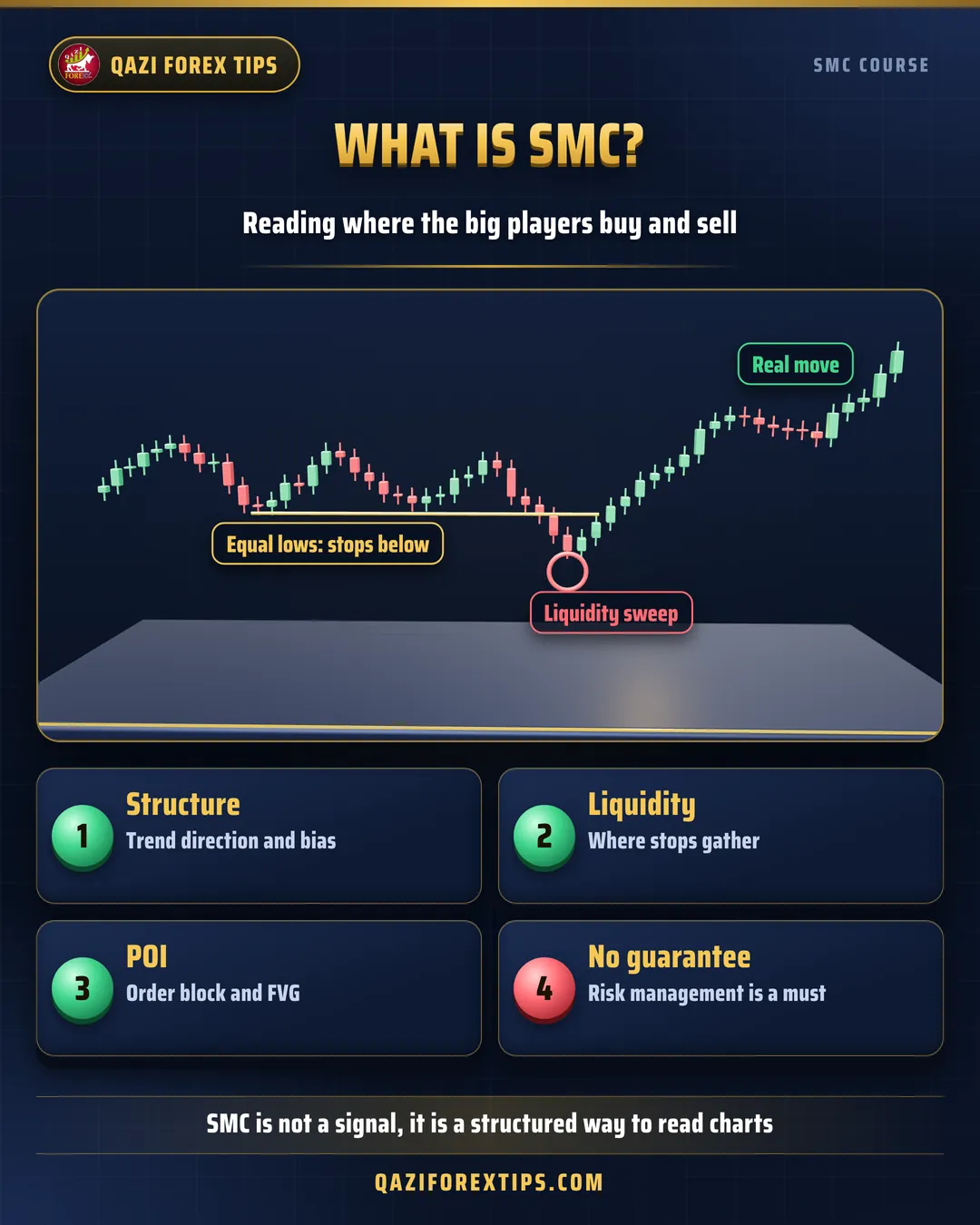
Who is smart money?
Smart money means the big players: banks, funds, large institutions and market makers. Their orders are so large that they cannot be filled at a single price. To build a position they need many orders on the opposite side. A retail trader trades small lots, and most retail traders put their entries and stop losses in the same places: just below support, just above resistance, next to a trend line. The core idea of SMC is that price often goes first to the places where many orders sit, and only then moves in its real direction.
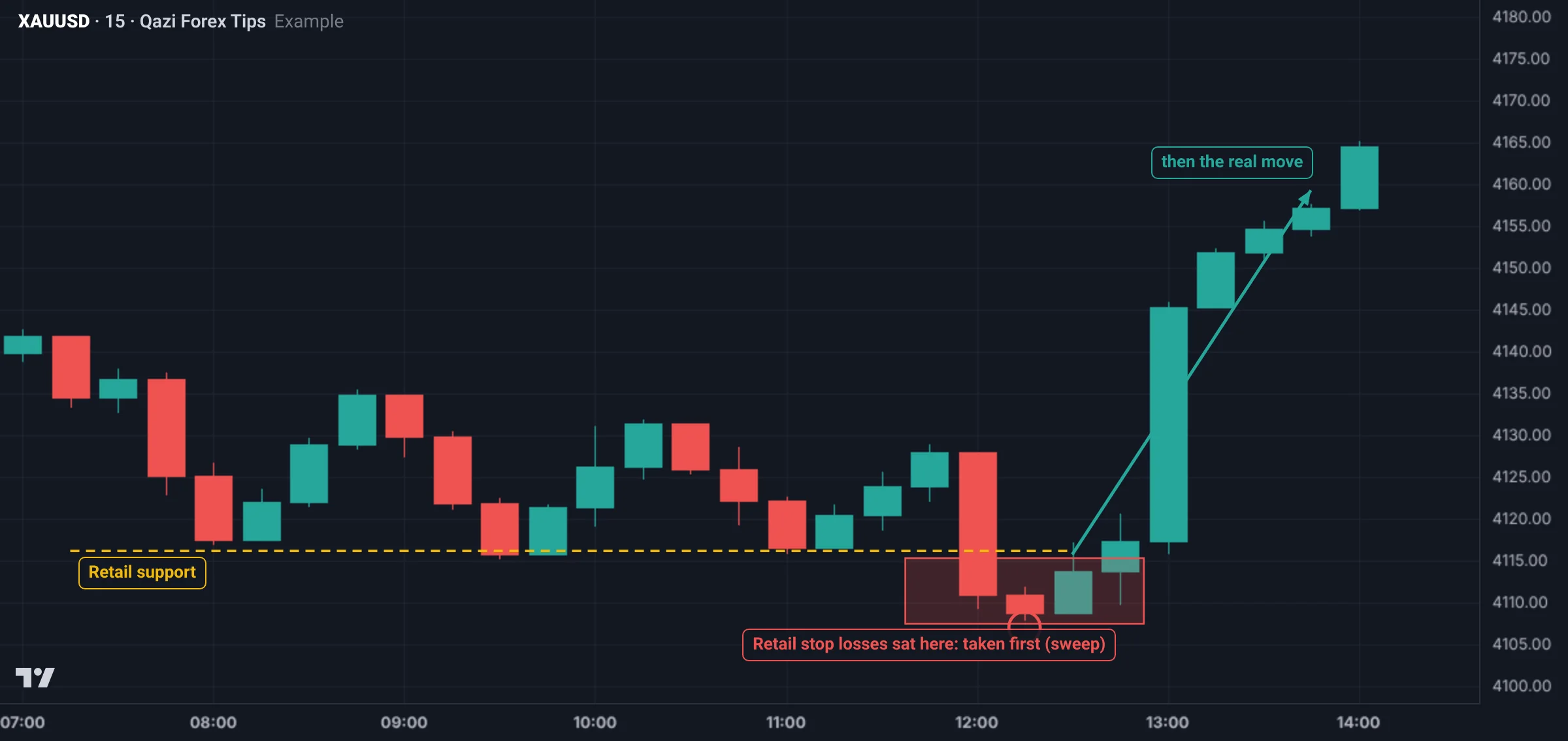
How SMC differs from classic price action
SMC is not a new market. It is price action seen through a specific lens:
| Classic price action | The SMC view |
|---|---|
| Buy at support | Treat the stop losses under support as liquidity |
| Enter on a breakout | Check whether the breakout is real or a liquidity sweep |
| Every level is equal | Only zones that produced a fast move and a structure break matter |
| Time is an afterthought | Sessions and killzones are part of the setup |
The five parts of SMC
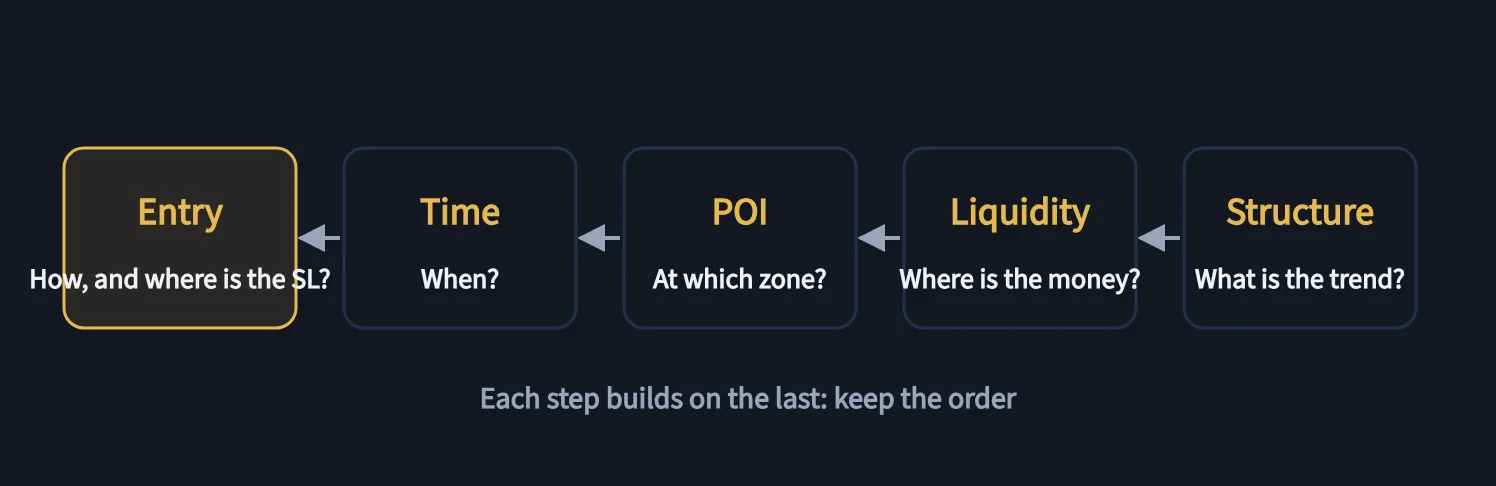
All of SMC answers five questions, and this course is built on them:
- Structure: what is the market's trend? (Phase 1)
- Liquidity: where are stop losses and orders sitting? (Phase 2)
- POI: from which zone is price likely to turn? (Phase 3)
- Time: when does that zone work best? (Phase 4)
- Entry: when and how to enter, and where do the SL and target go? (Phases 5 and 6)
SMC and ICT
Many concepts taught as SMC today (order block, FVG, liquidity, killzone) come from the work of ICT, the Inner Circle Trader. Other teachers later taught them under their own names with slightly different rules, so you will find small differences in definitions. In this course every term has one definition, and that definition is used throughout, so you are not confused.
The limits of SMC: know the truth too
- SMC is a language of probabilities, not guarantees. Not every order block works and not every sweep leads to a reversal.
- Explaining every move with SMC after the fact is easy; predicting it beforehand is hard. That is why backtesting is essential.
- SMC gives a small SL and a large RR, but the win rate is often only 35 to 50 percent. Without risk management even a good setup will not save the account.
How to study this course
- Every lesson ends with a checklist and an assignment. Do not read the next lesson until the assignment is done.
- Every phase ends with a gate: move to the next phase only when its conditions are met. Full details are in the course roadmap.
- With one to two hours a day, the full course takes about six months, the last two or three of which are backtesting and demo trading.
- Post your charts with your reasons in the free Facebook group so mistakes are caught early.
What you need for this course
- MT5 or TradingView (the free plan is enough).
- A demo account.
- A notebook or a trading journal.
- A replay tool to practise candle by candle on old charts, such as the QFT Replay Simulator.
One trade through SMC eyes: step by step
Let's join everything so far in one example, so the whole course fits in a single picture. The chart below is an ordinary uptrend, and an SMC trader reads it with four questions:
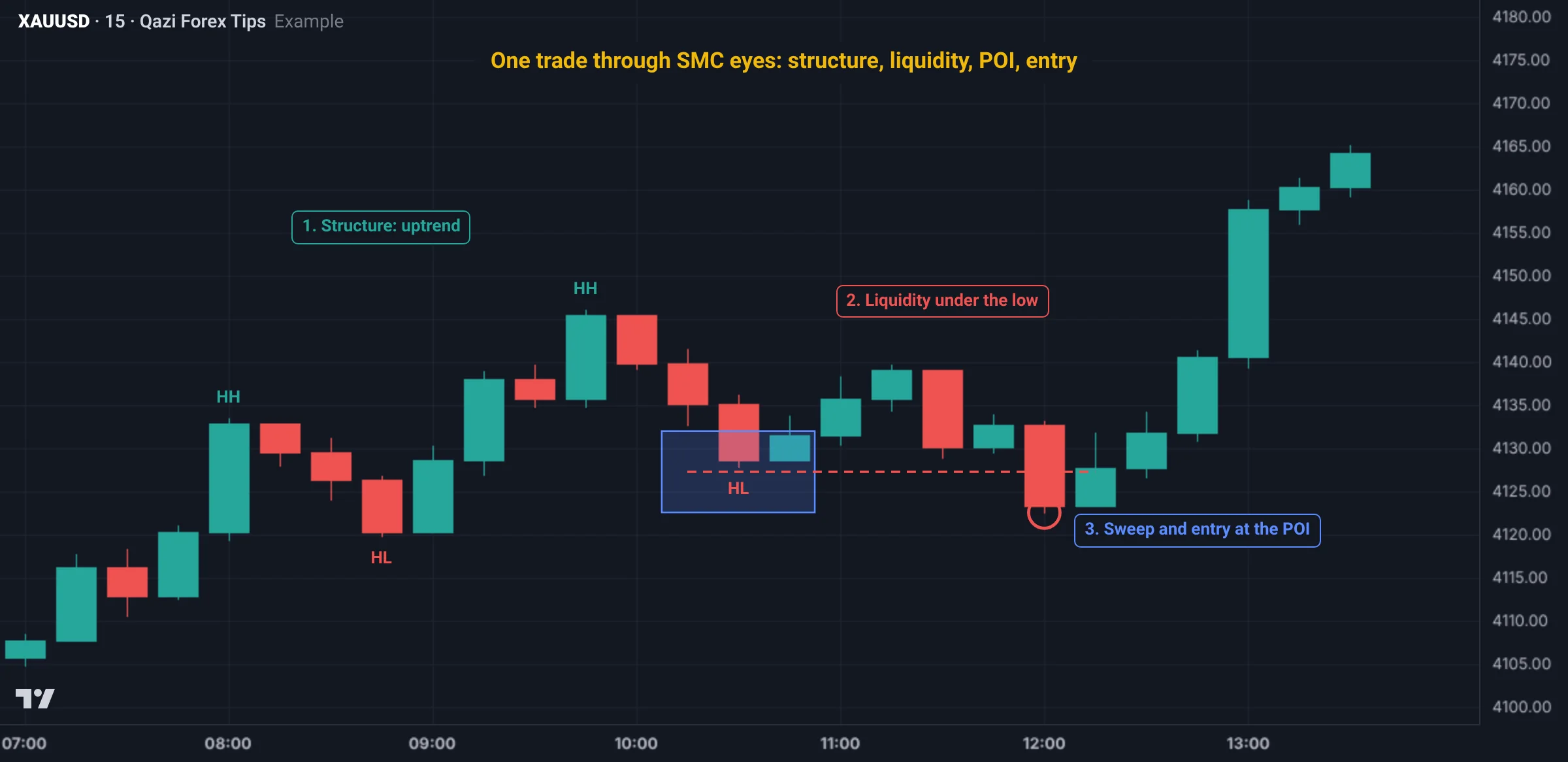
- Structure (Phase 1): price is making HH and HL, an uptrend. The bias is bullish, so we only look for buys.
- Liquidity (Phase 2): many buyers' stops sit below the last HL. That is SSL, and price often comes to take it.
- POI (Phase 3): the zone where the last strong move started (an order block or FVG) is our entry area.
- Entry (Phase 5): when price sweeps the SSL into the POI and a CHoCH appears on a lower timeframe, buy. Stop below the sweep wick, target the next liquidity above.
Each phase teaches one of these four questions in depth, and at the end you will use all four together.
Core SMC terms at a glance
| Term | Plain meaning | Phase |
|---|---|---|
| BOS | The previous high or low broken by a body close in the trend direction | Phase 1 |
| CHoCH | The first important break against the trend: a warning of change | Phase 1 |
| IDM | Inducement: the trap before the real zone | Phase 1 |
| BSL / SSL | Stop losses resting above highs and below lows | Phase 2 |
| Sweep | Price taking liquidity and coming back | Phase 2 |
| POI | A zone where price is more likely to turn | Phase 3 |
| Order block (OB) | The last opposite candle before a strong move | Phase 3 |
| FVG | The gap left between three candles | Phase 3 |
| Killzone | The hours of the day when big volume arrives | Phase 4 |
If these feel new, don't worry. Each term has its own lesson with pictures.
Five common beginner mistakes
Real Gold chart examples
Gold M15 on Tuesday 27 Oct 2026 (data: Dukascopy, bid price; Pakistan time):
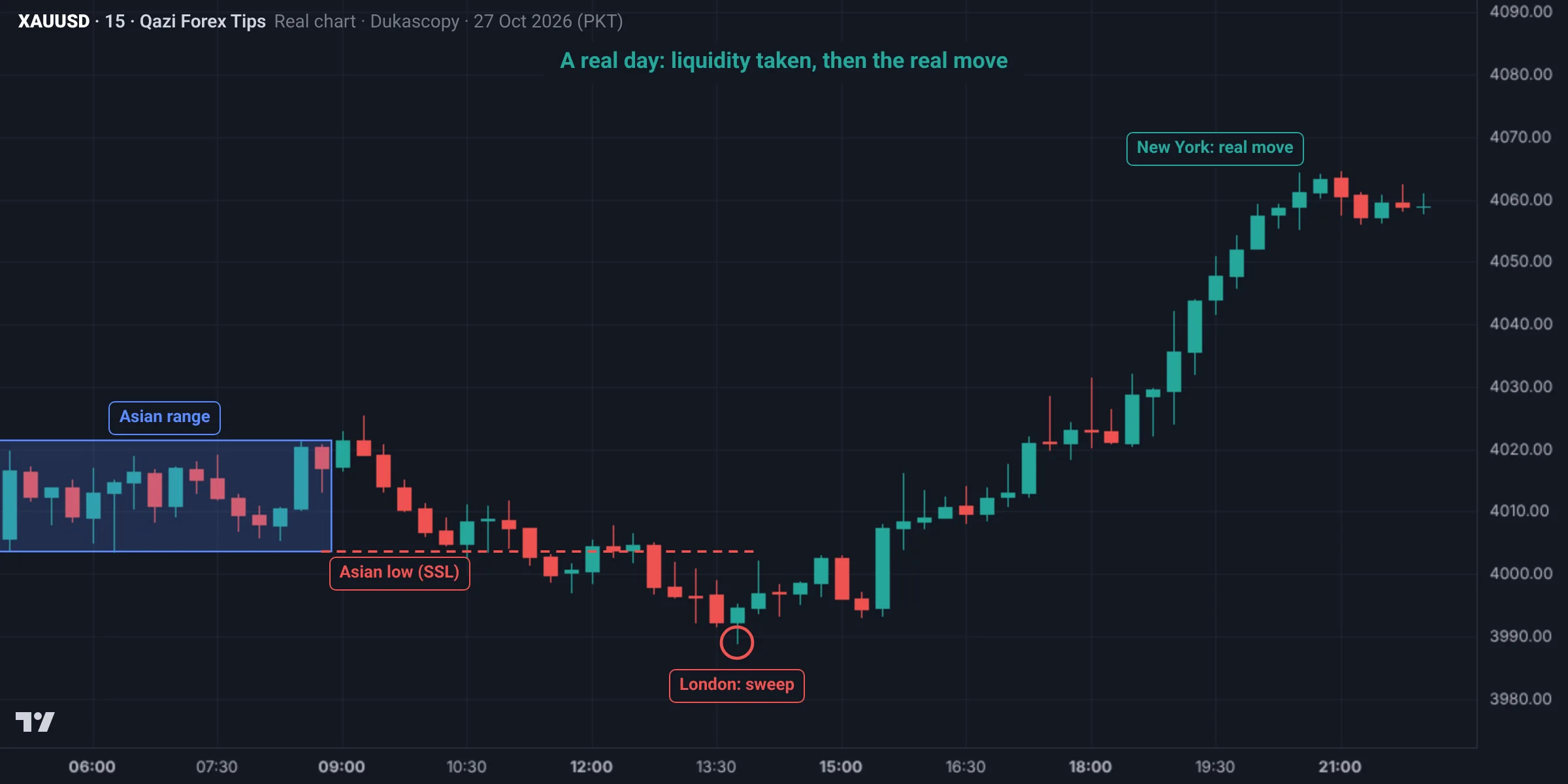
- Asia: from 05:00 to 09:00 Gold held a tight range of 4,003.6 to 4,021.4. Buyers' stops sat below that range.
- London: in the afternoon price dropped below the Asian low and reached 3,989.0 at 13:45. Retail thought "support broke" and sold.
- New York: Gold then turned and reached 4,064.5 by 21:00, about $75 above the swept low.
That is what SMC teaches you to read: where stops sit, when the large player takes them, and which way the real move goes after that.
Second example: a bearish day (22 Oct)
Gold H1 on 21 and 22 Oct 2026 (data: Dukascopy, bid price; Pakistan time). In the first example price took liquidity below and went up; here the opposite happened:
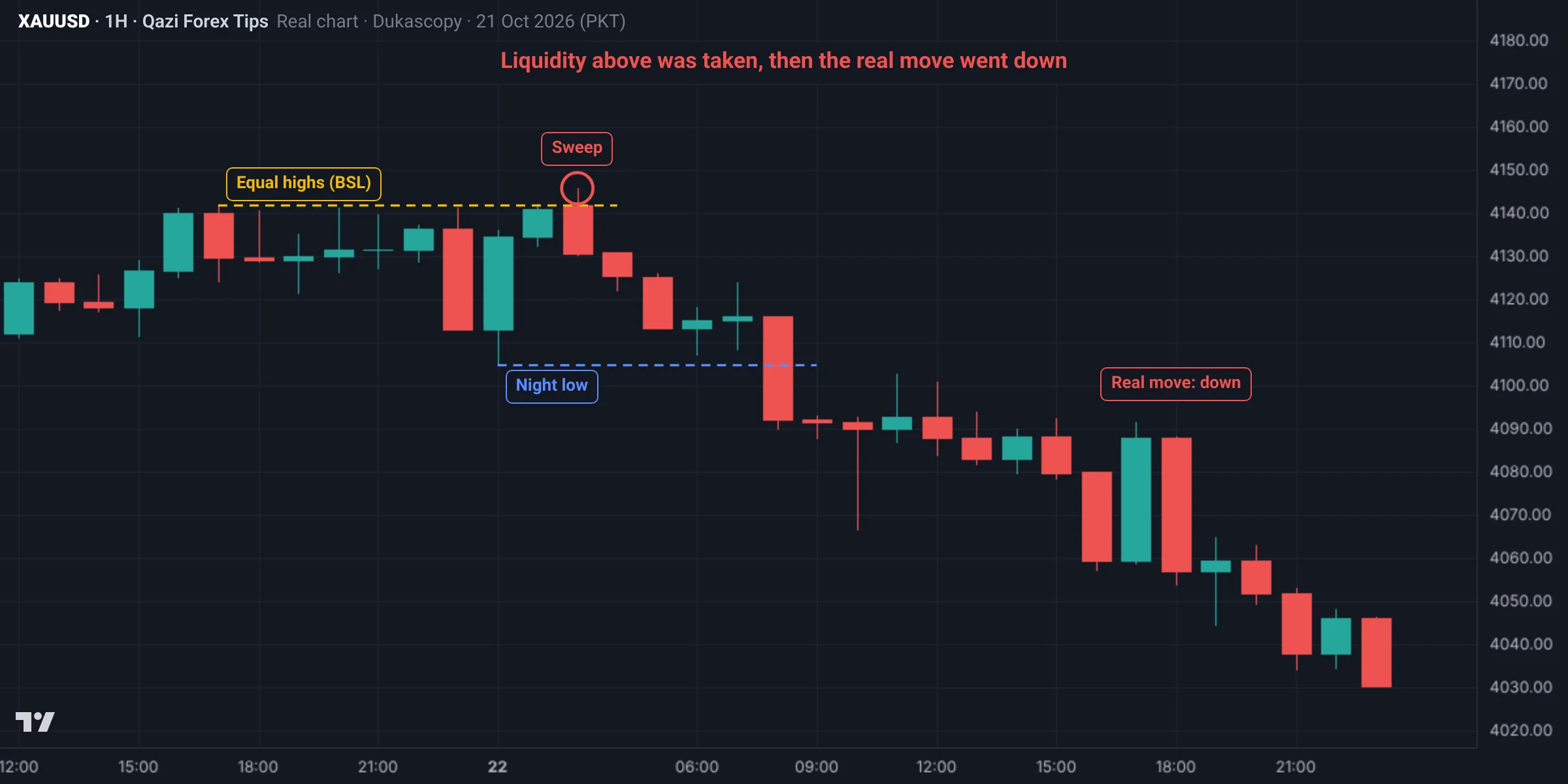
- 21 Oct: price stalled three times at almost the same level: 4,141.6, 4,141.1 and 4,141.0. Retail sold it as "resistance", and their stops gathered just above those highs.
- 03:00 on 22 Oct: price reached 4,145.6, above the equal highs, took the stops, and the candle closed back down at 4,130.6: a sweep.
- The real move: the 08:00 candle closed at 4,092.0, below the night low of 4,104.6, and by 23:00 Gold was at 4,030.1: about $115 below the swept high.
Same story, opposite direction: liquidity on one side first, then the real move the other way.
Summary
- SMC is a structured way to read the footprints of large orders on the chart.
- It has five parts: structure, liquidity, POI, time and entry, with risk management under all of them.
- SMC gives no signals and does not win every trade; patience, backtesting and risk control make the real difference.
- Study this course in order and pass each phase gate before moving on.
Spot it on the chart: practice
This is a real Gold chart (Dukascopy data, Pakistan time). Study it and pick an answer. After you answer, the fully marked chart and the explanation appear.
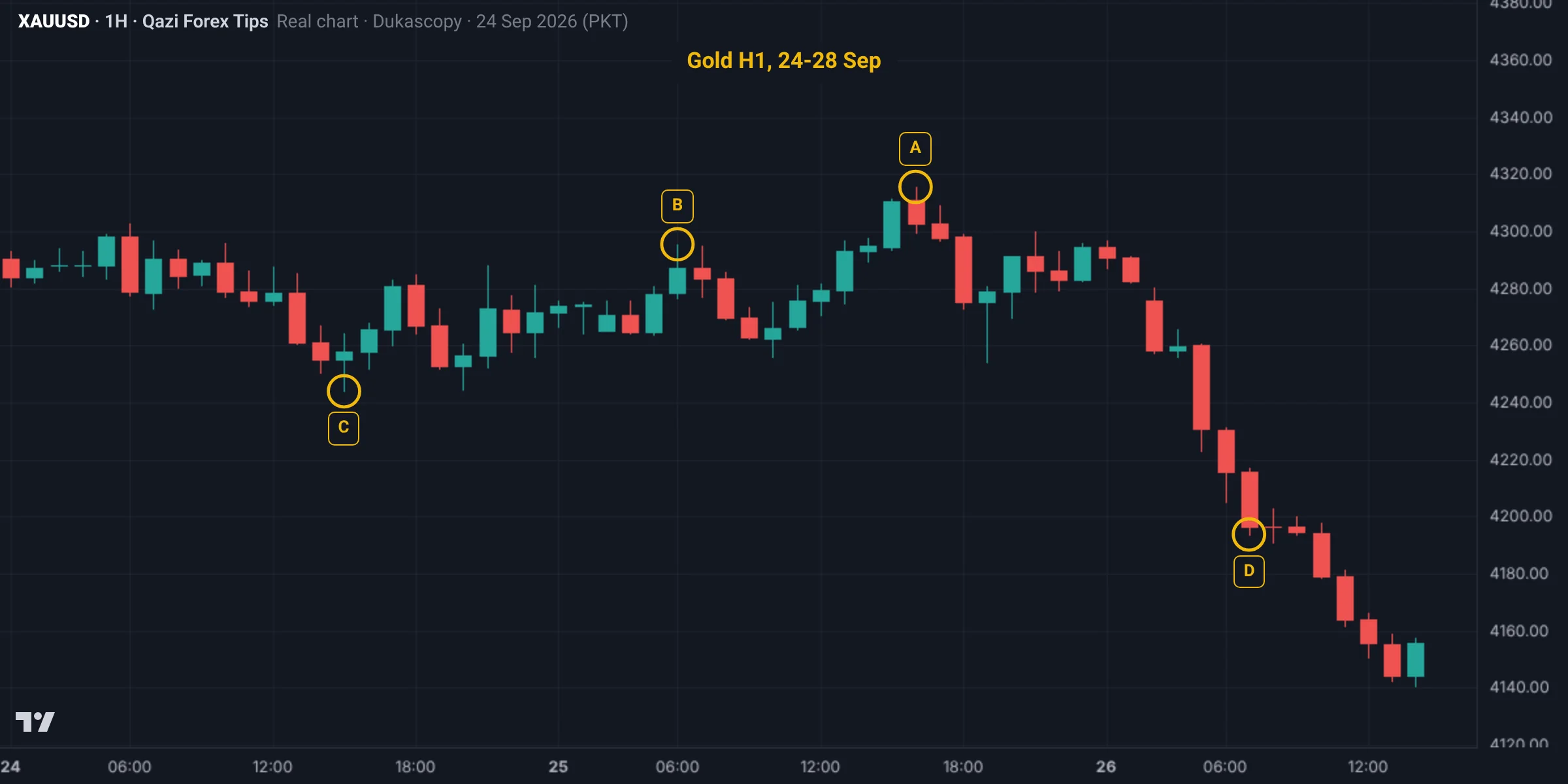
This is a real Gold H1 chart. Before the big drop on 28 Sep, where did price take the stops (BSL) resting above the old high (4,302.9)?
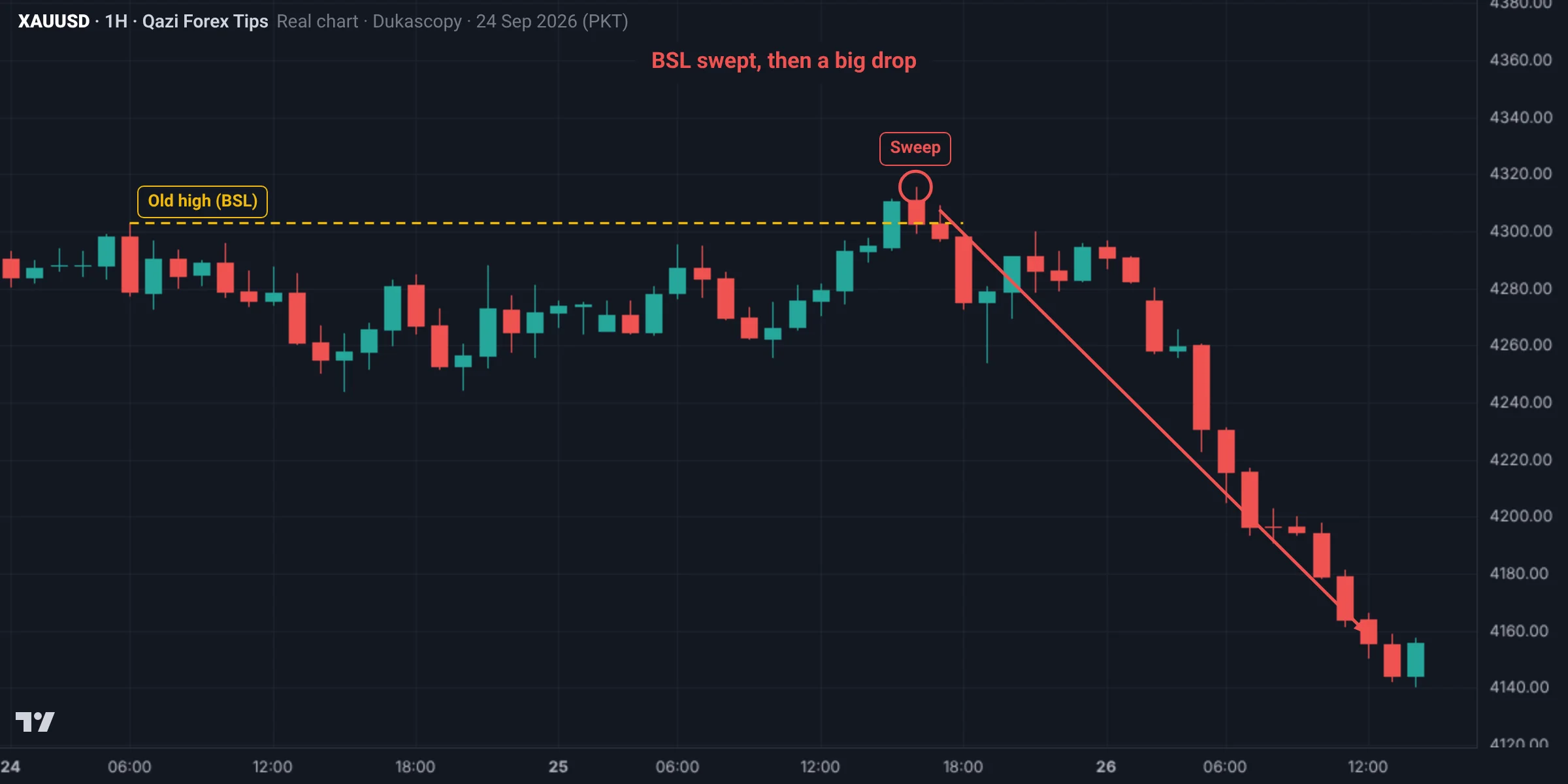
At 16:00 on 25 Sep price reached 4,315.5, taking the stops above the old high, and then closed back below. That is the core SMC idea: liquidity first, then the real move. On 28 Sep Gold fell to 4,140.5. C is a low (SSL); B and D are ordinary candles.
The marked chart
Test yourself: Lesson 0.1 quiz
12 questions. Pick one answer for each and you will see at once whether it is right and why. Your score and grade appear at the end. You need 70% to pass.
0 correct · 0 / 12
Question 1In SMC, what does "smart money" mean?
Smart money is the big players whose orders are too large to be filled at a single price.
Question 2Why does a big player need many orders on the opposite side to build a position?
Filling a huge order needs plenty of opposite orders, which is why price often goes first to where orders sit.
Question 3What is the core idea of SMC?
Places full of stops and orders are liquidity; price often takes them before its real move.
Question 4Classic price action says "buy at support". How does SMC look at that same support?
In SMC the stops below support are SSL, which price often comes to take.
Question 5What is the correct order of the five parts of SMC?
Trend first (structure), then where the orders are (liquidity), then the zone (POI), then time, and finally the entry.
Question 6Why should you not break the order of this course?
Each part stands on the one before it, so jumping to order blocks without the basics is a mistake.
Question 7Where do most SMC concepts like order blocks, FVGs and killzones come from?
These ideas come from ICT and were later taught by others under their own names, so definitions differ slightly.
Question 8What is a typical win rate for SMC setups?
SMC gives a small SL and large RR, but the win rate is often 35 to 50 percent, so risk management is essential.
Question 9Which statement about SMC is true?
Explaining moves after the fact is easy; predicting them is hard. That is why backtesting is essential.
Question 10The trend is making HH and HL. What kind of trade does an SMC trader look for?
HH and HL is an uptrend, so the bias is bullish and only buy setups are considered.
Question 11In the uptrend example, when was the entry taken?
Sweep, POI and a lower-timeframe CHoCH together make the entry; the stop goes below the sweep wick.
Question 12What is at the end of every phase in this course?
Each phase gate lists what you must be able to do before moving on.
Lesson checklist
Tick each point once you understand it. Your ticks are saved in this browser.
Assignment
- Open the Gold (XAUUSD) H1 chart and find 5 places in the last two weeks where price broke a clear support or resistance slightly, came back, and then went the other way.
- Take a screenshot of each and mark where retail stop losses would have been.
- Under each screenshot write one line: how far did price move after the sweep?
- In three lines of your own, write how SMC differs from the way you traded before.
- Copy the terms table into your notebook and write a one-line meaning of each term in your own words.
Post your assignment screenshots with your reasons in our free Facebook group, where your charts will be checked.
Join the free group
Who wrote this lesson
Dr. Qazi Abdul Basit, Ph.D
Ph.D in Business Administration and a forex and Gold trader since 2013. Founder of Qazi Forex Tips, which teaches traders in Pakistan and India price action, risk management and trading psychology in their own language: 65 student batches so far, free courses on YouTube, and MT5 tools for traders (QFT Replay Simulator, QFT Trade Assistant).
- 2013 trading since
- 75K+ Facebook group members
- 65 student batches
- 15K+ YouTube subscribers
How this lesson was made: the content follows Dr. Qazi's teaching method and years of trading. Real charts are built from Dukascopy Gold (XAUUSD) data, and backtest results are shown as they came out, even when negative. We do not sell signals, manage accounts or take money from any broker. Last updated: 19 November 2026.
Questions
What is SMC in trading?
Smart Money Concepts is a price action method that uses market structure, liquidity and institutional zones such as order blocks and FVGs to judge where price is likely to go.
Does SMC always make a profit?
No. SMC is a framework of probabilities. Win rates are often 35 to 50 percent, so risk management and backtesting decide the results.
Is SMC the same as ICT?
Most SMC concepts come from ICT's work. SMC is the simplified, widely taught version of those ideas.
How long does it take to learn SMC?
With one to two hours a day, about six months including backtesting and demo practice.
Can a beginner learn SMC?
Yes, if you start from the basics: candles, swings and structure, before liquidity and entry models.
Do I need paid tools to learn SMC?
No. MT5 or the free TradingView plan and a demo account are enough.
What does SMC mean in Urdu?
SMC stands for Smart Money Concepts, in Urdu roughly سمارٹ منی کے تصورات: reading the footprints of banks and large institutions on the chart. It rests on three things: market structure, liquidity and points of interest.
Is there a free SMC course in Urdu?
Yes, this one: 38 lessons in 9 phases, each with real Gold chart examples, a quiz, chart practice and an assignment. No fee and no sign-up, and every lesson is also available in English.
Read more
Education only, not financial advice. Trading forex, Gold and CFDs carries a high risk of loss. SMC concepts describe tendencies, not guarantees. Lesson 1 of 38.