 Qazi Forex Tips

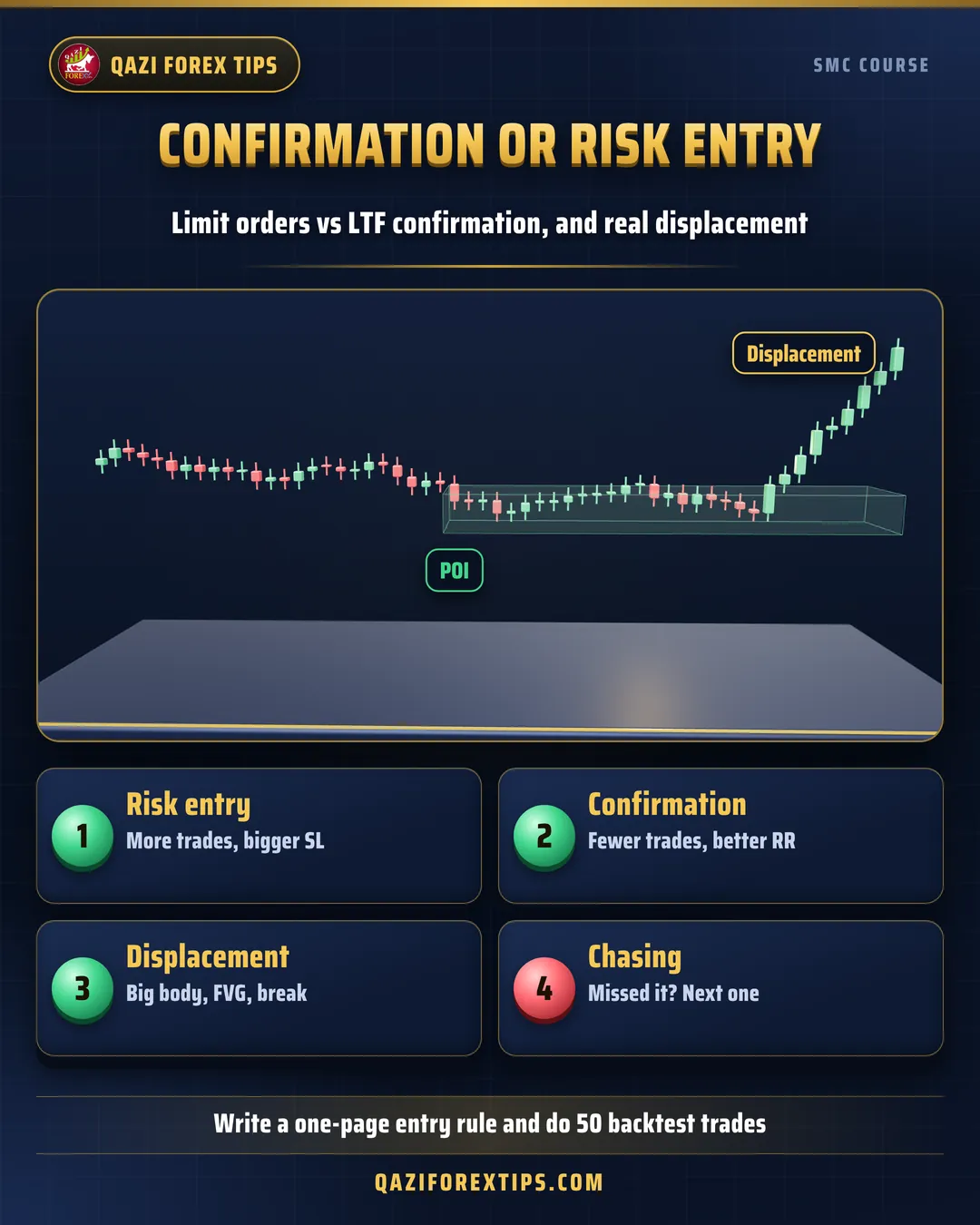
Two kinds of entry
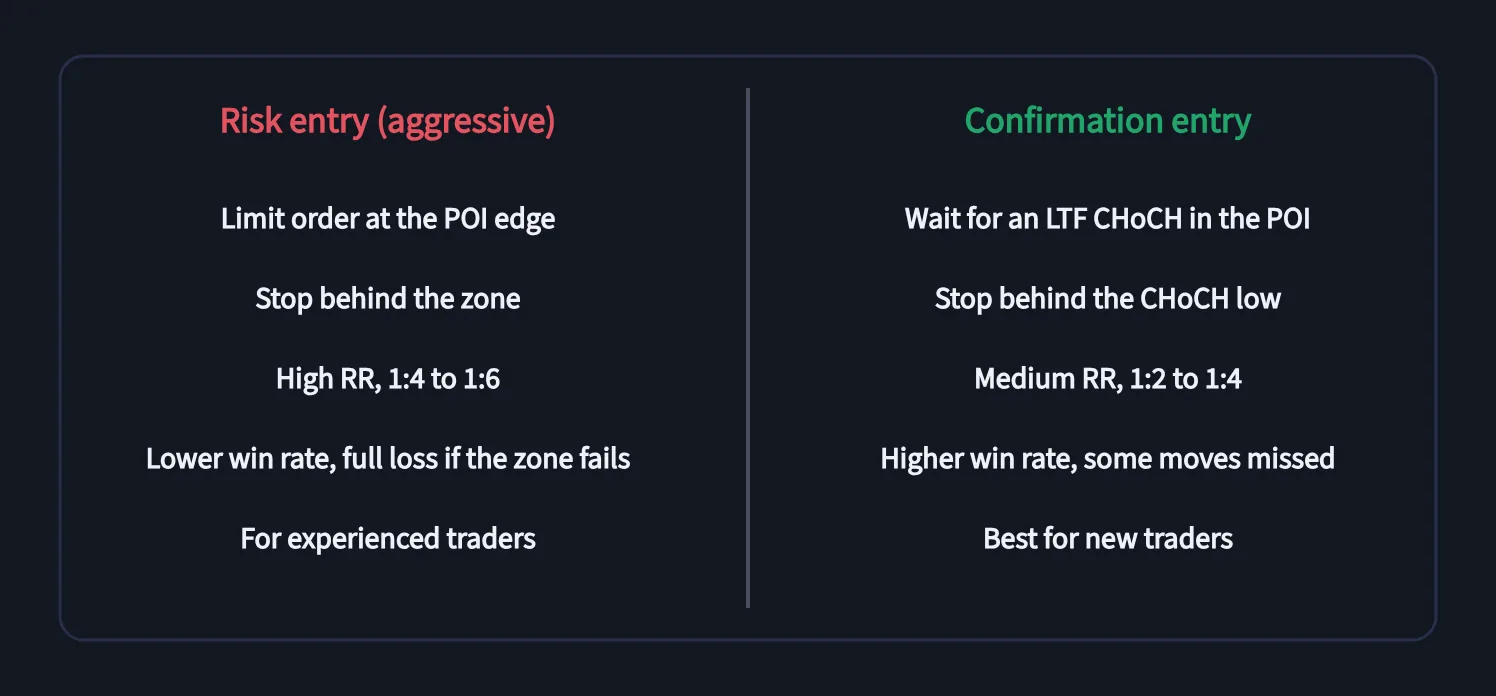
Risk entry (aggressive): a limit order placed in advance at the POI edge or 50%, with the SL behind the zone. If price arrives, the trade opens by itself. Confirmation entry: price enters the POI, then a sweep and CHoCH form on the LTF, then you enter from the new small POI, with the SL behind the CHoCH low.
The difference in numbers
A hypothetical comparison of 20 opportunities at the same type of H1 order block on Gold:
| Method | Trades opened | Win rate | Average RR | Result over 20 opportunities |
|---|---|---|---|---|
| Risk entry | 20 | 40% | 1:3 | 8 × 3 − 12 = +12R |
| Confirmation entry | 13 (no confirmation in 7) | 55% | 1:4 | 7 × 4 − 6 = +22R |
These numbers are only an illustration; your backtest numbers will differ. But the usual tendency is the same: confirmation gives fewer trades, saves losses on failing zones, and improves RR with a smaller stop.
When a risk entry makes sense
- The POI is very strong (score 9 or 10), the bias is clear and the zone is extreme (the origin of the move).
- Price arrives fast and there is no time for LTF confirmation (for example the first minutes of the New York open).
- You are experienced and your own backtest shows risk entries are positive on this zone type.
- A middle way: half the position as a risk entry, half on confirmation.
Displacement: recognising real strength
Almost everything in SMC rests on displacement: a good OB, a real MSS, a strong FVG. Displacement means price moving fast and forcefully in one direction, showing a large order arrived.
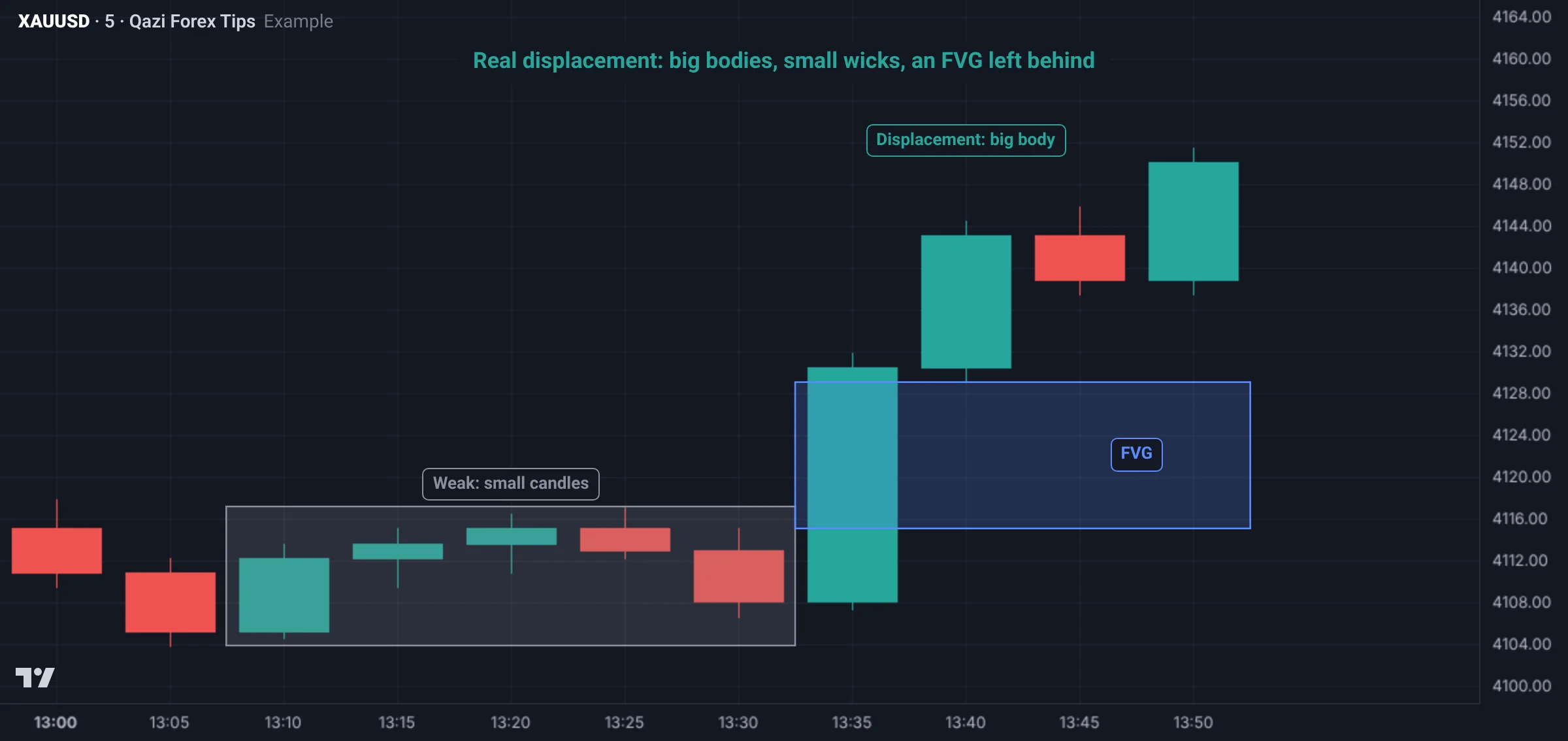
Signs of displacement:
- One or more candles with a body clearly larger than the average of the previous 10 to 20 candles (roughly twice or more).
- Small wicks, closing near the high (bullish) or low (bearish).
- An FVG left behind.
- A structure break (BOS or MSS).
A weak move: many small candles, long wicks, overlapping bodies, no FVG. Do not trust OBs or CHoCHs built from such moves.
Write your entry rule
Before finishing Phase 5, write a one-page rule. Example:
- Model: B (H1 POI + M5 CHoCH).
- Bias: H4 structure, H1 DOL.
- POI: score 8 or more, right side of discount or premium.
- Time: only the London and New York killzones; not within 30 minutes of news.
- Entry: confirmation, an M5 CHoCH with displacement, then a limit in the FVG.
- SL: below the CHoCH low, at least $4.
- TP: TP1 the first liquidity, TP2 the DOL; RR at least 1:2.
- Risk: 1% per trade, at most 2 trades or 2% loss per day.
Gold example: one POI, two entries
H1 bullish order block 4,110 to 4,120, DOL 4,152.
- Risk trader: limit at 4,118, SL 4,107, risk $11, $34 to target: 1:3.1.
- Confirmation trader: price reached 4,113, the M5 LH at 4,119 broke (one large $12 green candle: displacement), an FVG formed from 4,116 to 4,120. Entry 4,118, SL 4,111, risk $7: 1:4.9.
- Both won that day, but the confirmation trader got the same target for $7 of risk. The next day the zone broke: the risk trader was stopped out, and the confirmation trader's trade never opened.
Real Gold chart examples
Gold H1 on 4 Nov 2026 (data: Dukascopy, bid price; Pakistan time):
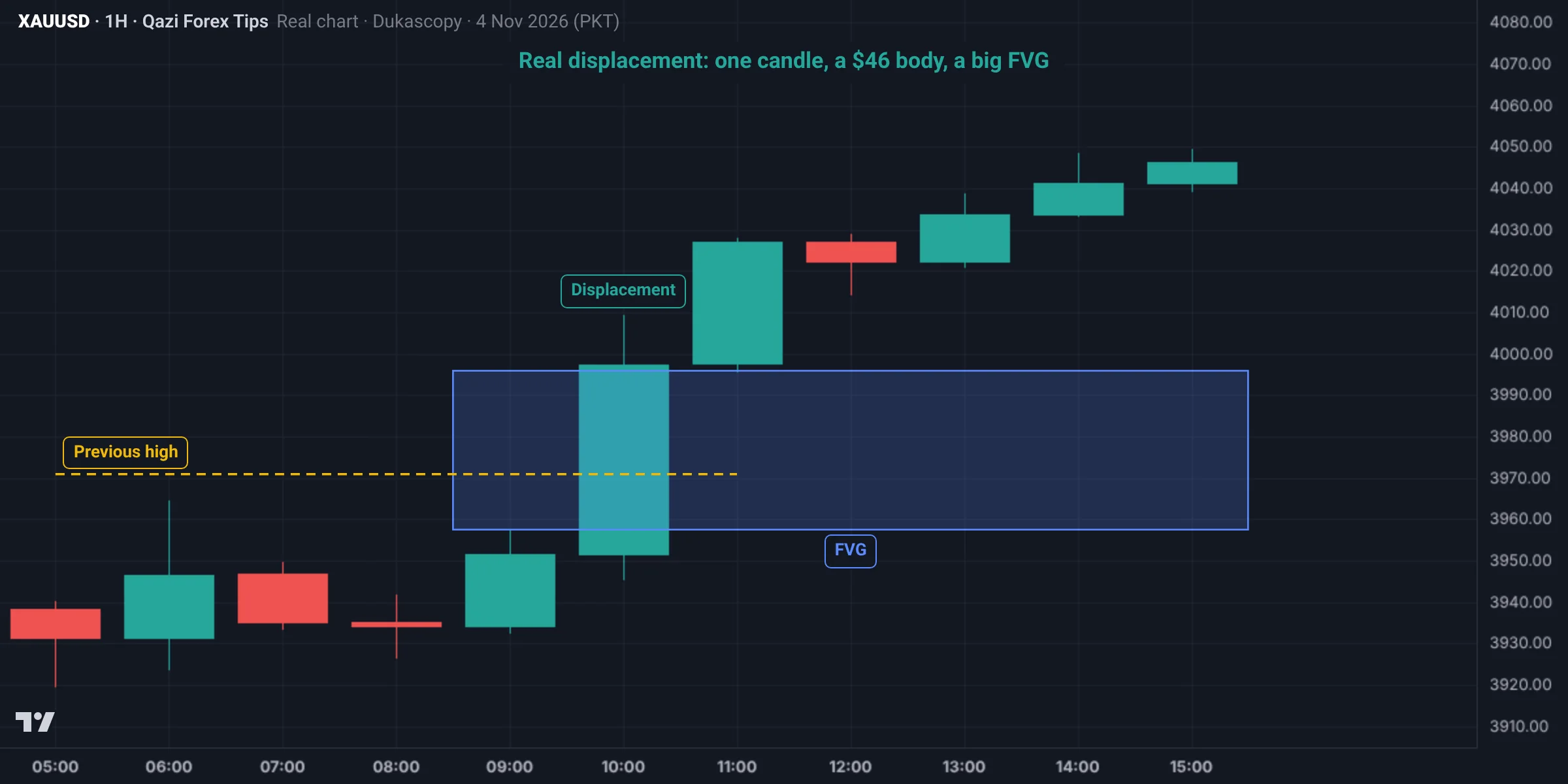
- Over the previous 20 hours the average H1 body was about $10.0.
- The 10:00 candle's body ran from 3,951.7 to 3,997.5, about $46: many times the average, with a small upper wick (high 4,009.5).
- It broke the 3 Nov high at 3,970.9 (BOS) and left a big FVG from 3,957.5 to 3,995.9.
- That is real displacement: a big body, a close near the high, an FVG and a structure break, all together.
- A risk-entry trader with a limit in the FVG never got filled, because price never came back and ran straight to 4,146.8. That day confirmation traders entered on small M15 pullbacks.
Second example: bearish displacement and a risk entry (12-13 Nov)
Gold H1 on 12 and 13 Nov 2026 (data: Dukascopy, bid price; Pakistan time). In the first example the risk entry never filled; here it did:
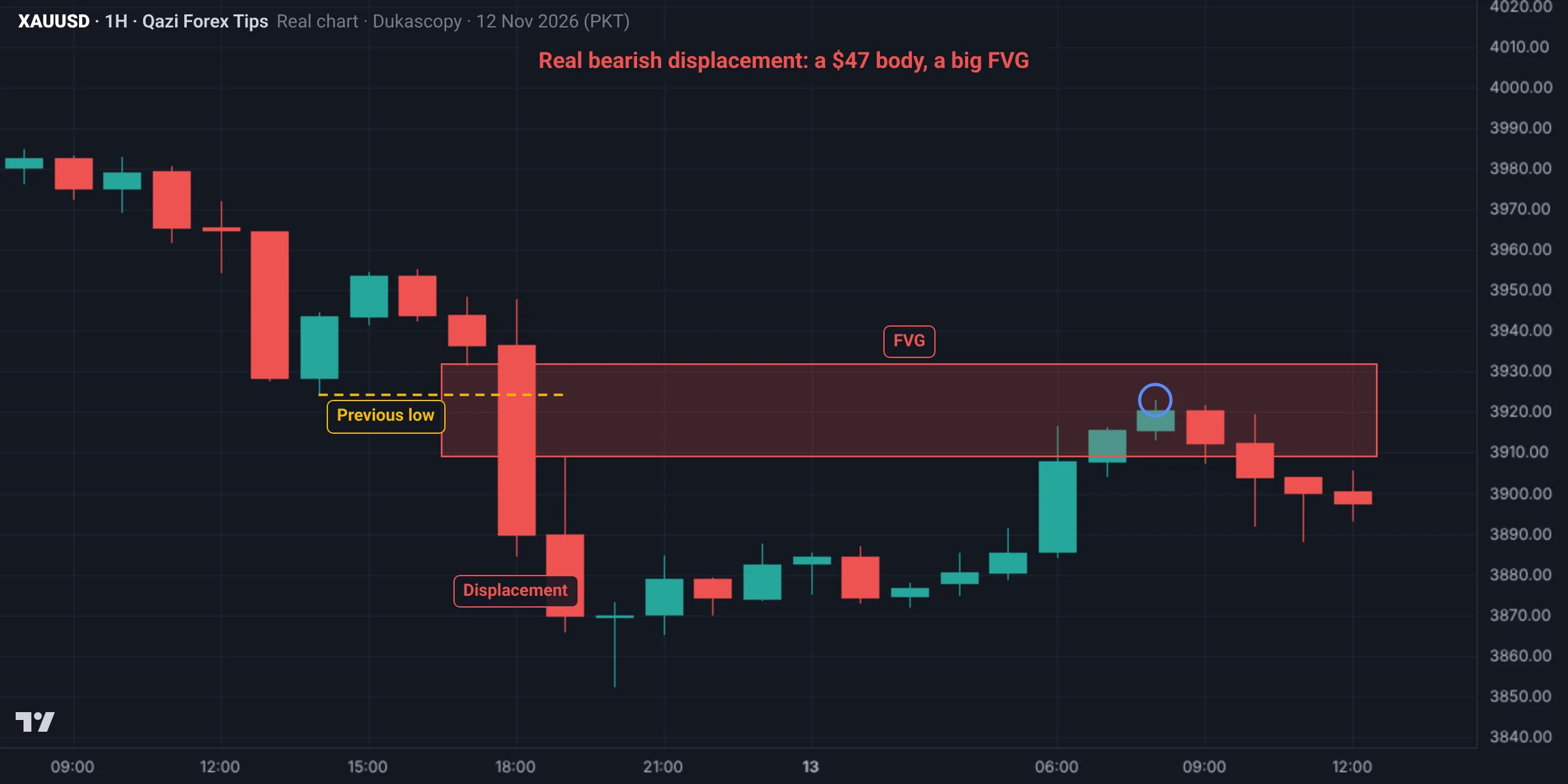
- Over the previous 20 or so hours the average H1 body was $8.6.
- The 18:00 candle's body ran from 3,936.6 to 3,889.7, about $47: many times the average, with a close near the low.
- It broke the 14:00 low at 3,924.3 (BOS) and left a big FVG from 3,909.1 to 3,931.9.
- Risk entry: a sell limit at the FVG's CE 3,920.5, SL above the displacement candle's high at 3,948.4. The order filled the next day, 13 Nov 2026, at 08:00, the stop was not hit, and price reached 3,867.6: about +1.9R.
- A confirmation trader would have waited for an M15 CHoCH inside the FVG: a smaller RR, but more certainty.
Both methods are valid; the difference is how much certainty you buy, and at what price.
Common mistakes
Phase 5 gate: before moving on
- Your one-page entry rule is written (model, bias, POI, time, entry, SL, TP, risk).
- You have at least 50 backtest trades on that rule in a journal.
- You know your win rate, average RR and longest losing streak.
- You can tell real displacement from a weak move on any chart.
Next is risk management, which decides whether your good rule protects your account.
Summary
- Risk entry: more trades, bigger stop, full loss if the zone fails. Confirmation: fewer trades, smaller stop, better RR.
- For new traders: confirmation, or a half-and-half split.
- Displacement: big bodies, small wicks, an FVG and a structure break.
- Write your rule and do not go live without 50 backtest trades.
Try this lesson on your own chart
Qazi Forex Tips' own tools that make this lesson easier. A tool helps; your rules make the decision.
QFT FVG Pro indicator
100% free · MT5 & MT4Draws FVGs, IFVGs, BPRs and higher timeframe FVGs on your chart automatically, with the 50% (CE) line: everything in this lesson, on your own chart.
Details and downloadSpot it on the chart: practice
This is a real Gold chart (Dukascopy data, Pakistan time). Study it and pick an answer. After you answer, the fully marked chart and the explanation appear.
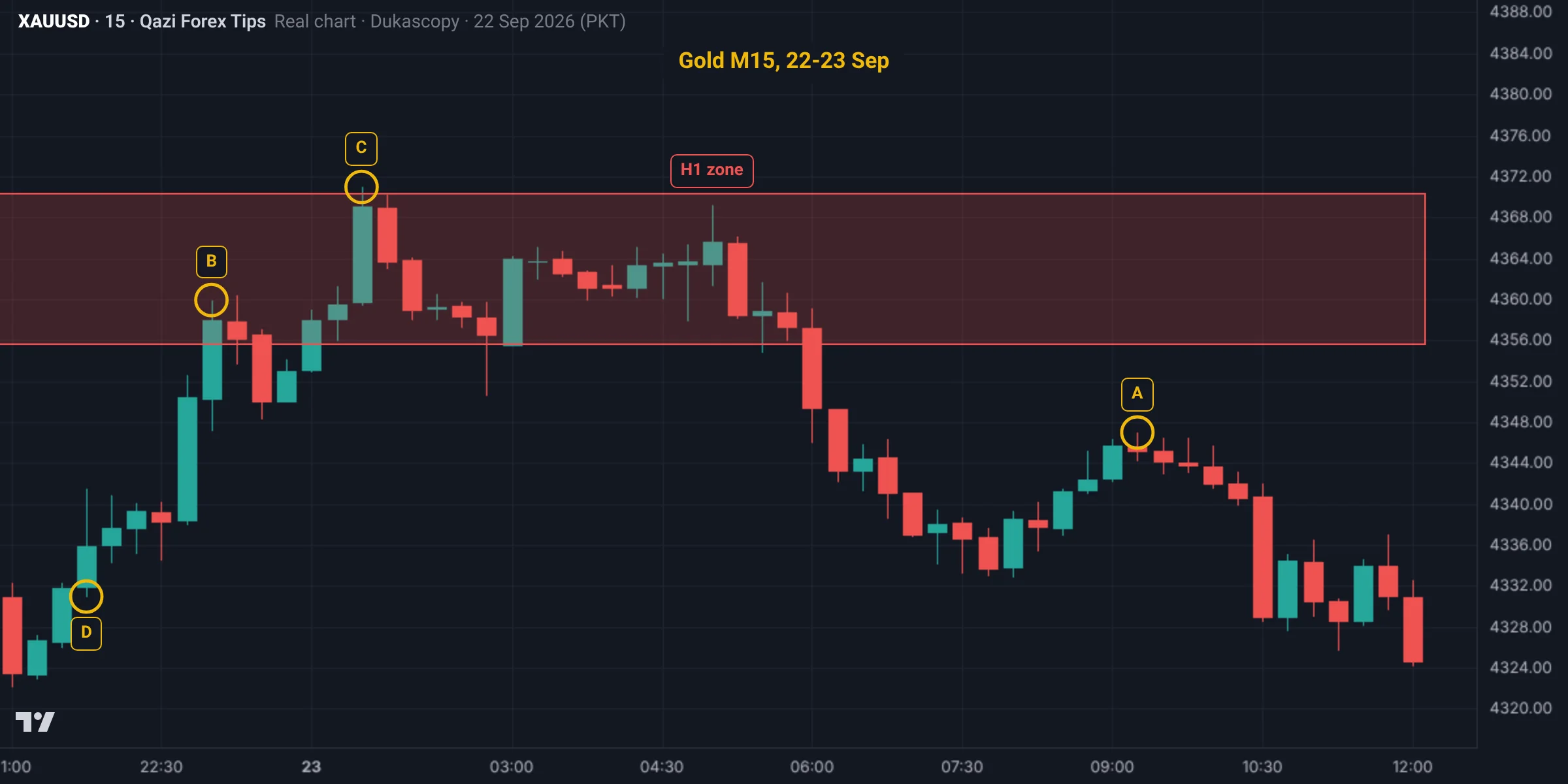
Price came into the bearish H1 zone (4,355.6 to 4,370.3). Which of these is the confirmation entry?
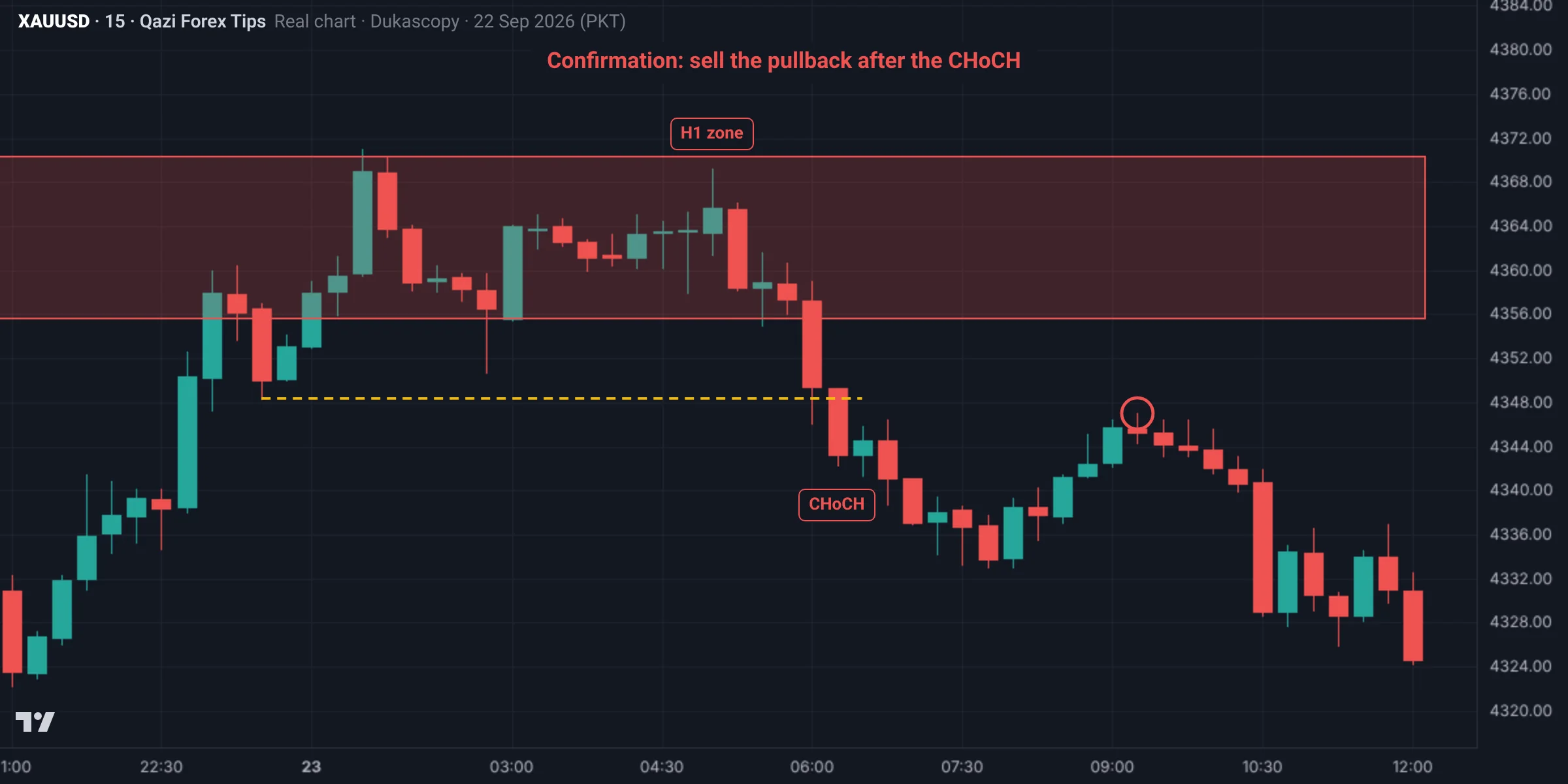
A (09:15 on 23 Sep): first, at 06:15, an M15 candle closed below the 4,348.3 HL (a CHoCH), then the pullback came to 4,347.0: selling there is the confirmation entry. Price reached 4,324.3 the same day. B is the first touch of the zone, a risk entry (limit); C guesses the top; D is before price reached the zone.
The marked chart
Test yourself: Lesson 5.5 quiz
9 questions. Pick one answer for each and you will see at once whether it is right and why. Your score and grade appear at the end. You need 70% to pass.
0 correct · 0 / 9
Question 1What is a risk entry?
Confirmation entry: after a sweep and CHoCH in the POI, enter from the new small POI.
Question 2In the example table, what was the confirmation entry result over 20 opportunities?
Only an illustration, but the tendency holds: fewer trades, saved losses on failing zones, better RR.
Question 3When does a risk entry make sense?
A middle way: half the position as a risk entry, half on confirmation.
Question 4Which is NOT a sign of displacement?
Small overlapping candles are a weak move; don't trust OBs or CHoCHs built from them.
Question 5A normal Gold M5 candle is 2 to 4 dollars. At the London open, which candle is displacement?
These numbers change with conditions; always compare with the previous candles.
Question 6What should a one-page entry rule contain?
Example: model B, score 8+, killzones only, 30 minutes away from news, 1% risk, max 2 trades a day.
Question 7Same POI: the risk trader at 4,118 with SL 4,107 (1:3.1), the confirmation trader at 4,118 with SL 4,111 (1:4.9). The next day the zone broke. Then?
That is the benefit of confirmation: no loss on a failing zone.
Question 8Why is switching method every trade wrong?
Chasing price that left without confirmation is also a mistake.
Question 9How many backtest trades does the Phase 5 gate require?
And you should know your win rate, average RR and longest losing streak.
Lesson checklist
Tick each point once you understand it. Your ticks are saved in this browser.
Assignment
- Write your one-page entry rule (as in the example).
- For last month's 20 POIs, record the result of both a risk entry and a confirmation entry.
- Calculate the win rate, average RR and total R of both.
- Screenshot 10 real displacements and 10 weak moves on Gold M5.
- Post your rule and results in the group.
Post your assignment screenshots with your reasons in our free Facebook group, where your charts will be checked.
Join the free group
Who wrote this lesson
Dr. Qazi Abdul Basit, Ph.D
Ph.D in Business Administration and a forex and Gold trader since 2013. Founder of Qazi Forex Tips, which teaches traders in Pakistan and India price action, risk management and trading psychology in their own language: 65 student batches so far, free courses on YouTube, and MT5 tools for traders (QFT Replay Simulator, QFT Trade Assistant).
- 2013 trading since
- 75K+ Facebook group members
- 65 student batches
- 15K+ YouTube subscribers
How this lesson was made: the content follows Dr. Qazi's teaching method and years of trading. Real charts are built from Dukascopy Gold (XAUUSD) data, and backtest results are shown as they came out, even when negative. We do not sell signals, manage accounts or take money from any broker. Last updated: 19 November 2026.
Questions
What is displacement in SMC?
A fast, forceful move with large bodies and small wicks that leaves a fair value gap and breaks structure, showing institutional intent.
Confirmation entry or limit entry?
Limit entries catch more moves but take full losses when zones fail; confirmation entries take fewer trades with smaller stops and usually better reward to risk.
Which entry should a new trader use?
Confirmation, or half the position as a risk entry and half on confirmation.
What is the difference between a limit order and a market order?
A market order fills immediately at the current price; a limit order fills only at the price you set. A risk entry is usually a limit order; a confirmation entry is usually a market order or a limit in a small FVG.
Is a risk entry gambling?
No, if the zone is strong, the stop is logical and the risk is 1% or less. You simply accept less certainty in exchange for a better RR.
Read more
Education only, not financial advice. Trading forex, Gold and CFDs carries a high risk of loss. SMC concepts describe tendencies, not guarantees. Lesson 32 of 38.