 Qazi Forex Tips

What is a protected low?
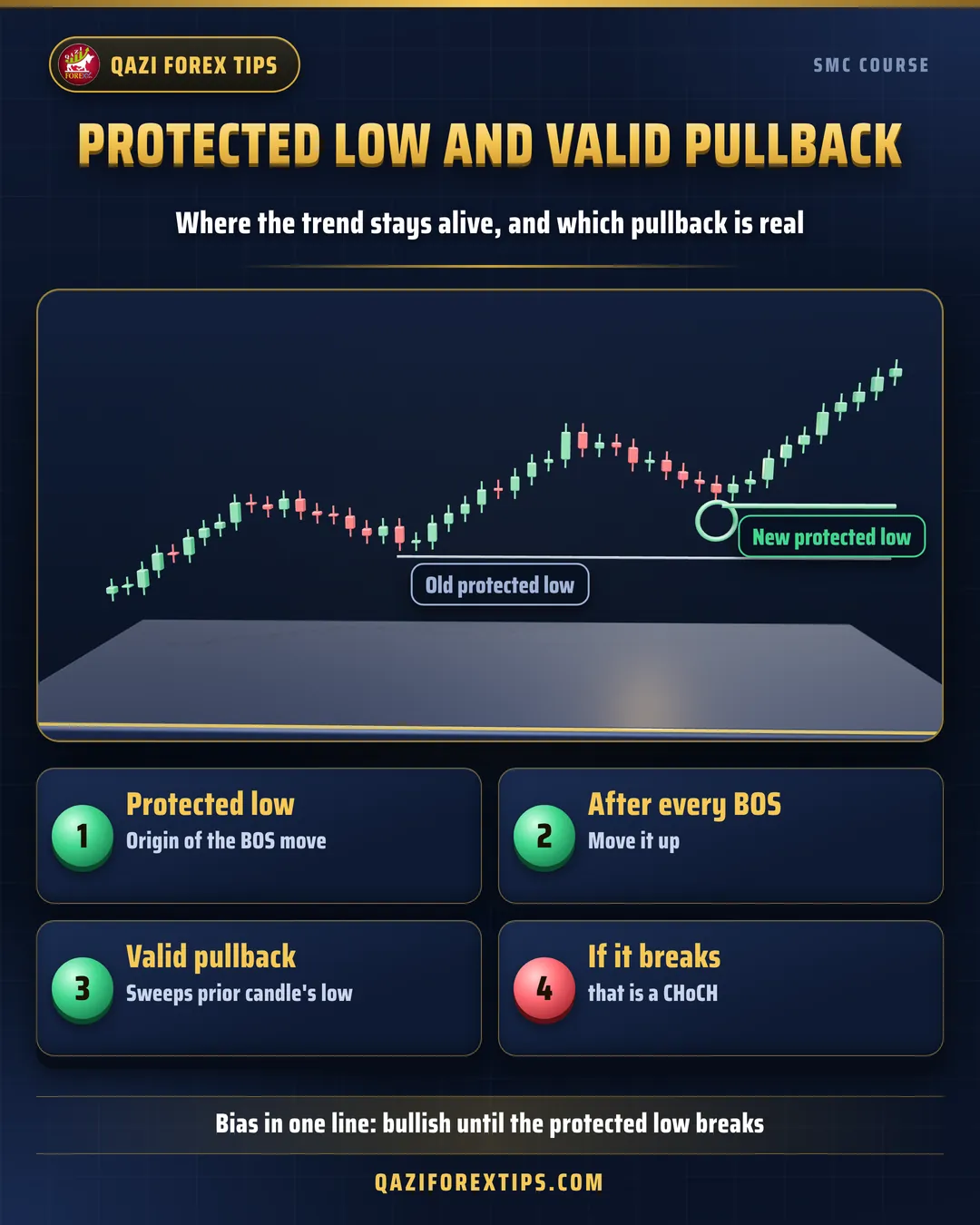
In an uptrend, the low where the move that broke the previous high (the BOS) began is the protected low. Buyers are defending that place.
- As long as the protected low does not break with a body close, the bias is bullish.
- When it breaks, that is a CHoCH (lesson 1.3).
- In a downtrend it is the reverse: the protected high.
When does the protected low move?
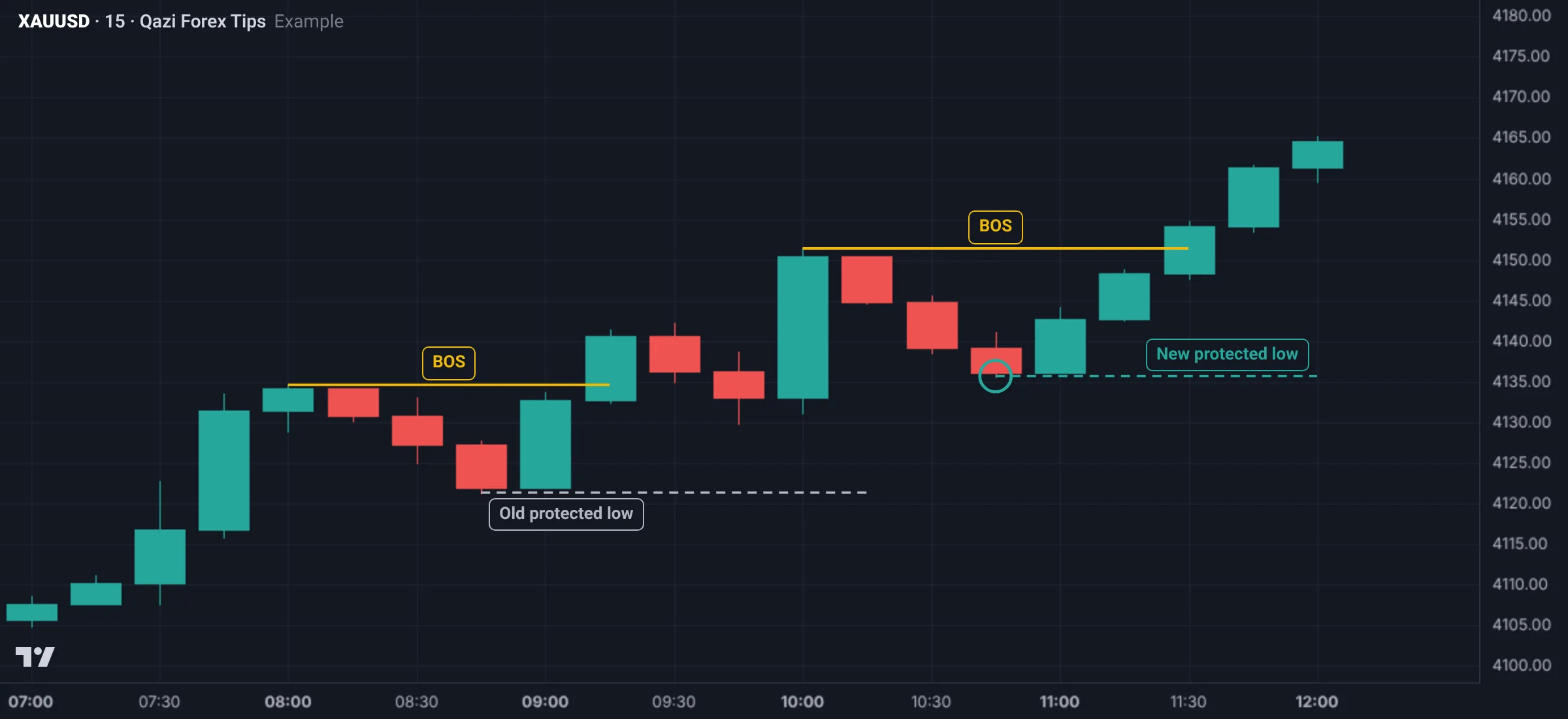
- Price makes a new BOS (breaks the previous high).
- The low where that BOS move began is the new protected low.
- The old protected low is now just an old level and no longer matters for bias.
What is a valid pullback?
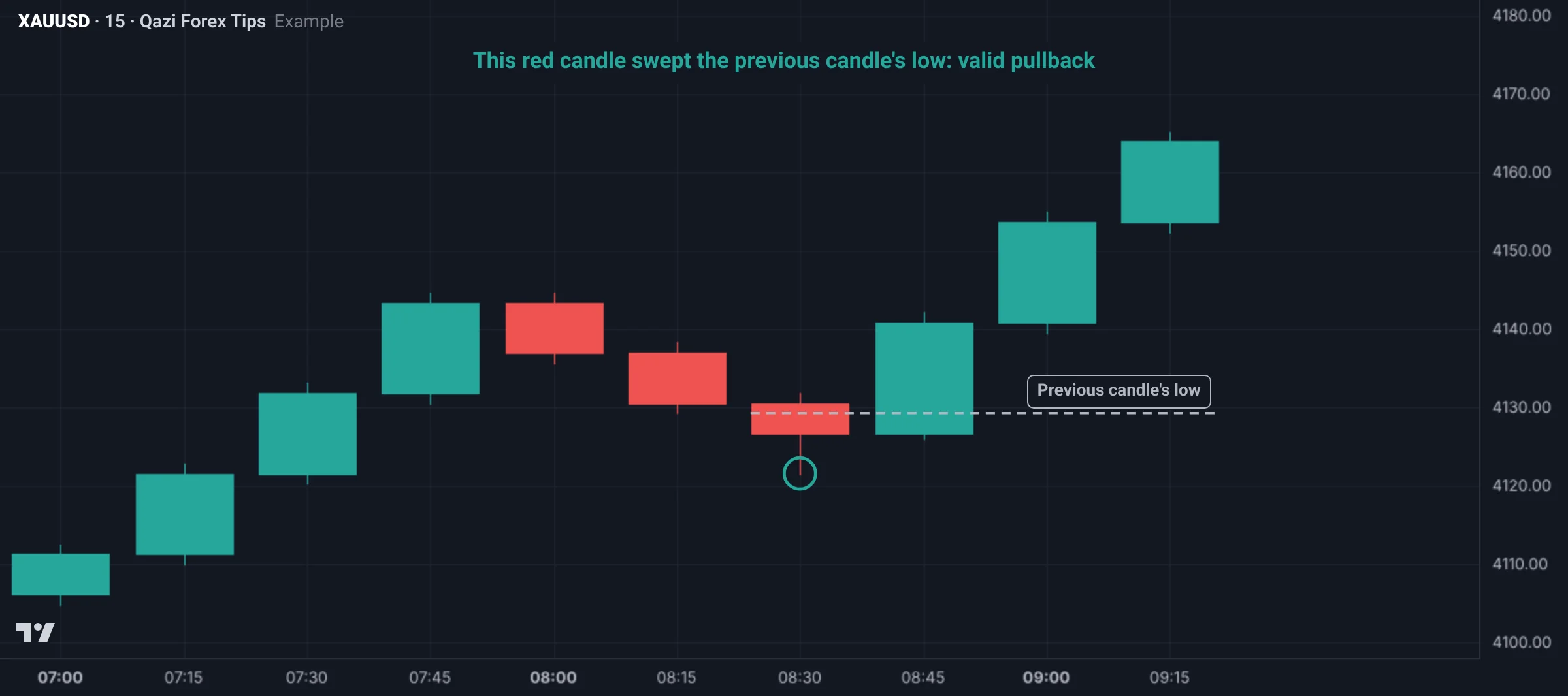
Not every small red candle is a pullback. Many teachers use this rule: a pullback is valid (real) when the pullback candle sweeps the previous candle's low (in an uptrend).
Why this rule?
- It stops every small pause from being treated as a swing; only places where some liquidity was actually taken count.
- It reduces the confusion between internal and swing structure.
| Situation | Result |
|---|---|
| The pullback swept the previous candle's low | Valid pullback, mark the new HL |
| Two or three candles paused sideways, no low broke | Not valid, don't mark a swing |
Using the protected low
- SL placement: the SL of a swing trade is often safest below the protected low.
- Where to look for POIs: near the protected low and at the origin of that move, the order block (Phase 3).
- Decisions: if the protected low breaks, close or avoid bullish trades.
When the protected low breaks
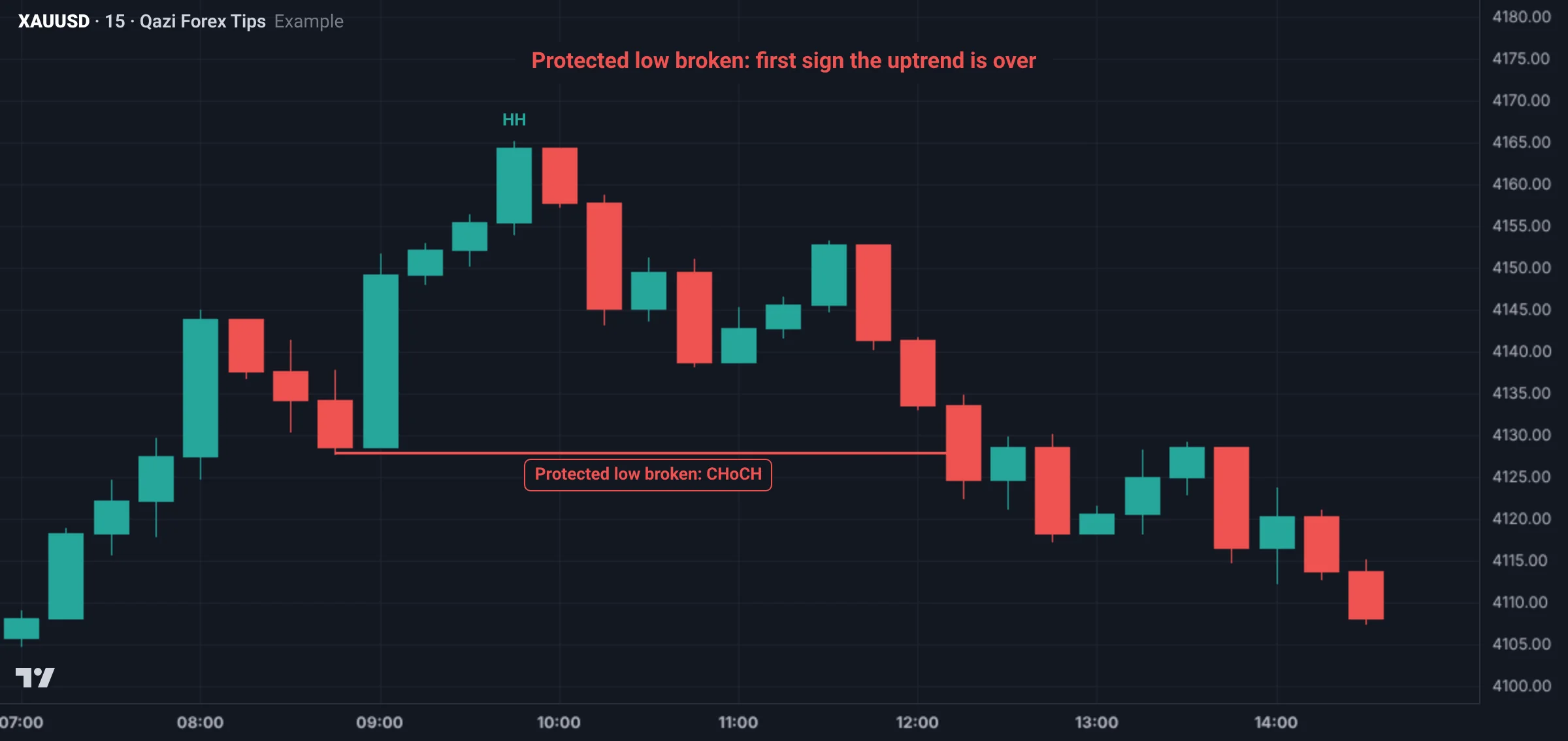
The protected low is the uptrend's last wall. When price closes its body below it:
- The proof of the uptrend is gone. This is where a CHoCH forms.
- The bias turns from bullish to neutral, and bearish after confirmation.
- Now find the new protected high: the high where this down move started.
Finding the protected low: step by step
- Find the last BOS in the uptrend (the previous high broken by a body).
- Walk the BOS move backwards: which low did it start from?
- That low is the protected low. Draw a horizontal line on it.
- Move the line up after every new BOS.
- Accept only a low from a valid pullback as protected: a pullback that took the previous candle's low.
The stop loss and the protected low
The protected low gives the most logical stop for a swing trade. If you are buying in an uptrend, your idea is wrong when the protected low breaks. So:
- Swing trade: stop below the protected low, with a little room.
- Intraday trade: stop below the lower timeframe's protected low, so the lot does not get too small.
- If the protected low is very far and the RR doesn't work, look for an entry on a lower timeframe, or skip the trade.
A Gold example
H1 uptrend: price rises from a low at 4,121, breaks the previous high at 4,140 and reaches 4,149.
- Protected low = 4,121, because the BOS move started there.
- A pullback reaches 4,133, then a new BOS above 4,149: the protected low moves up to 4,133.
- If an H1 candle ever closes below 4,133, the uptrend is in question and new buys stop.
Real Gold chart examples
Gold H4 from 3 to 12 Nov 2026 (data: Dukascopy, bid price; Pakistan time):
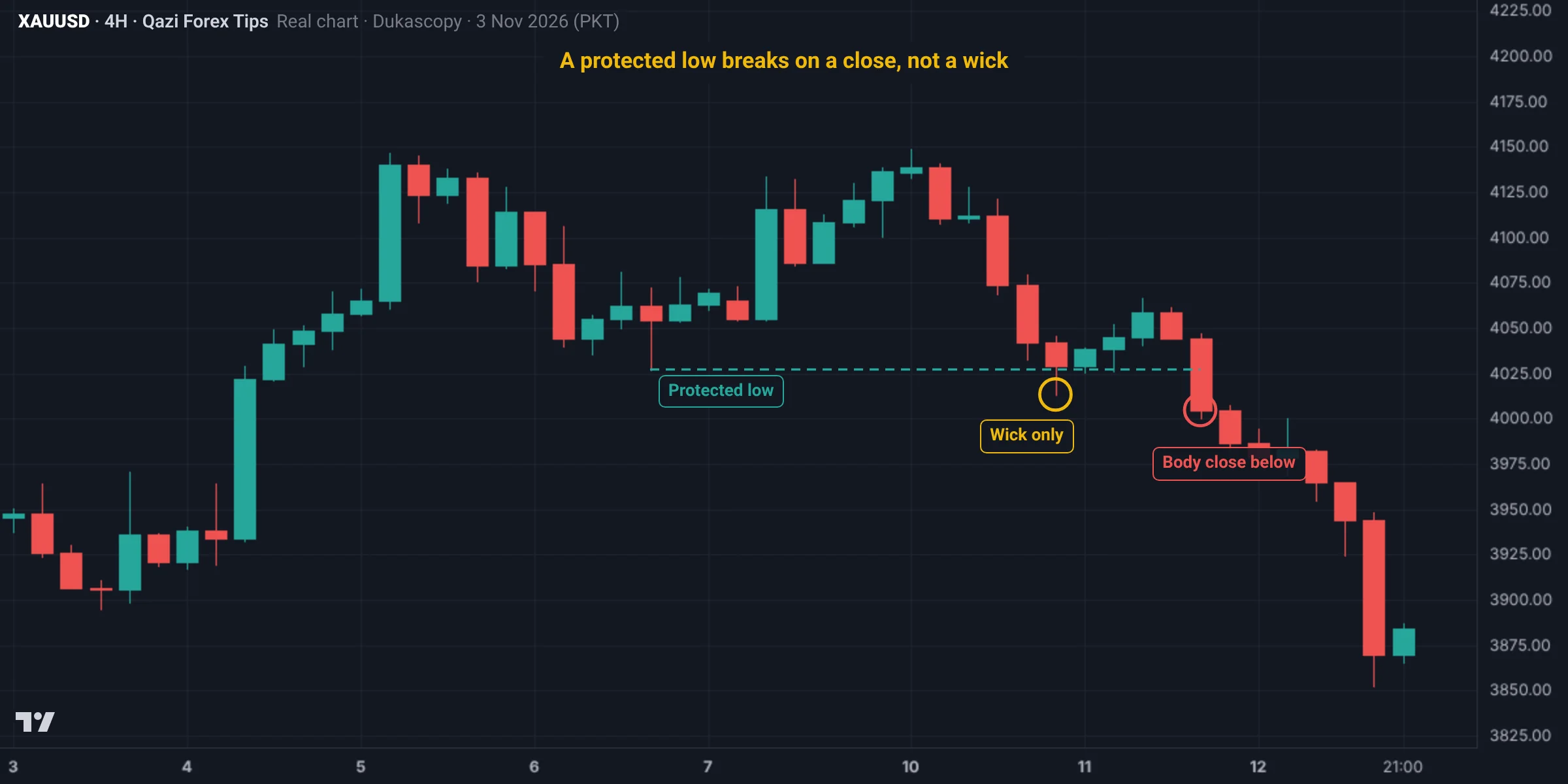
- The low at 4,027.2 on 6 Nov was the HL that produced the HH at 4,148.6 on 10 Nov. That was the protected low.
- Late on 10 Nov an H4 wick reached 4,013.4, but the candle closed above. A wick does not break a protected low.
- The 17:00 H4 candle on 11 Nov closed at 4,004.8: now the protected low really broke and the H4 bias turned bearish. Price reached 3,852 the next day.
Second example: a protected high (29 Oct to 5 Nov)
Gold H4 from 21 Oct to 5 Nov 2026 (data: Dukascopy, bid price; Pakistan time). The first example was a protected low; this is a protected high:
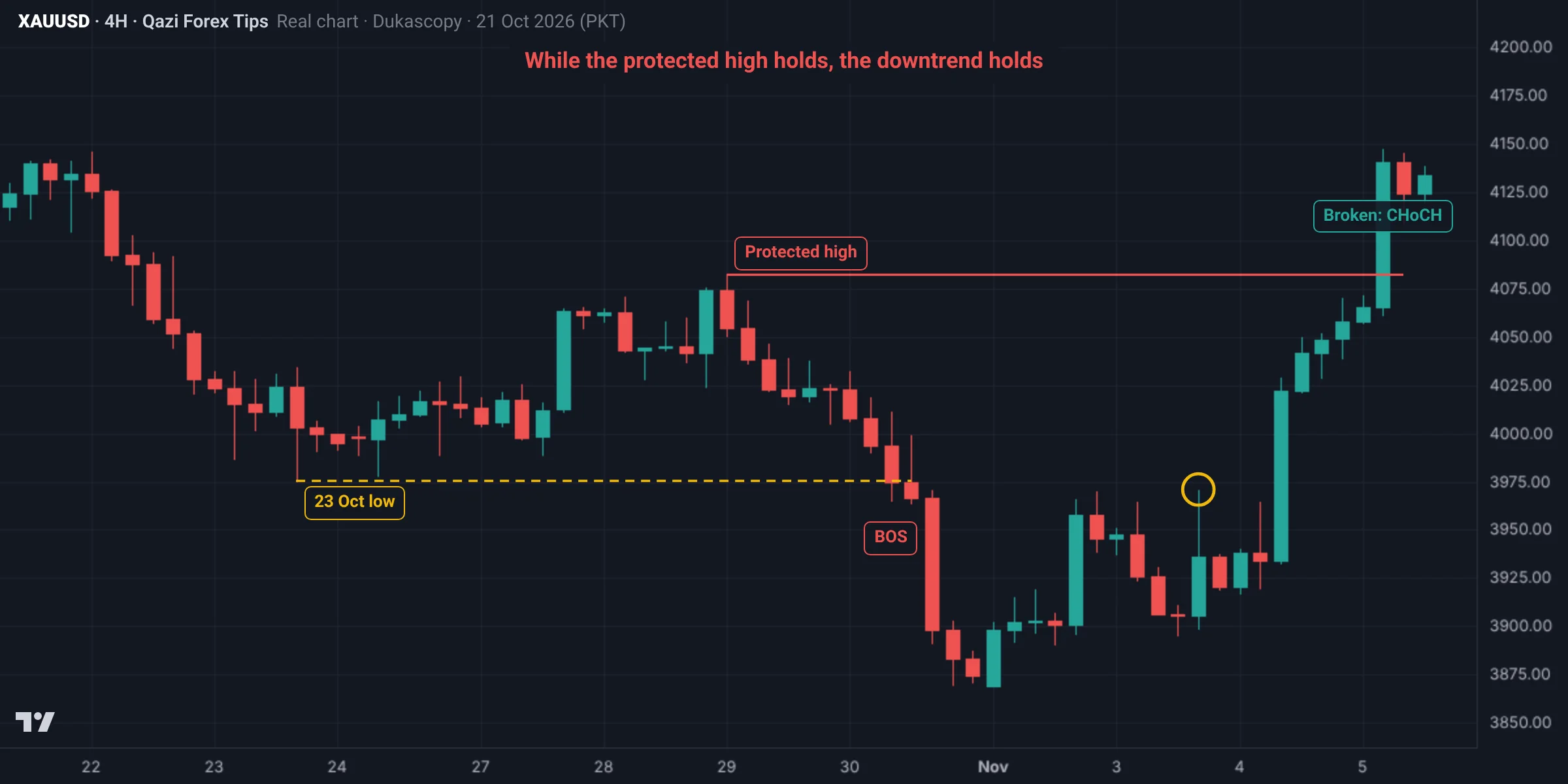
- A high formed at 4,082.0 at 01:00 on 29 Oct. The move from there broke the 23 Oct low at 3,975.3 (30 Oct 2026, H4 close 3,974.9): a bearish BOS. So 4,082.0 became the protected high.
- On 2 and 3 Nov price came back up to 3,970.9 but stayed below the protected high: only a pullback, the downtrend held.
- On 5 Nov 2026 an H4 candle closed at 4,140.1, above the protected high: a CHoCH, and the downtrend was over.
A sell's stop loss logically goes above the protected high, because its break is what proves the idea wrong.
Common mistakes
Summary
- The protected low is the uptrend's last wall; its break by a body close is a CHoCH.
- Find it at the start of the BOS move and move it with every new BOS.
- The logical stop for a swing trade sits behind the protected low.
Spot it on the chart: practice
This is a real Gold chart (Dukascopy data, Pakistan time). Study it and pick an answer. After you answer, the fully marked chart and the explanation appear.
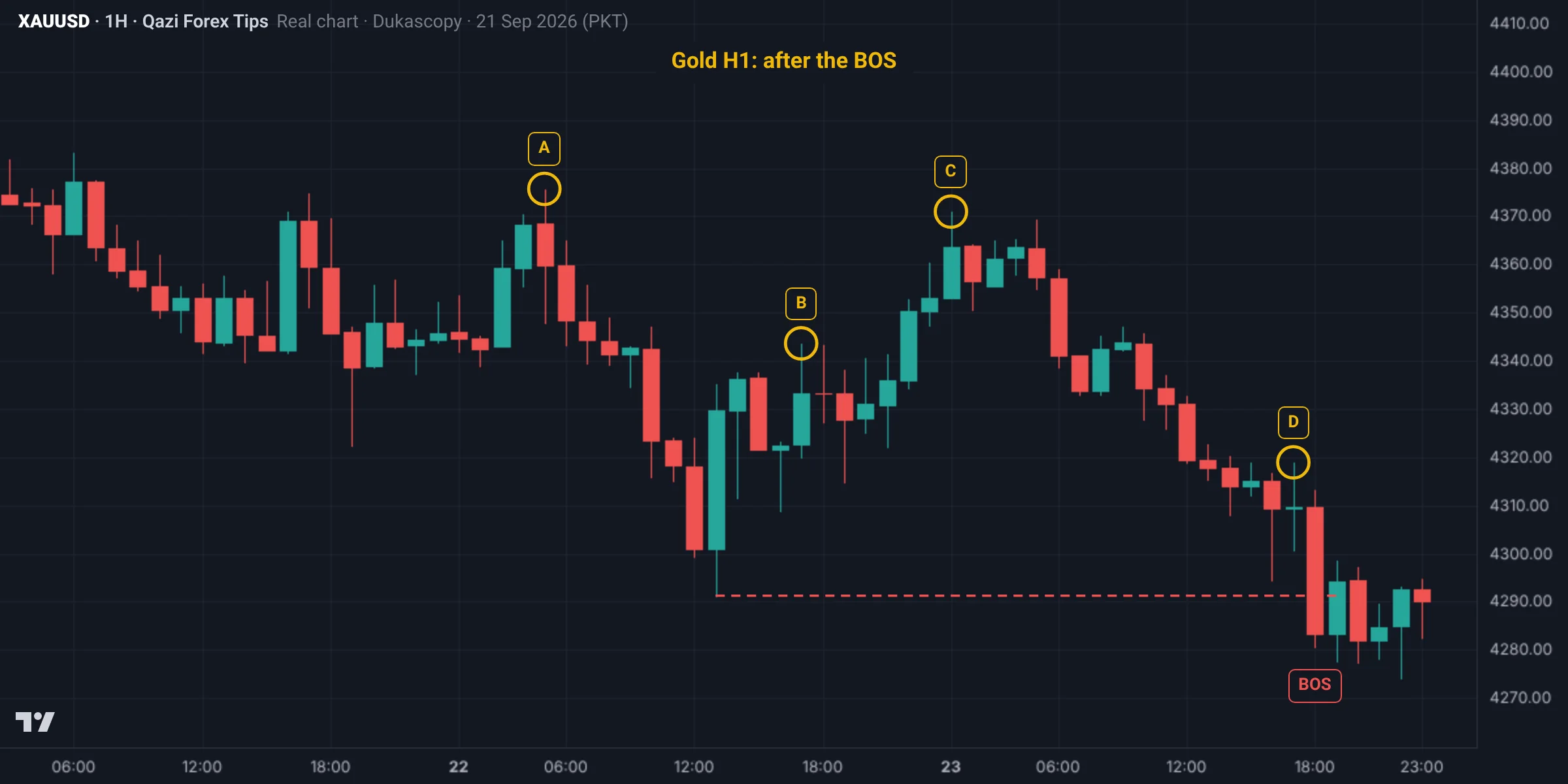
The 18:00 candle on 23 Sep closed below 4,291.2 (a BOS). Which is the protected high now?
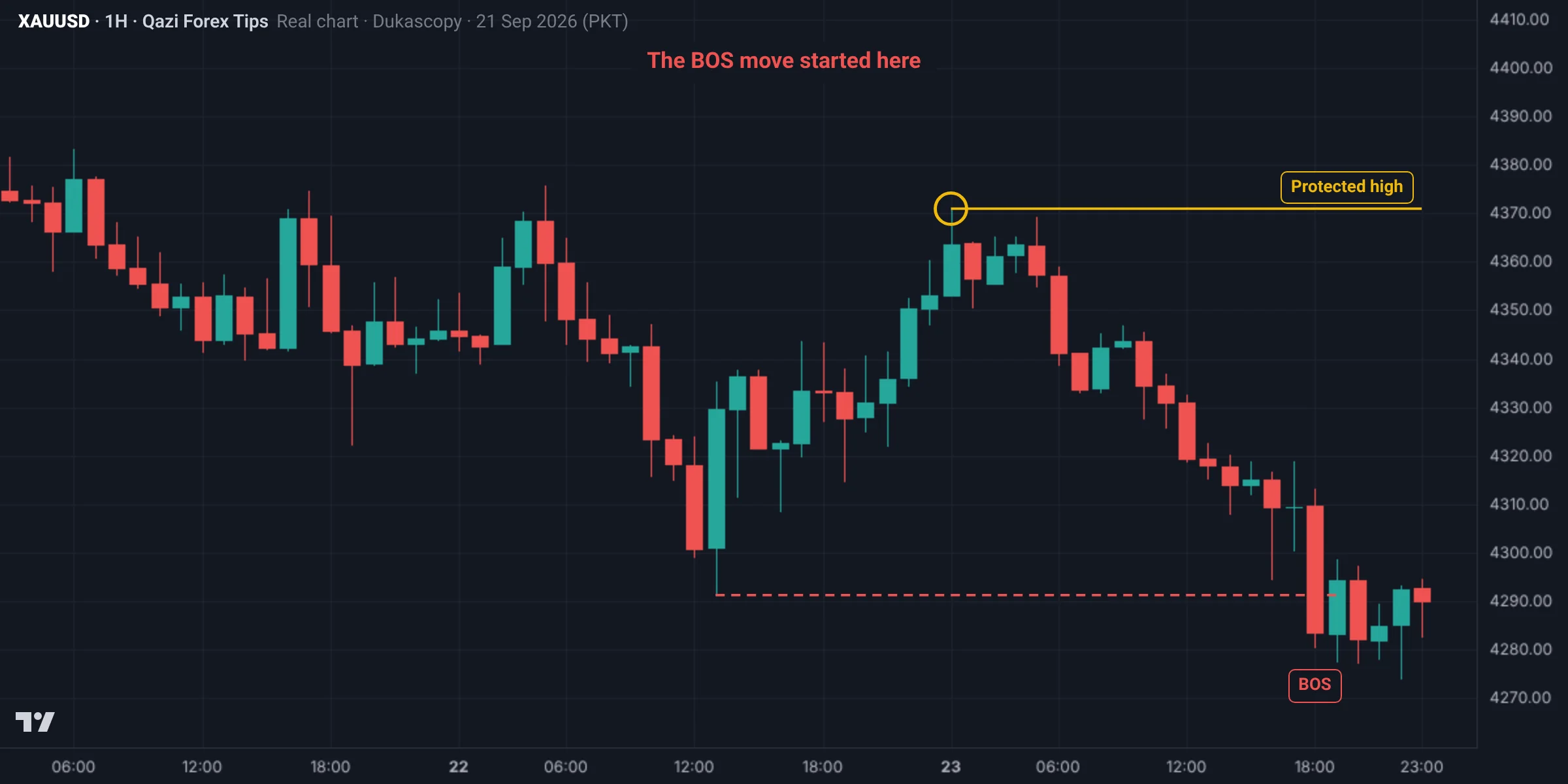
C (4,371.0, 00:00 on 23 Sep) is the high where the BOS move began, so it is the protected high. A is an older LH now left behind, B is an internal pullback high, and D is only a small pause. A close above C ends the downtrend idea.
The marked chart
Test yourself: Lesson 1.5 quiz
9 questions. Pick one answer for each and you will see at once whether it is right and why. Your score and grade appear at the end. You need 70% to pass.
0 correct · 0 / 9
Question 1In an uptrend, which is the protected low?
Buyers are defending that place; in a downtrend the reverse: the protected high.
Question 2If the protected low breaks on a body close, what is it?
The protected low is the uptrend's last wall; when it breaks the bias turns neutral, then bearish after confirmation.
Question 3When does the protected low move up?
After a new BOS the old protected low is just an old level.
Question 4What is the valid pullback rule (in an uptrend)?
This stops every small pause being treated as a swing; only places where some liquidity was taken count.
Question 5Two or three candles pause sideways but no low breaks. What do you do?
A valid pullback needs the previous candle's low to be taken.
Question 6Where is the most logical SL for a swing trade?
If the protected low breaks, the buy idea is wrong.
Question 7The protected low is very far and the RR doesn't work. What do you do?
For intraday trades the SL goes below the lower timeframe's protected low.
Question 8Gold H1: a BOS move from 4,121, a pullback to 4,133, then a new BOS above 4,149. What is the protected low now?
The new BOS move started at 4,133, so the line moves there.
Question 9A small wick goes below the protected low but the body closes above. Has it broken?
Treating a wick sweep as a break is a mistake.
Lesson checklist
Tick each point once you understand it. Your ticks are saved in this browser.
Assignment
- Find one long uptrend and one long downtrend on the Gold H4 chart.
- After each BOS, mark the protected low (or high) as it moves, and colour the old ones grey.
- See where each trend ended: was it when the last protected low or high broke?
- Apply the valid pullback rule to 10 pullbacks on H1 and write how many were valid.
- Take an uptrend on Gold H1, show the protected low line moving with each BOS, and write CHoCH where it breaks.
Post your assignment screenshots with your reasons in our free Facebook group, where your charts will be checked.
Join the free group
Who wrote this lesson
Dr. Qazi Abdul Basit, Ph.D
Ph.D in Business Administration and a forex and Gold trader since 2013. Founder of Qazi Forex Tips, which teaches traders in Pakistan and India price action, risk management and trading psychology in their own language: 65 student batches so far, free courses on YouTube, and MT5 tools for traders (QFT Replay Simulator, QFT Trade Assistant).
- 2013 trading since
- 75K+ Facebook group members
- 65 student batches
- 15K+ YouTube subscribers
How this lesson was made: the content follows Dr. Qazi's teaching method and years of trading. Real charts are built from Dukascopy Gold (XAUUSD) data, and backtest results are shown as they came out, even when negative. We do not sell signals, manage accounts or take money from any broker. Last updated: 19 November 2026.
Questions
What is a protected low in SMC?
In an uptrend, the low from which the move that broke the previous high began; bias stays bullish until it breaks by a body close.
What is a valid pullback?
A pullback whose candle sweeps the previous candle's low (in an uptrend) or high (in a downtrend).
When does the protected low move?
After every new bullish BOS, to the low that started that BOS move.
What happens if the protected low breaks?
That is a CHoCH, the first sign of a trend change, and a reason to avoid bullish trades.
Where should the stop loss go on a swing trade?
Often below the protected low (or above the protected high), plus room for the spread.
Is a protected high the same idea?
Yes, it is the downtrend version: the high where the bearish BOS move began.
What are a strong low and a weak high?
A strong low is the protected low that produced the BOS; its break changes the trend. A weak high is the high most likely to be taken, because the trend points that way.
What is a protected high?
In a downtrend, the swing high that produced the BOS down. While it holds the downtrend holds; a sell's stop usually goes above it.
Read more
Education only, not financial advice. Trading forex, Gold and CFDs carries a high risk of loss. SMC concepts describe tendencies, not guarantees. Lesson 9 of 38.