 Qazi Forex Tips

Why a journal?
- Memory lies: we remember winners and forget mistakes. The journal tells the truth.
- Mistake patterns: after 50 trades the journal shows where most of your losses come from: bad timing, weak POIs, early entries or oversized lots.
- Confidence: in a losing streak the journal reminds you that your system has recovered from streaks like this before.
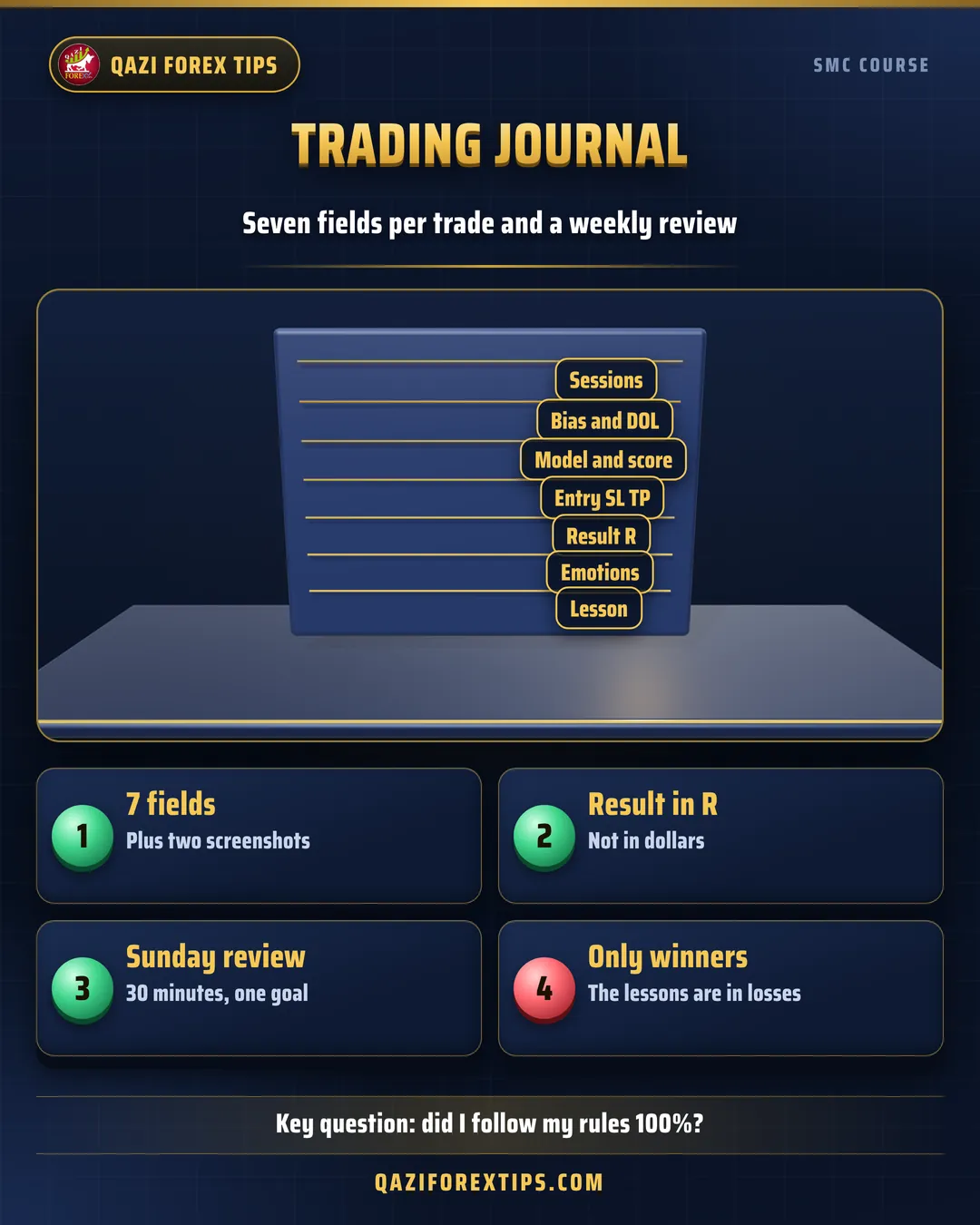
Seven fields per trade
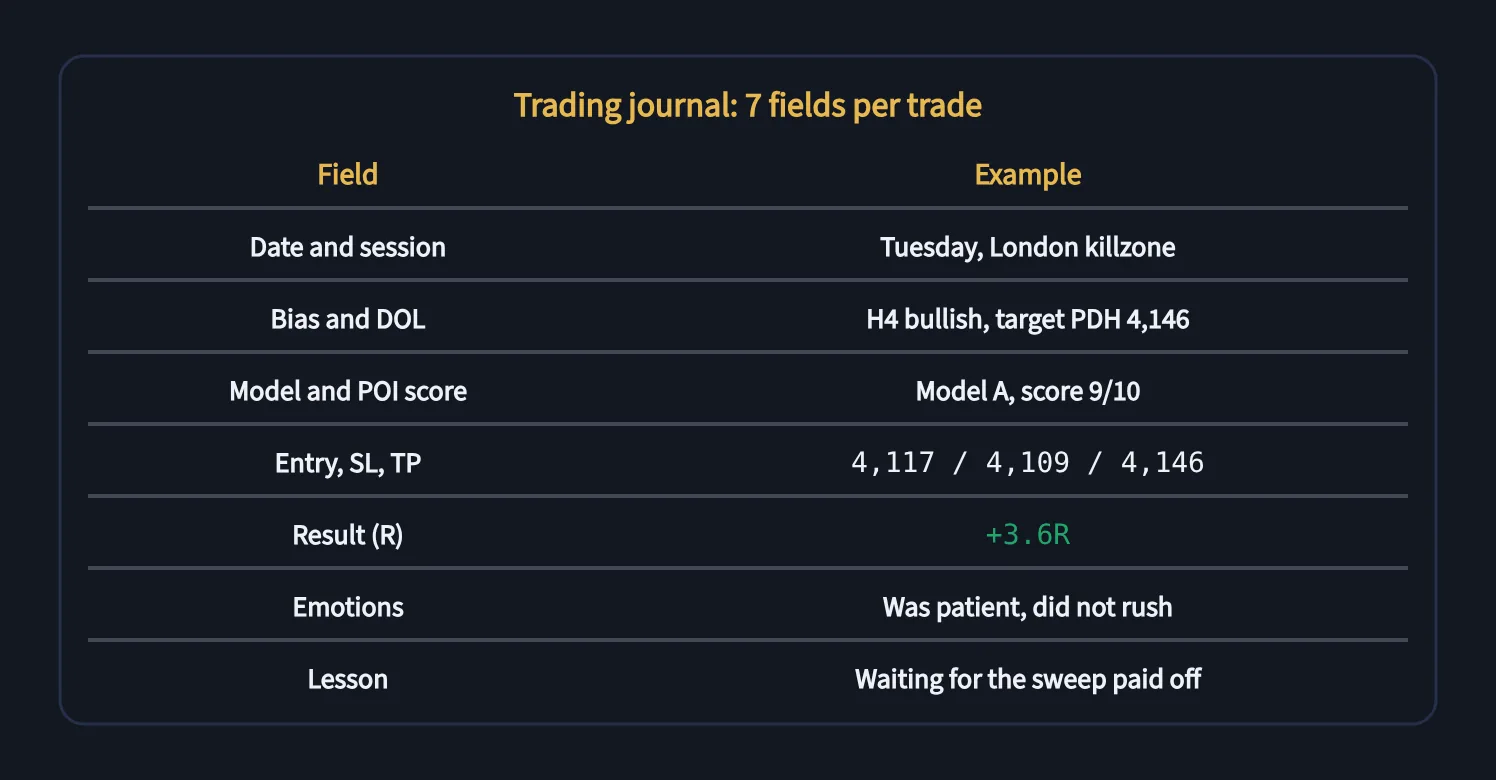
- Date and session: which day and which killzone.
- Bias and DOL: the higher timeframe bias and the target liquidity.
- Model and POI score: model A, B, C, D or E, and the scorecard number.
- Entry, SL, TP and lot: the numbers and the RR.
- Result in R: not dollars, R, so trades compare across account and lot sizes.
- Emotions: how you felt before and during the trade (calm, rushed, angry, bored).
- Lesson: one line: what went well, what could be better.
Plus two screenshots: at entry and after the close.
Which tool?
| Tool | Advantage | Disadvantage |
|---|---|---|
| QFT Trading Coach (our free MT5 journal) | Free; reads your MT5 history automatically, finds 9 trading mistakes and their cost, grades every trade, English and Urdu reports | MT5 only; you still note your entry reason and emotions yourself |
| Excel or Google Sheets | Free, custom fields, your own formulas | Screenshots kept separately |
| Paper notebook | Writing helps memory | Hard to calculate and filter |
| Journal software or website | Imports trades from MT5, charts | Often paid |
Our advice: if you trade on MT5, download the free QFT Trading Coach; it does the maths and finds your mistakes for you. Keep each trade's reason and screenshot in a small Google Sheet alongside it. More important than the tool is recording every trade, losers included.
Weekly review (Sunday, 30 minutes)
- Total R, win rate and average RR for the week.
- How many trades followed the rules? (Target: 90% or more)
- The single biggest mistake.
- One goal for next week, for example "no trades in the 30 minutes before news".
- Next week's news times in your time zone (lesson 4.4).
Find your most expensive mistake
After 50 trades, filter the journal:
| Filter | Question |
|---|---|
| Session | Which killzone is negative? |
| POI score | What is the result of trades scoring below 8? |
| Emotions | What about trades marked "rushed" or "angry"? |
| Rules | Total R of rule-breaking trades? |
| Day | Is one day (say Friday) consistently bad? |
Most traders find that most of their losses come from a few types of mistake, such as bored night trading or taking another trade right after a loss. Stopping one or two of these often changes the result.
Gold example: one month's review
24 trades in a month, total +5.2R:
- Following the rules: 18 trades, +11.4R.
- Breaking the rules: 6 trades (4 near news, 2 right after a loss), −6.2R.
- Result: with only rule-following trades the month would have been +11.4R, about 11% at 1% risk. Next month's goal: "No trades 30 minutes before news, and a one-hour break after a loss."
Real Gold chart examples
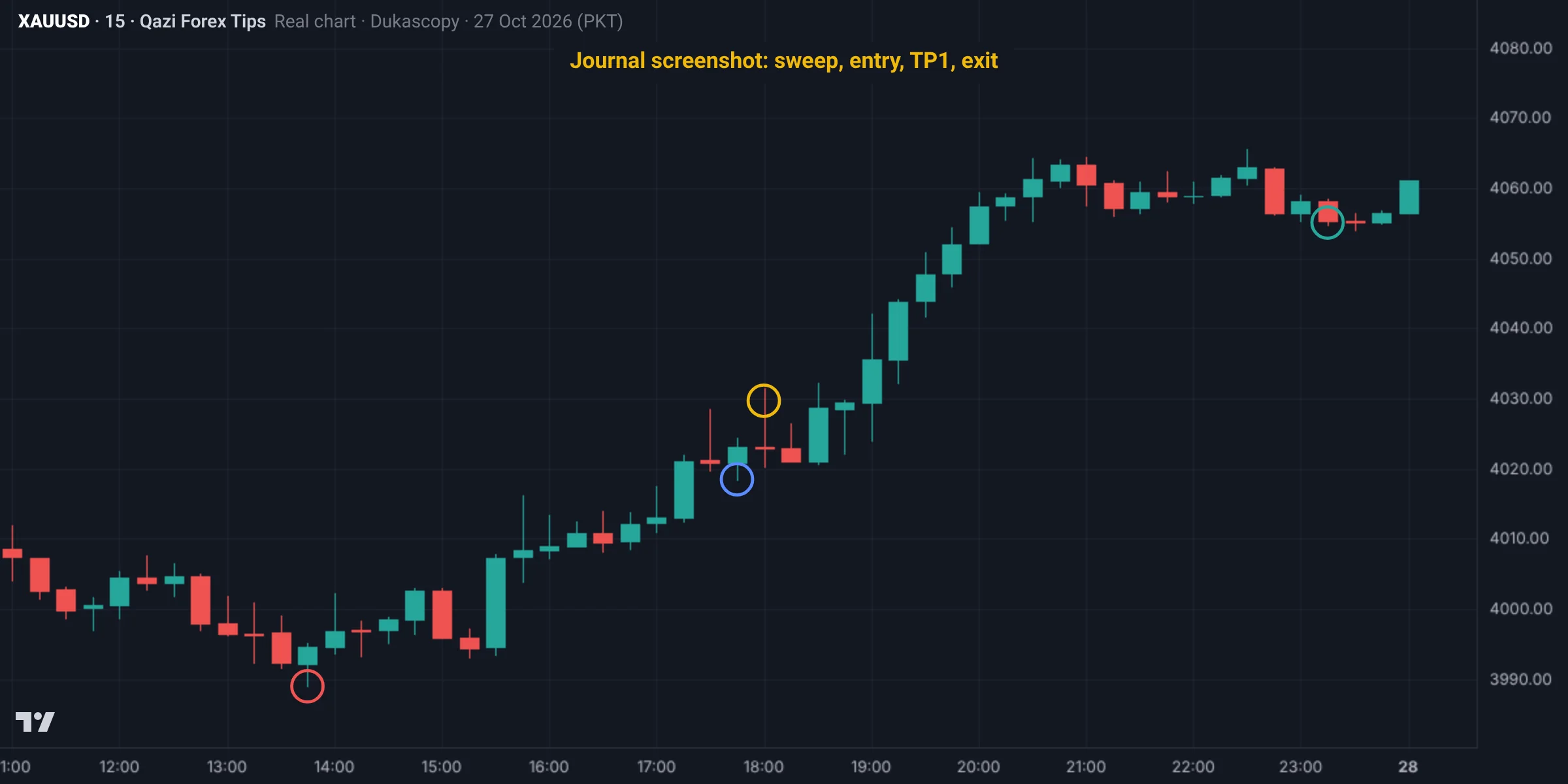
The journal entry for the 27 Oct 2026 model A trade (lessons 5.2 and 6.2), Gold M15 (data: Dukascopy, bid price; Pakistan time):
| Field | Entry |
|---|---|
| Date and session | Tuesday 27 Oct; sweep in the London killzone, entry in the New York killzone |
| Bias and DOL | H4 CRT (candle 2 swept the low); DOL first the PDH at 4,029.7 |
| Model and POI score | Model A; score 8/10 (HTF bias only from the CRT, no clear H4 trend) |
| Entry, SL, TP, lot | 4,019.9 / 4,009.5 / TP1 4,029.7 / 0.04 lot (1% of $5,000) |
| Result | +2.2R |
| Rules followed 100%? | Yes; did not chase when the first FVG was missed |
| Emotions | Restless after missing the first FVG, but waited |
| Lesson | The sweep was next to the PDL: two liquidity levels together give a stronger reaction |
Every trade should be logged like this, losers too, so patterns show up after 50 trades.
Second example: a winning trade, a broken rule (22 Oct)
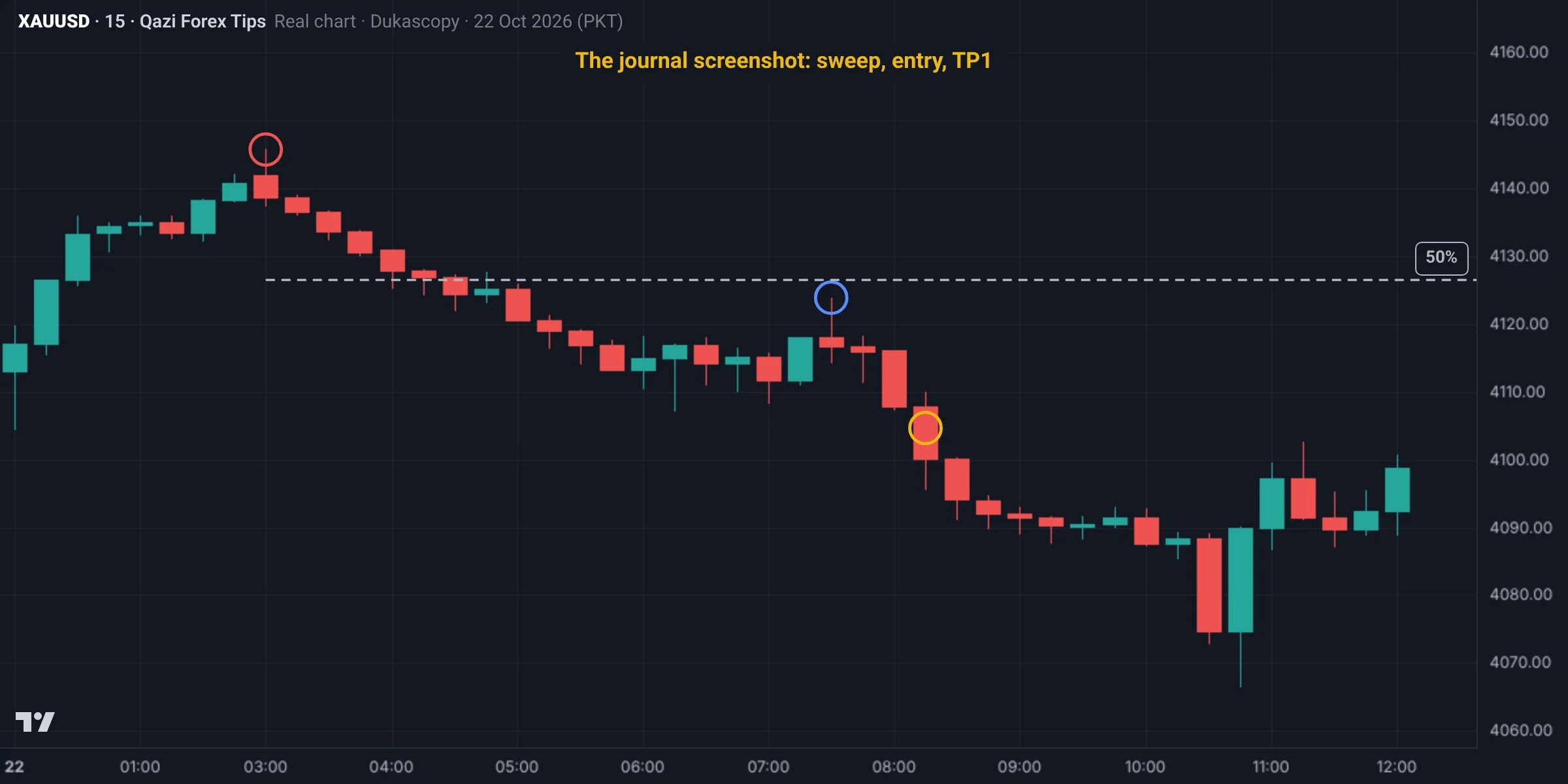
The journal entry for the 22 Oct 2026 model A sell (the second examples in lessons 5.2 and 6.2), Gold M15 (data: Dukascopy, bid price; Pakistan time):
| Field | Entry |
|---|---|
| Date and session | Thursday 22 Oct; sweep at 03:00, entry at 07:30 (Asian killzone) |
| Bias and DOL | H4 bearish (LH after LH); DOL the night low at 4,104.6 |
| Model and POI score | Model A; score 7/10 (entry below the 50% at 4,126.4, in discount) |
| Entry, SL, TP, lot | 4,121.2 / 4,128.5 / TP1 4,104.6 / 0.06 lot (1% of $5,000) |
| Result | +3.1R |
| Rules followed 100%? | No: a score of 7 means half risk; full risk was taken |
| Emotions | Restless after missing the first FVG; a "must take this one" rush |
| Lesson | The rule broke despite the win; half risk on a B setup |
This entry matters because the trade won but a rule was broken. By lesson 7.2 that is a bad trade; if it is not logged honestly, the same habit will cost full risk on tomorrow's losing trade.
Common mistakes
Summary
- Seven fields and two screenshots per trade; the key one: "100% rule adherence?"
- Record results in R.
- A 30-minute review every Sunday with one goal for the next week.
- After 50 trades, filter to find your most expensive mistake and stop it.
Free downloads
Print them or keep them on your phone. No sign-up, no email.
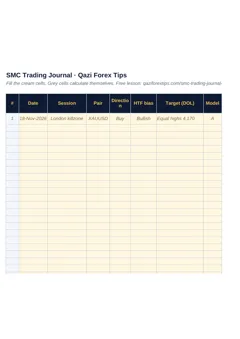
Trading Journal Sheet (Excel)
One row per trade with dropdowns and automatic maths: win rate, total R, expectancy, drawdown, results by session and emotion, weekly review. Works in Excel and Google Sheets.
Free downloadاردو میںTry this lesson on your own chart
Qazi Forex Tips' own tools that make this lesson easier. A tool helps; your rules make the decision.
QFT Trading Coach (journal)
100% free · MT5Reads your MT5 history automatically, finds 9 trading mistakes and what each one cost, grades every trade and saves English and Urdu reports.
Details and downloadSpot it on the chart: practice
This is a real Gold chart (Dukascopy data, Pakistan time). Study it and pick an answer. After you answer, the fully marked chart and the explanation appear.
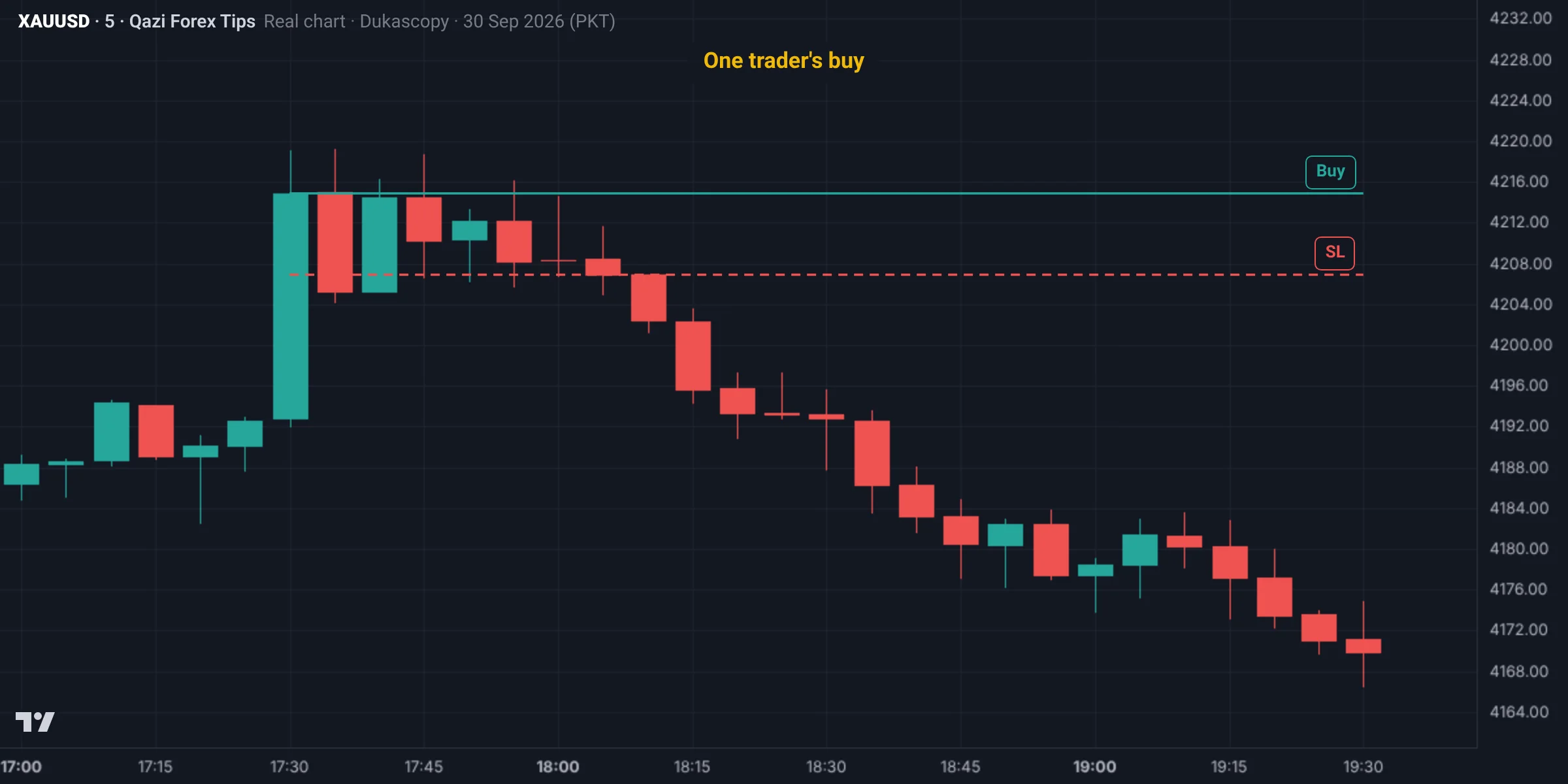
A trader bought at 4,214.9 on the 17:30 candle on 30 Sep (the 8:30 New York release), SL 4,206.9. How should this trade go in the journal?
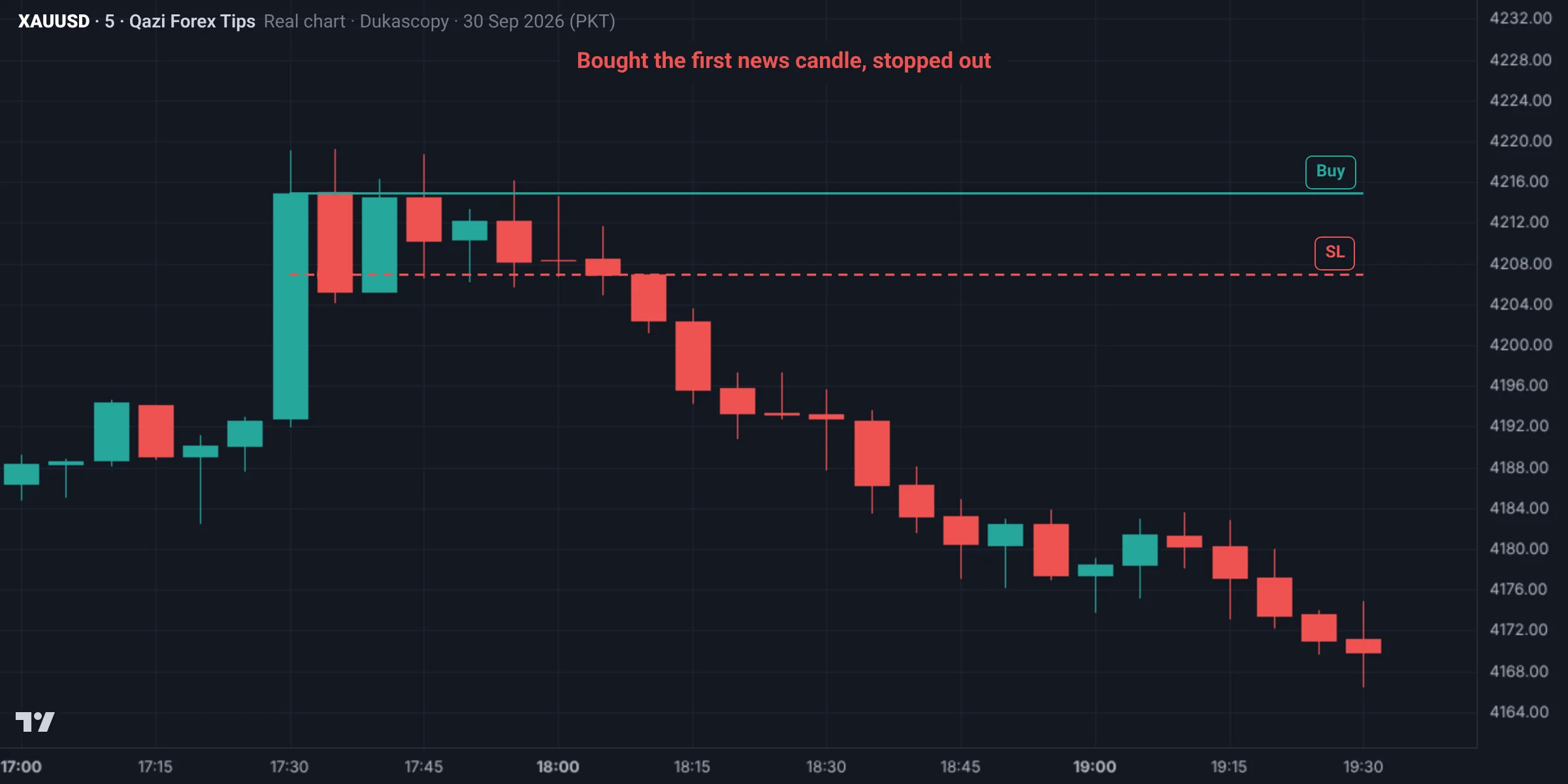
Price hit the SL at 17:35: the result is −1R. The journal's most important field, "were the rules followed 100%?", gets a "no" here: no trades from 30 minutes before to 15 minutes after news, and the entry had no sweep, CHoCH or POI. Writing a rule-breaking loss off as "bad luck" hides the real lesson.
The marked chart
Test yourself: Lesson 7.2 quiz
8 questions. Pick one answer for each and you will see at once whether it is right and why. Your score and grade appear at the end. You need 70% to pass.
0 correct · 0 / 8
Question 1Why is a journal necessary?
In a losing streak it reminds you the system has recovered before.
Question 2Why record results in R rather than dollars?
With changing lots, dollar comparisons are wrong.
Question 3What is the most important journal field?
A losing trade that followed the rules is good; a winning trade that broke them is bad.
Question 4How many screenshots per trade?
Seven fields: date/session, bias/DOL, model/score, entry/SL/TP/lot, R, emotions, lesson.
Question 5In the weekly review, what is the rule-following target?
Sunday, 30 minutes: total R, rules, biggest mistake, one goal for next week, news times.
Question 6After 50 trades, what do traders usually find?
Stopping one or two such mistakes often changes the result.
Question 7One month: 24 trades, +5.2R; 18 rule-following trades +11.4R, 6 rule-breaking trades −6.2R. The lesson?
Next month's goal: no trades 30 minutes before news, and a one-hour break after a loss.
Question 8What about writing a journal and never reading it?
Recording only winners is also a mistake; the biggest lessons are in the losers.
Lesson checklist
Tick each point once you understand it. Your ticks are saved in this browser.
Assignment
- Build a seven-field journal in Google Sheets, plus a "rules followed" field.
- Enter your last 20 trades (or backtest).
- Calculate the total R of rule-following and rule-breaking trades separately.
- Filter by session and POI score.
- Post your most expensive mistake and next week's goal in the group.
Post your assignment screenshots with your reasons in our free Facebook group, where your charts will be checked.
Join the free group
Who wrote this lesson
Dr. Qazi Abdul Basit, Ph.D
Ph.D in Business Administration and a forex and Gold trader since 2013. Founder of Qazi Forex Tips, which teaches traders in Pakistan and India price action, risk management and trading psychology in their own language: 65 student batches so far, free courses on YouTube, and MT5 tools for traders (QFT Replay Simulator, QFT Trade Assistant).
- 2013 trading since
- 75K+ Facebook group members
- 65 student batches
- 15K+ YouTube subscribers
How this lesson was made: the content follows Dr. Qazi's teaching method and years of trading. Real charts are built from Dukascopy Gold (XAUUSD) data, and backtest results are shown as they came out, even when negative. We do not sell signals, manage accounts or take money from any broker. Last updated: 19 November 2026.
Questions
What should a trading journal include?
Date and session, bias and draw on liquidity, model and POI score, entry, stop, target and lot, result in R, emotions, a lesson, and before and after screenshots.
Why record results in R?
R makes trades comparable regardless of account size and lot size.
How often should I review my journal?
Every week, for example 30 minutes on Sunday, plus a detailed filter every 50 trades.
Where can I get a free trading journal?
There are two free options on this page: our Excel journal sheet (it does the maths) and QFT Trading Coach for MT5, which reads your history and finds your mistakes.
Can I keep the journal in Google Sheets?
Yes, open our Excel sheet in Google Sheets with File > Import; the formulas and dropdowns work there too.
Read more
Education only, not financial advice. Trading forex, Gold and CFDs carries a high risk of loss. SMC concepts describe tendencies, not guarantees. Lesson 36 of 38.