 Qazi Forex Tips

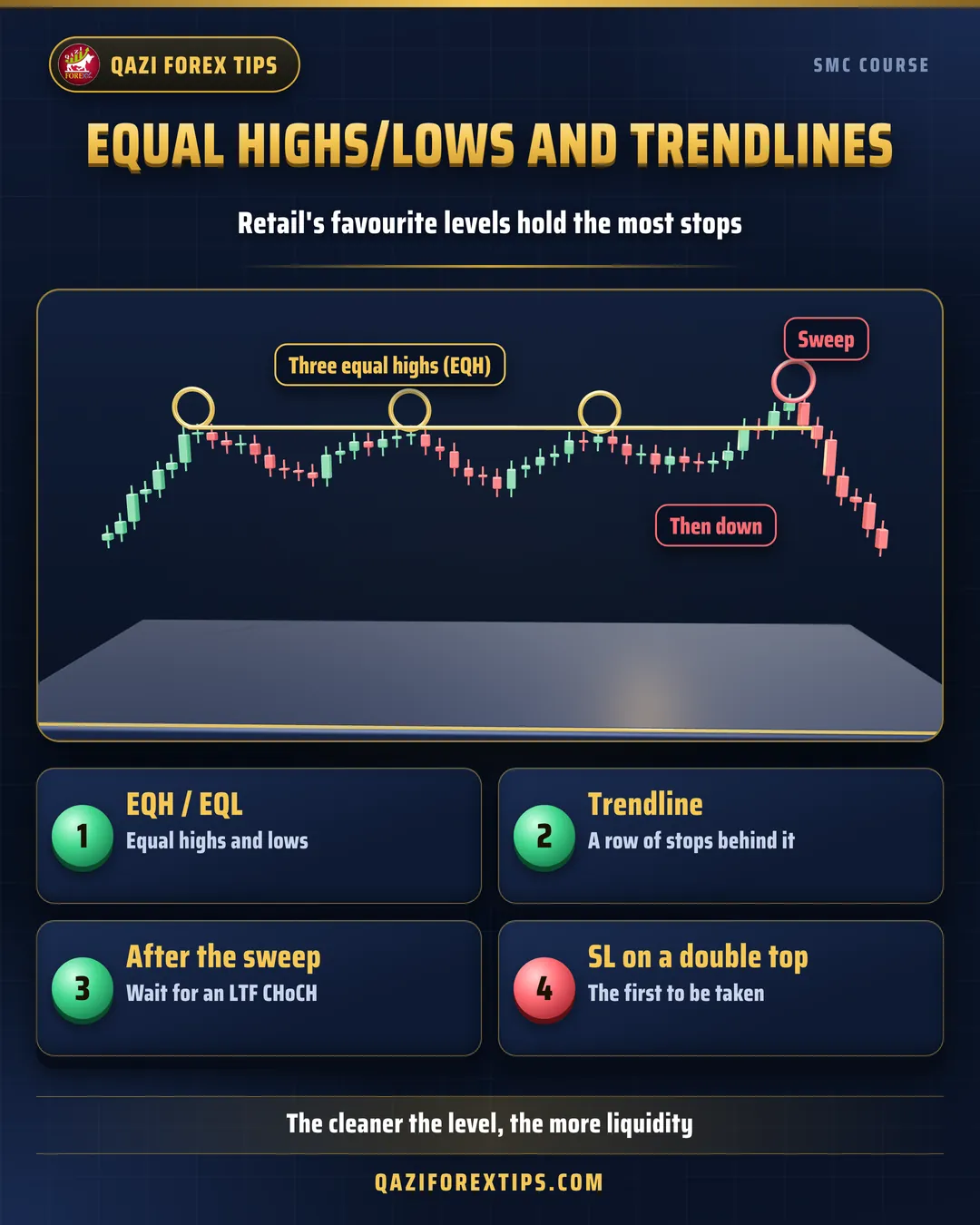
Why are these levels so special?
In the previous lesson you learned that the more traders can see a level, the more liquidity sits behind it. Equal highs, equal lows and clean trendlines are the most visible levels on a chart. Retail traders treat them as strong support and resistance, trade right there and place their stops just behind them. The result is a huge pile of stops, and in SMC terms this is the cleanest liquidity there is.
What are equal highs and equal lows?
- EQH (Equal Highs): two or more highs at almost the same price.
- EQL (Equal Lows): two or more lows at almost the same price.
Classic price action calls them a double top / double bottom or strong resistance / support. Retail sells or buys there with a stop just above or below.
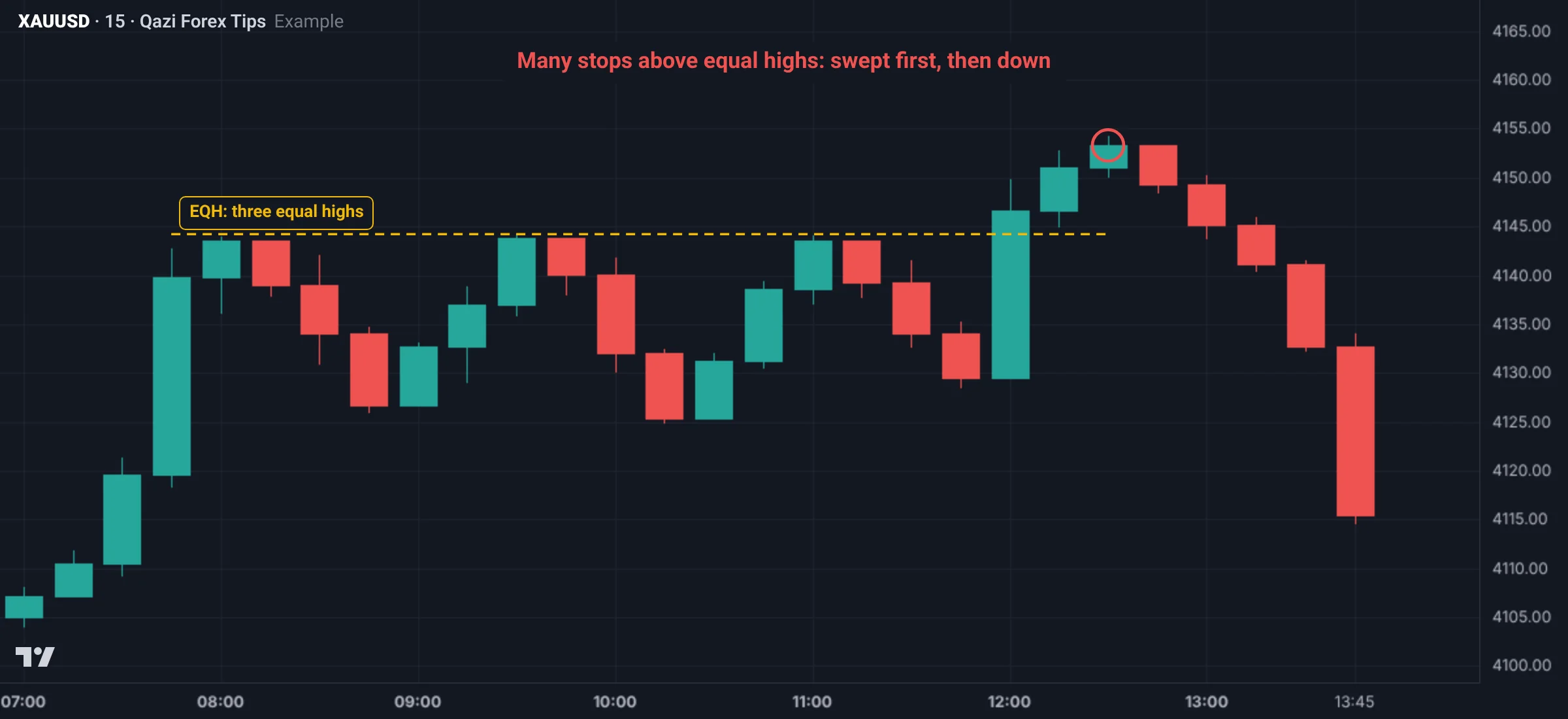
How liquidity grows with every touch
- First touch: price makes a high. Some traders sell there with a stop above.
- Second touch: price stops at the same place again. More traders call it a double top and sell, and more stops gather above.
- Third touch: now everyone sees the level. Breakout traders place buy stops above it.
- The sweep: price trades above the level, all those buy orders fire at once, the big seller fills its sell, and price comes back down.
That is why traders say: a very clean double top often breaks first and only then works.
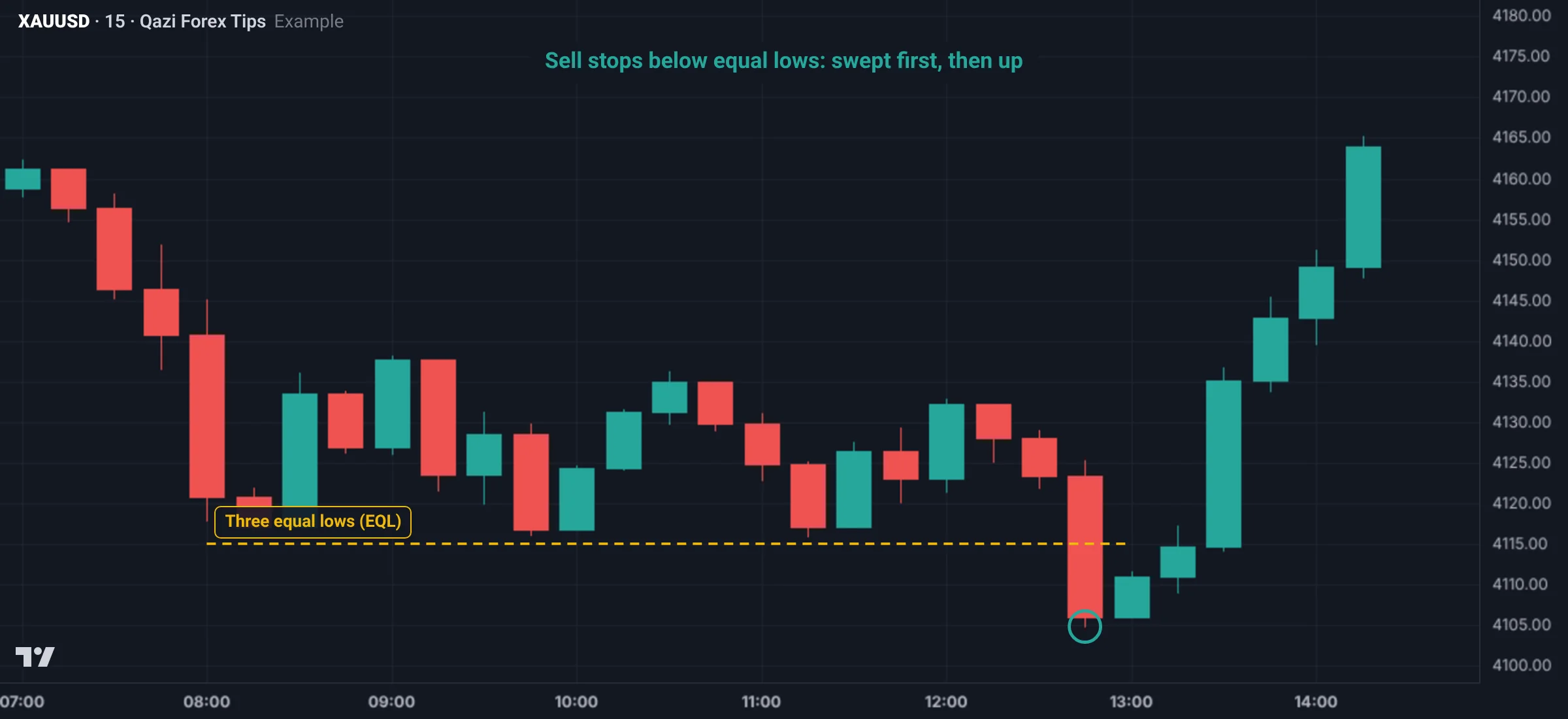
Equal lows: the mirror image
Below equal lows sit buyers' stops and sell stops. In a bullish bias this is one of the best places to buy: price sweeps below, then a lower timeframe CHoCH appears.
How equal is equal?
They don't need to be the exact same price. On Gold H1 a difference of 1 to 2 dollars, and on EURUSD 2 to 3 pips, still counts as equal. The real question is: does an ordinary trader see this as one clear level? If yes, there is liquidity there.
- On higher timeframes a bigger gap is fine (3 to 4 dollars on Gold H4).
- On lower timeframes, a smaller one (up to 0.5 dollars on M5).
Trendline liquidity
When a trend bounces three or four times off a very clean trendline, many traders buy on the line and put their stop just below it. Those stops line up in one long row, because the trendline keeps rising.
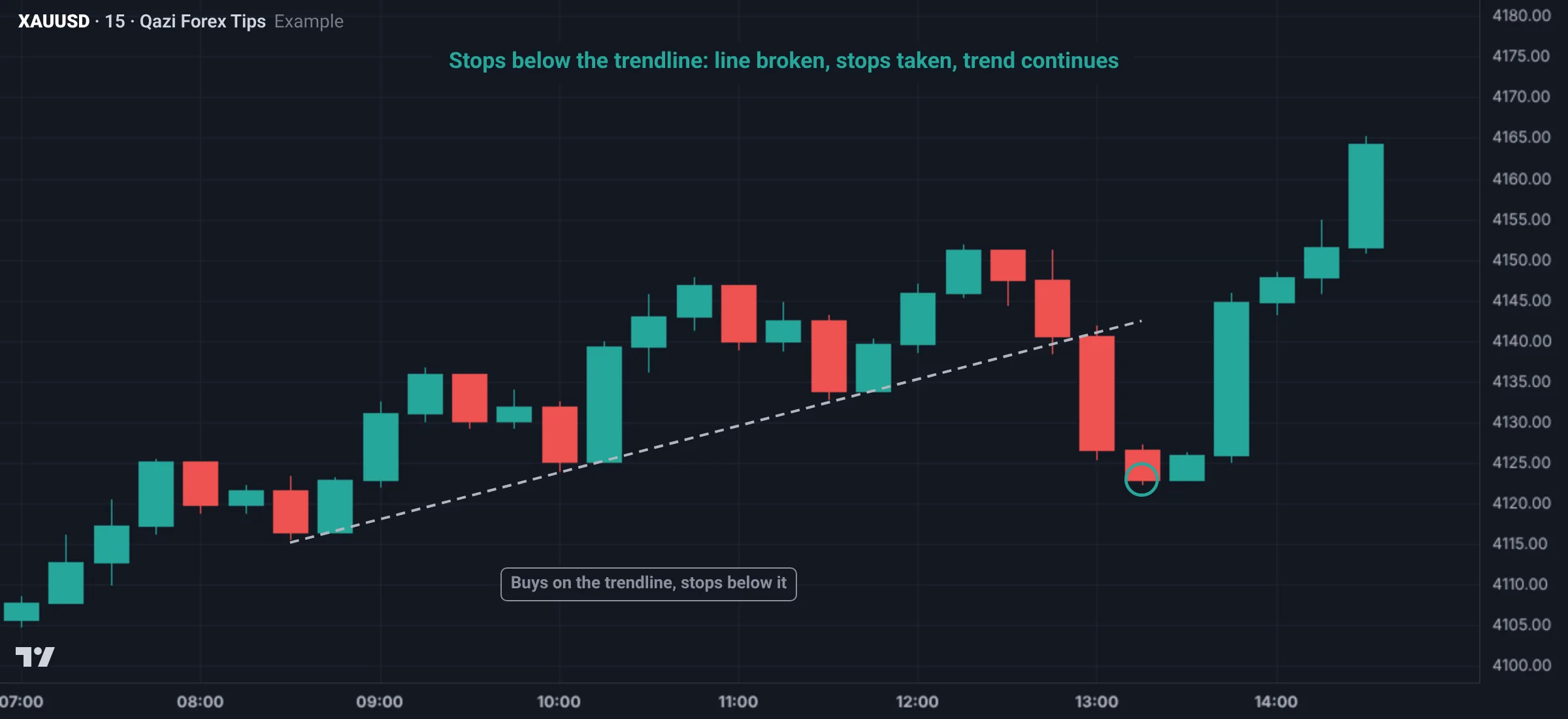
Many retail traders treat a trendline break as "trend over" and sell. An SMC trader checks whether the structure (the protected low) broke, or only the line. If only the line broke and structure holds, it is usually a liquidity sweep.
How to trade them
| What retail does | What an SMC trader does |
|---|---|
| Sells the double top, stop above the top | Waits for a sweep above the top, then a bearish CHoCH on a lower timeframe |
| Buys the trendline, stop below the line | Waits for a sweep below the line, then a bullish CHoCH on a lower timeframe |
| Sells when equal lows break | Checks whether it is a break or a sweep (lesson 2.4) |
- Mark EQH, EQL and clean trendlines on your chart.
- Check the higher timeframe bias: in a bullish bias, EQL and trendlines below are sweep opportunities and EQH above are targets.
- Treat them both as possible targets and possible sweep zones.
- After a sweep, do not enter without a lower timeframe CHoCH.
- If there is no sweep but a strong-body break and retest, think in the direction of the break.
- Stop behind the sweep wick; target the next opposite liquidity.
A Gold example
Suppose Gold on M15 made three highs at 4,138.50, 4,139.20 and 4,138.80, and the H1 bias is bearish.
- These highs are almost equal: an EQH, with BSL above it.
- In London, price reaches 4,142.30 and the M15 candle closes at 4,137.90: a sweep.
- On M5 the last HL breaks: a bearish CHoCH.
- Sell on the pullback near 4,138.00, stop at 4,143.50 (above the wick), target the SSL below at 4,126.00. That is 5.5 dollars of risk for 12 dollars of target, about 1:2.
Real Gold chart examples
Gold M15 on 23 Oct 2026 (data: Dukascopy, bid price; Pakistan time):
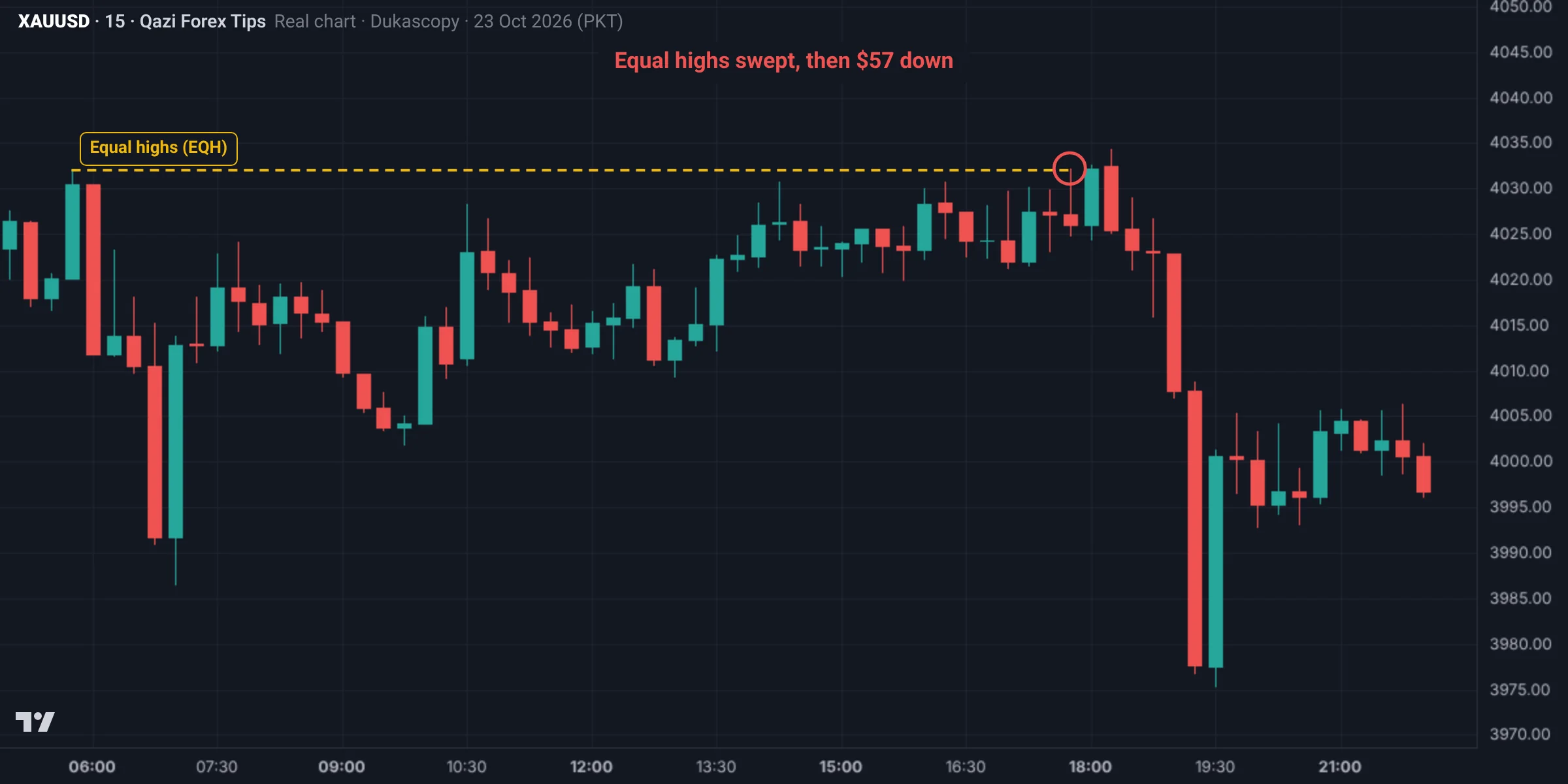
- The 05:45 high at 4,032.0 and the 14:15 high at 4,030.8 were almost equal (a $1.2 difference). Price stopping twice at the same place means many sellers put stops just above, and breakout traders put buy stops there.
- At 17:45 price reached 4,032.2, just above both highs: the liquidity was taken, and the candle closed back below.
- Gold then fell quickly to 3,975.3, about $57. Traders who bought the breakout were trapped.
Second example: a sweep of equal lows (22 Oct)
The first example was equal highs; these are equal lows. Gold H1 on 21 and 22 Oct 2026 (data: Dukascopy, bid price; Pakistan time):
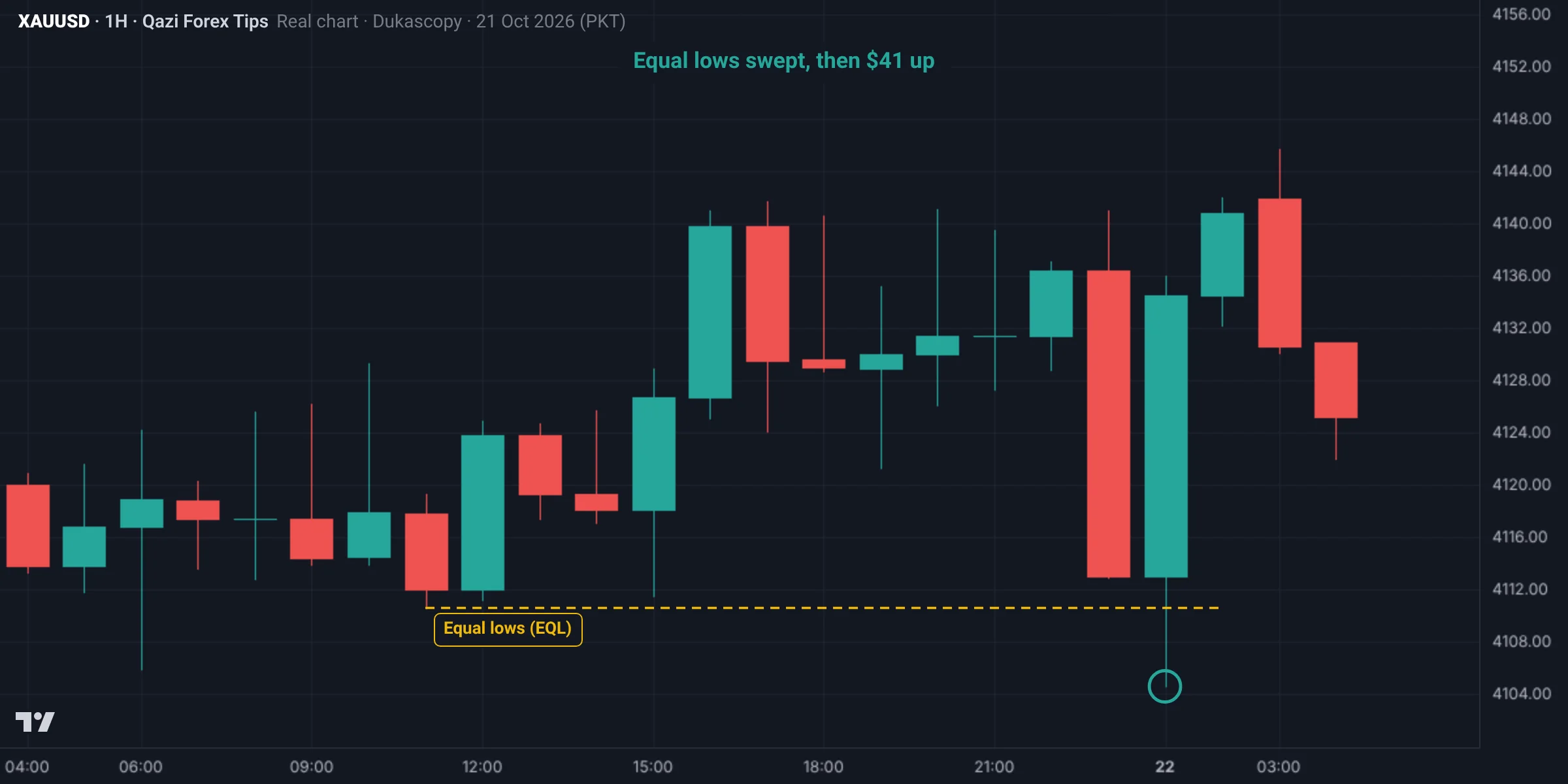
- On 21 Oct price stopped three times at almost the same level: 4,110.6 (11:00), 4,111.3 (12:00) and 4,111.5 (15:00), within $0.9. Buyers put stops below, breakout sellers put sell stops there.
- The 00:00 candle on 22 Oct reached 4,104.6, below the equal lows, took the liquidity and closed back up at 4,134.5.
- By 03:00 price was at 4,145.6: breakout sellers were trapped.
Note: this sweep later became part of a bigger downtrend (the second example in lesson 0.1). A sweep of equal lows gives a reaction; the higher timeframe decides the trend.
Common mistakes
Summary
- EQH, EQL and clean trendlines are the most visible levels, so they hold the most stops.
- Liquidity grows with every touch.
- These levels are both targets and sweep zones.
- After a sweep wait for a lower timeframe CHoCH; after a break wait for the retest.
Spot it on the chart: practice
This is a real Gold chart (Dukascopy data, Pakistan time). Study it and pick an answer. After you answer, the fully marked chart and the explanation appear.
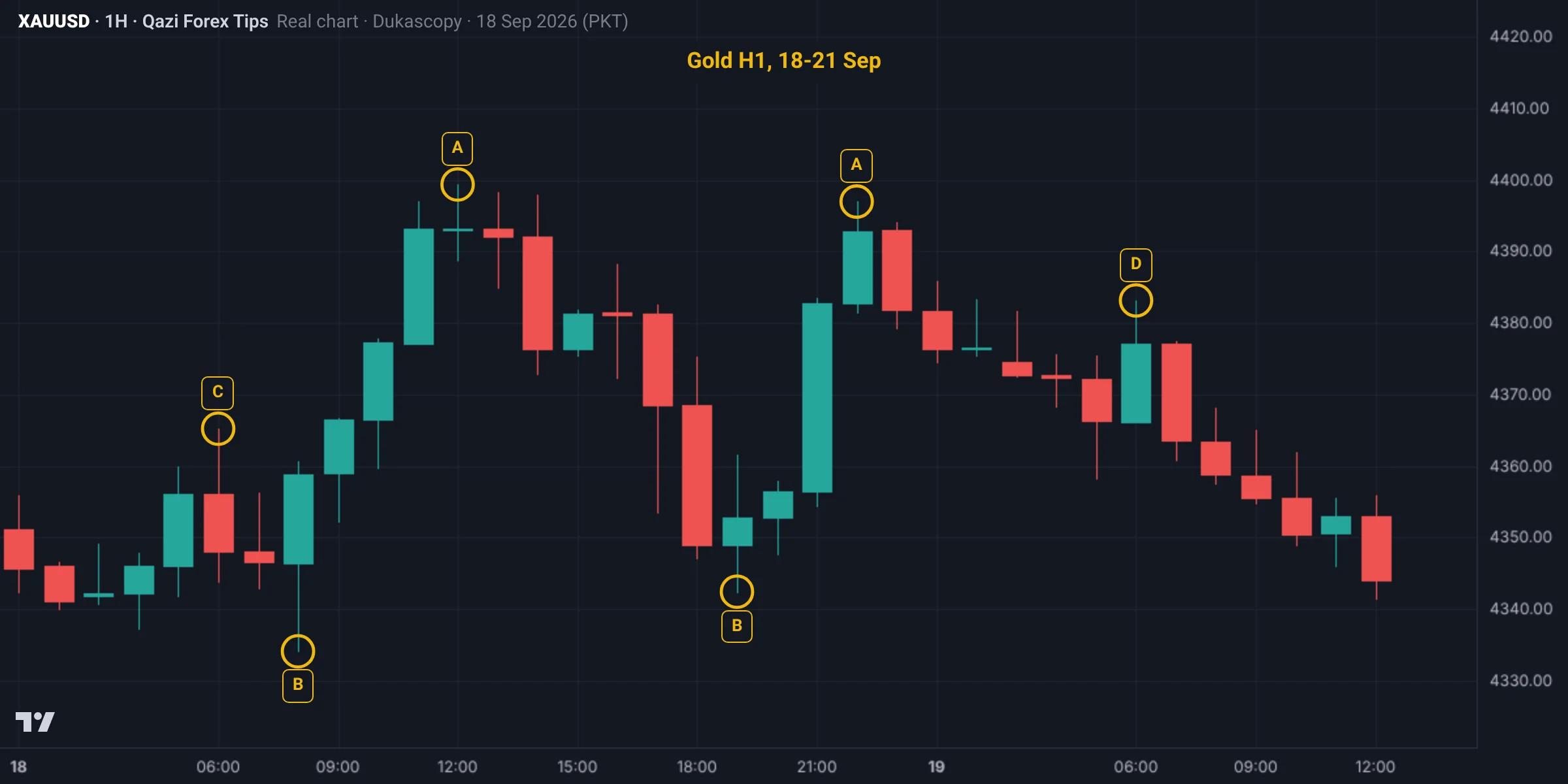
Which pair is an EQH (equal highs)? Two points with the same letter form one pair.
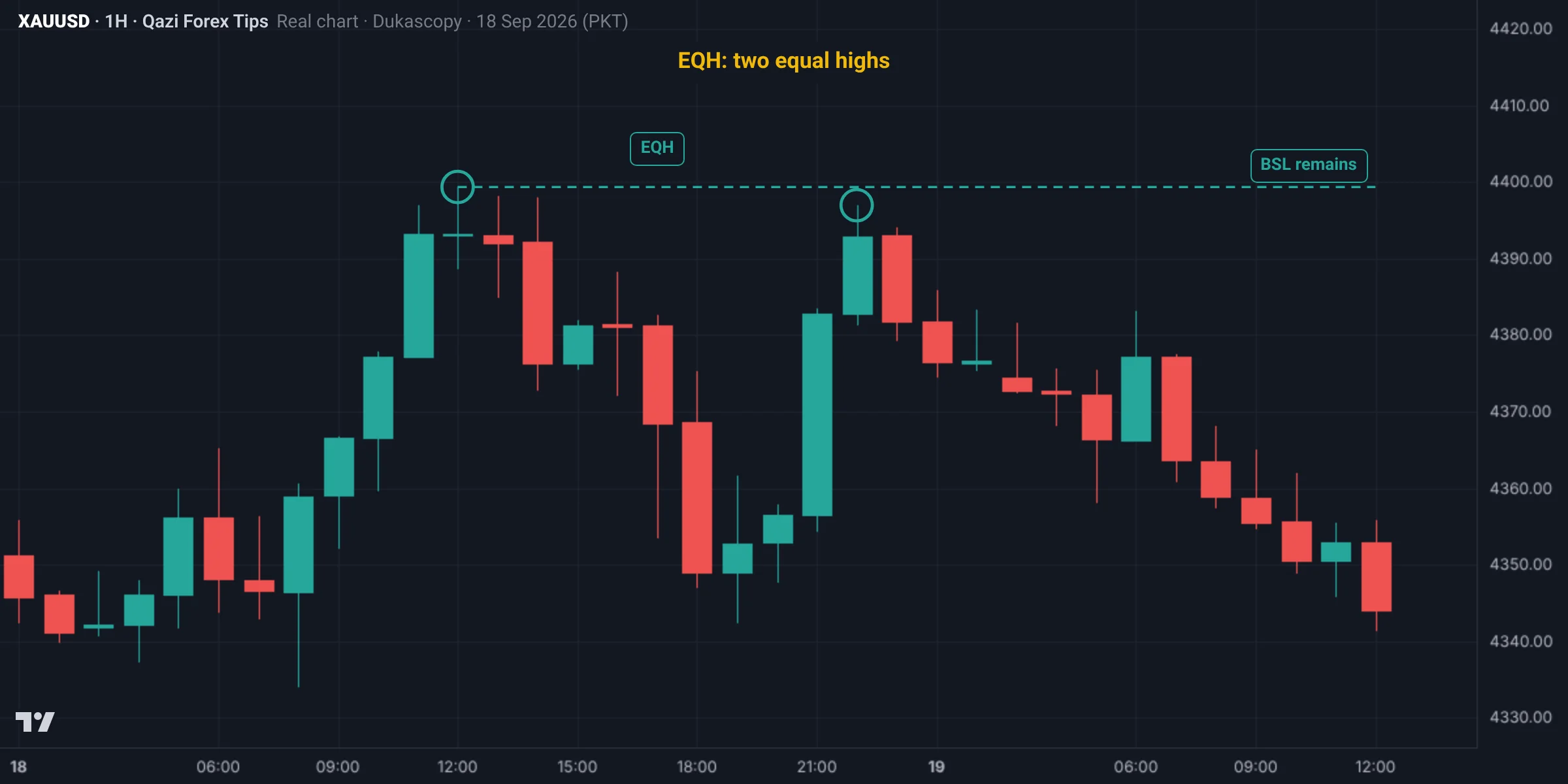
A's two highs are 4,399.4 and 4,397.0, only 2.4 dollars apart: an EQH with BSL resting above it. B is a pair of lows 8.3 dollars apart, and C and D are single highs.
The marked chart
Test yourself: Lesson 2.2 quiz
9 questions. Pick one answer for each and you will see at once whether it is right and why. Your score and grade appear at the end. You need 70% to pass.
0 correct · 0 / 9
Question 1What is an EQH?
Classic price action calls it a double top or strong resistance.
Question 2Why does liquidity grow with every touch?
By the third touch breakout traders add buy stops too.
Question 3What do traders say about a very clean double top?
The buy orders above fire and fill the big seller, then price comes back down.
Question 4On Gold H1, how much difference between two highs still counts as equal?
The real question: would an ordinary trader see it as one clear level? 3 to 4 dollars on H4, up to 0.5 on M5.
Question 5A trendline breaks but structure (the protected low) holds. What is it usually?
An SMC trader watches structure, not the line.
Question 6Retail sells the double top. What does an SMC trader do?
No entry after a sweep without a lower timeframe CHoCH.
Question 7In a bullish bias, what are EQL and trendlines below?
In a bullish bias liquidity below is a sweep zone and EQH above is a target.
Question 8Why is treating every EQH as an instant sell signal wrong?
Selling below it usually means trading against the target.
Question 9Gold M15 highs 4,138.50, 4,139.20, 4,138.80; H1 bearish. Price hits 4,142.30, closes 4,137.90, then an M5 bearish CHoCH. Where is the stop?
Sell near 4,138.00, stop above the wick, target the SSL at 4,126.00; about 1:2.
Lesson checklist
Tick each point once you understand it. Your ticks are saved in this browser.
Assignment
- Find 10 EQH and 10 EQL on Gold H1 and H4.
- For each one, write: did price sweep it and reverse, or break it and continue?
- Find 3 clean trendlines with three or more touches and see what happened after the line broke: did structure break?
- On one EQH or EQL sweep, open M5 and mark the CHoCH, entry, stop and target.
- Post your counts in the group.
Post your assignment screenshots with your reasons in our free Facebook group, where your charts will be checked.
Join the free group
Who wrote this lesson
Dr. Qazi Abdul Basit, Ph.D
Ph.D in Business Administration and a forex and Gold trader since 2013. Founder of Qazi Forex Tips, which teaches traders in Pakistan and India price action, risk management and trading psychology in their own language: 65 student batches so far, free courses on YouTube, and MT5 tools for traders (QFT Replay Simulator, QFT Trade Assistant).
- 2013 trading since
- 75K+ Facebook group members
- 65 student batches
- 15K+ YouTube subscribers
How this lesson was made: the content follows Dr. Qazi's teaching method and years of trading. Real charts are built from Dukascopy Gold (XAUUSD) data, and backtest results are shown as they came out, even when negative. We do not sell signals, manage accounts or take money from any broker. Last updated: 19 November 2026.
Questions
What are equal highs in SMC?
Two or more highs at almost the same price; stops cluster above them, making them obvious liquidity.
Is it wrong to sell a double top?
Not always, but price often sweeps above the top first. Selling after the sweep and a lower timeframe CHoCH is safer.
What is trendline liquidity?
Stops placed just beyond a clean, many-touch trendline, which price often sweeps before continuing.
How many touches make a level liquidity?
Two touches make an equal level; three or more add even more liquidity.
Does a broken trendline end the trend?
Not necessarily. If the protected low holds, it is often just a liquidity sweep.
Are equal highs the same as a double top?
The shape is the same but the thinking is opposite: retail sells a double top, while SMC treats equal highs as liquidity that often gets swept first.
What are equal lows?
Two or more lows at roughly the same level. Buyers' stops gather below them, so they are sell-side liquidity.
Read more
Education only, not financial advice. Trading forex, Gold and CFDs carries a high risk of loss. SMC concepts describe tendencies, not guarantees. Lesson 13 of 38.