 Qazi Forex Tips

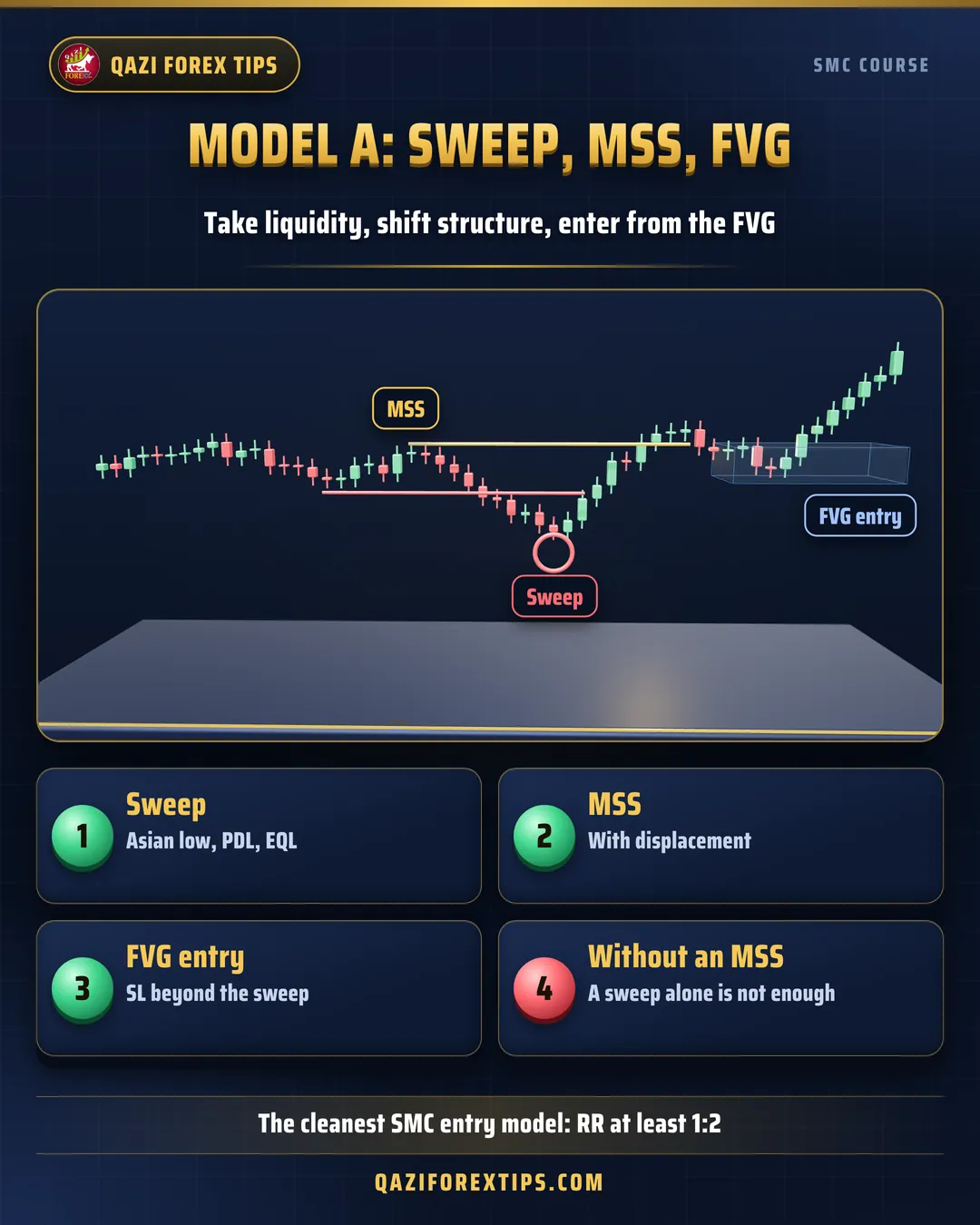
Model A at a glance
- Sweep: price takes clear liquidity (the Asian low, PDL, equal lows).
- MSS: right after the sweep, the last minor high breaks with strong displacement.
- FVG: that displacement leaves a fair value gap.
- Entry: when price returns into the FVG.
- SL: below the swept low. TP: liquidity on the other side.
This is often called the ICT "2022 model". You already know every part: the sweep (lesson 2.4), CHoCH and MSS (lesson 1.3), the FVG (lesson 3.2).
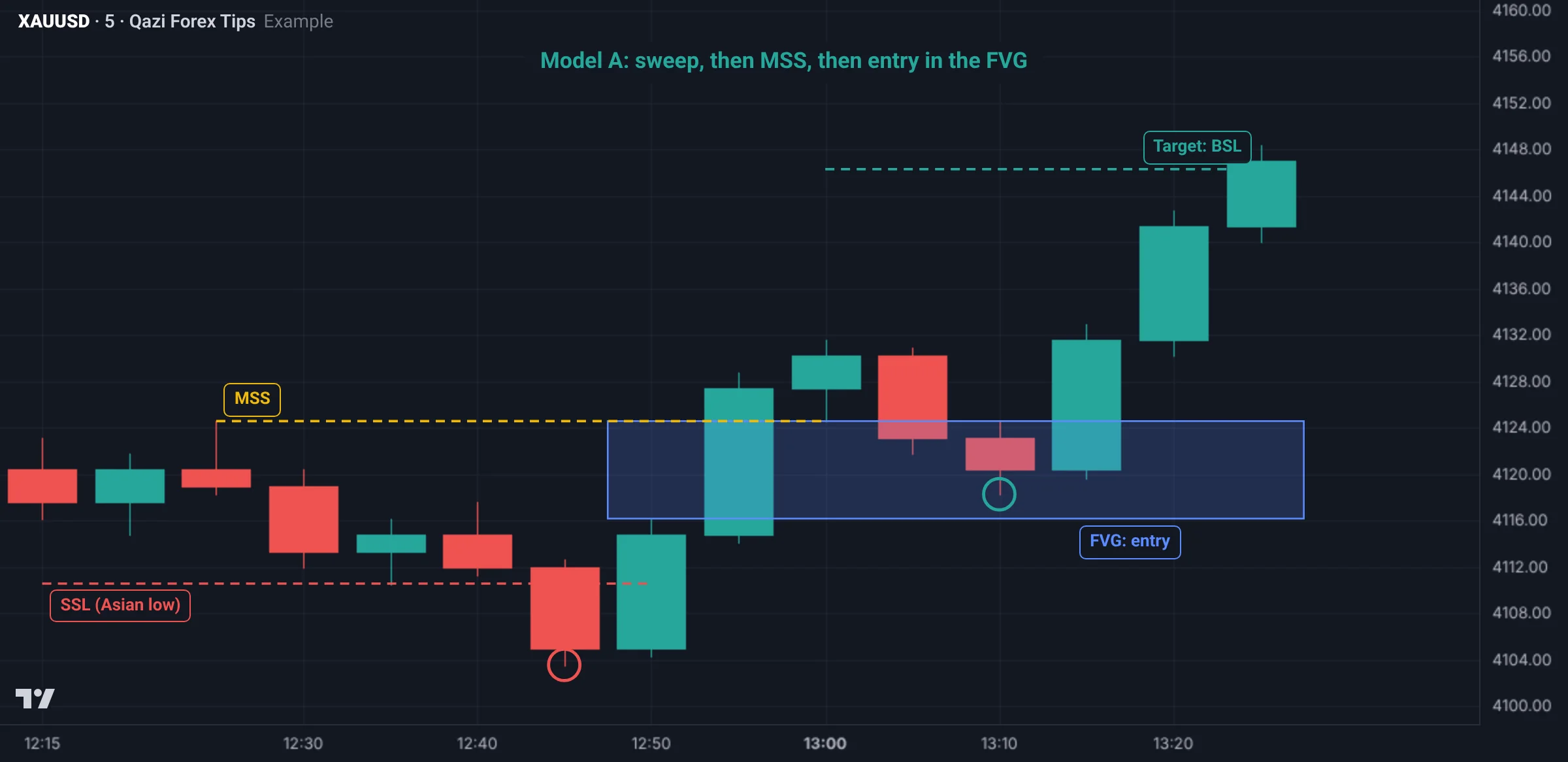
Full rules
Bullish model A
- Condition 1, bias: H4 or H1 bias is bullish, or price is in higher timeframe discount and inside a major POI.
- Condition 2, sweep: on M5 or M15, a wick or brief move below a clear low, then back.
- Condition 3, MSS: the move after the sweep breaks the last minor high before the sweep with a body close.
- Condition 4, displacement and FVG: the MSS move has large-bodied candles and leaves an FVG.
- Condition 5, time: all of this in a killzone, with no high-impact news in the next 30 minutes.
- Entry: a limit at the top edge of the FVG or its CE (50%).
- SL: a little below the swept low.
- TP1: the nearby high (the MSS high or session high); TP2: the draw on liquidity.
- No trade if the RR is below 1:2.
Bearish model A
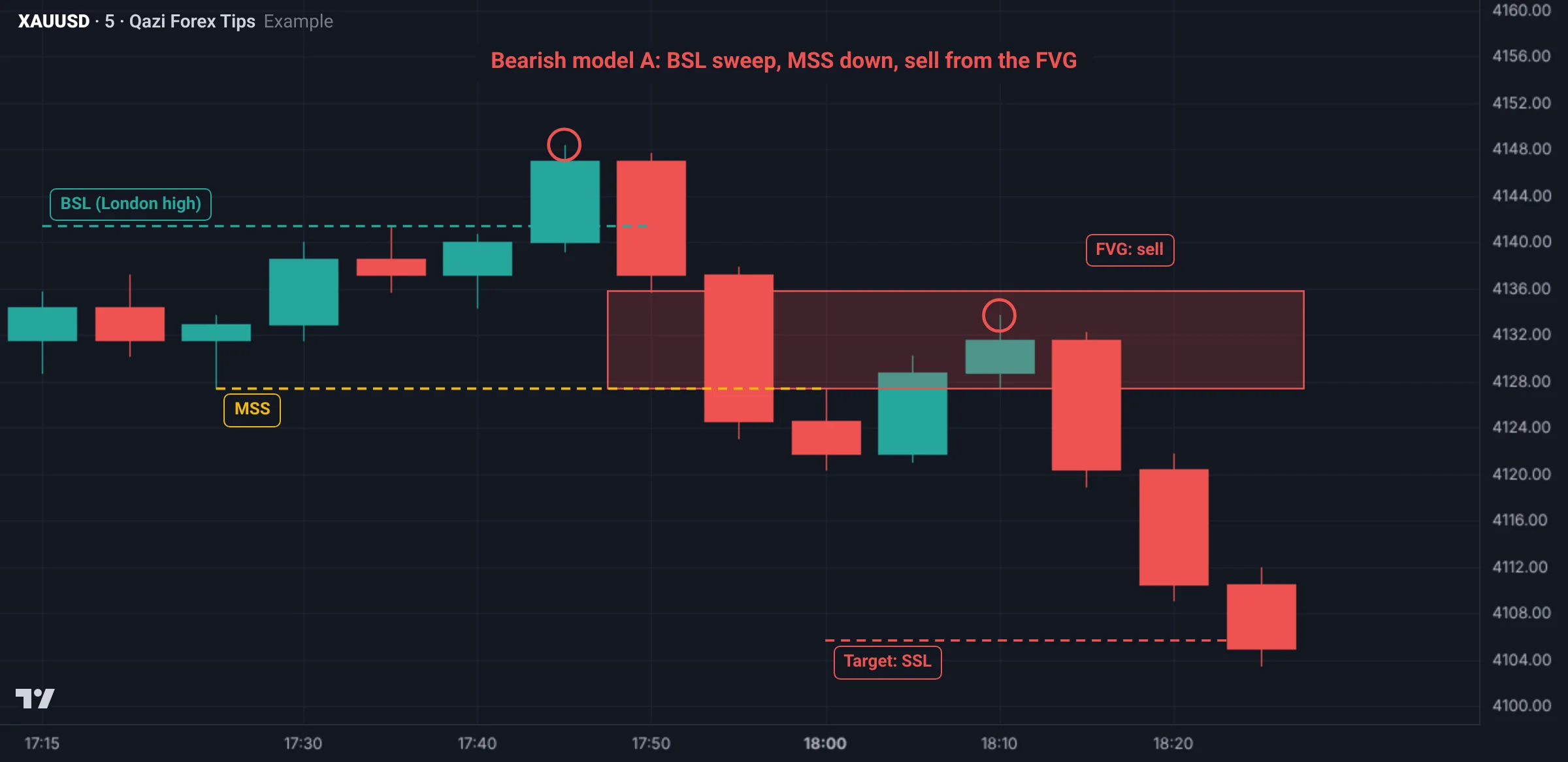
Everything reversed: a sweep of a clear high, a body break of the last minor low, a bearish FVG, a sell on the return into the FVG, SL above the swept high, TP at the sell-side liquidity below.
Why model A works
- Sweep: traders on the wrong side got trapped, and their stops filled the large player's orders.
- MSS: the large player is now positioned in the real direction, because minor structure broke forcefully.
- FVG: price often returns to fill the gap the large order left; that is our cheaper entry.
- The SL is logical: if the swept low breaks too, the sweep failed and the idea is over.
Good vs weak model A
| Point | Good | Weak |
|---|---|---|
| Swept level | Asia, PDH/PDL, equal lows | An unnamed minor low |
| MSS | Big bodies, immediate | Slow, over many candles |
| FVG | Clean, reasonable size | Tiny, or the stop gets huge |
| Location | In higher timeframe discount and a POI | Bullish in higher timeframe premium |
| Time | Killzone | Quiet Asian hours |
When model A fails
- Price enters the FVG and closes a body below it: weakness. If you are not filled yet, cancel the limit.
- Price closes below the swept low: the model failed. This often happens when the higher timeframe bias is opposite and the "sweep" was really a break.
- A model A formed at news often sweeps both sides; avoid news.
Gold example
Tuesday, winter. H4 bullish, DOL at PDH 4,148.
- Asia: range 4,121 to 4,130.
- London open: price dropped to 4,113, sweeping the Asian low (4,121).
- Next 15 minutes: large green M5 candles broke the 4,128 minor high (MSS) and left an FVG from 4,121 to 4,127.
- Return: price came back to 4,124 (the CE). Entry 4,124, SL 4,111, risk $13.
- TP1: the post-sweep high 4,134 ($10). TP2: PDH 4,148 ($24, about 1:1.8).
- That is below our 1:2 minimum. A better entry: a limit at the lower part of the FVG at 4,122, SL 4,111, risk $11, $26 to TP2: 1:2.4. Follow the rule, not the excitement.
- At 1% risk on a $1,000 account ($10): 10 ÷ (11 × 100) = 0.009, below 0.01 lot. Either skip the trade or accept that 0.01 lot means about 1.1% risk.
Real Gold chart examples
Gold M15 on 27 Oct 2026 (data: Dukascopy, bid price; Pakistan time):
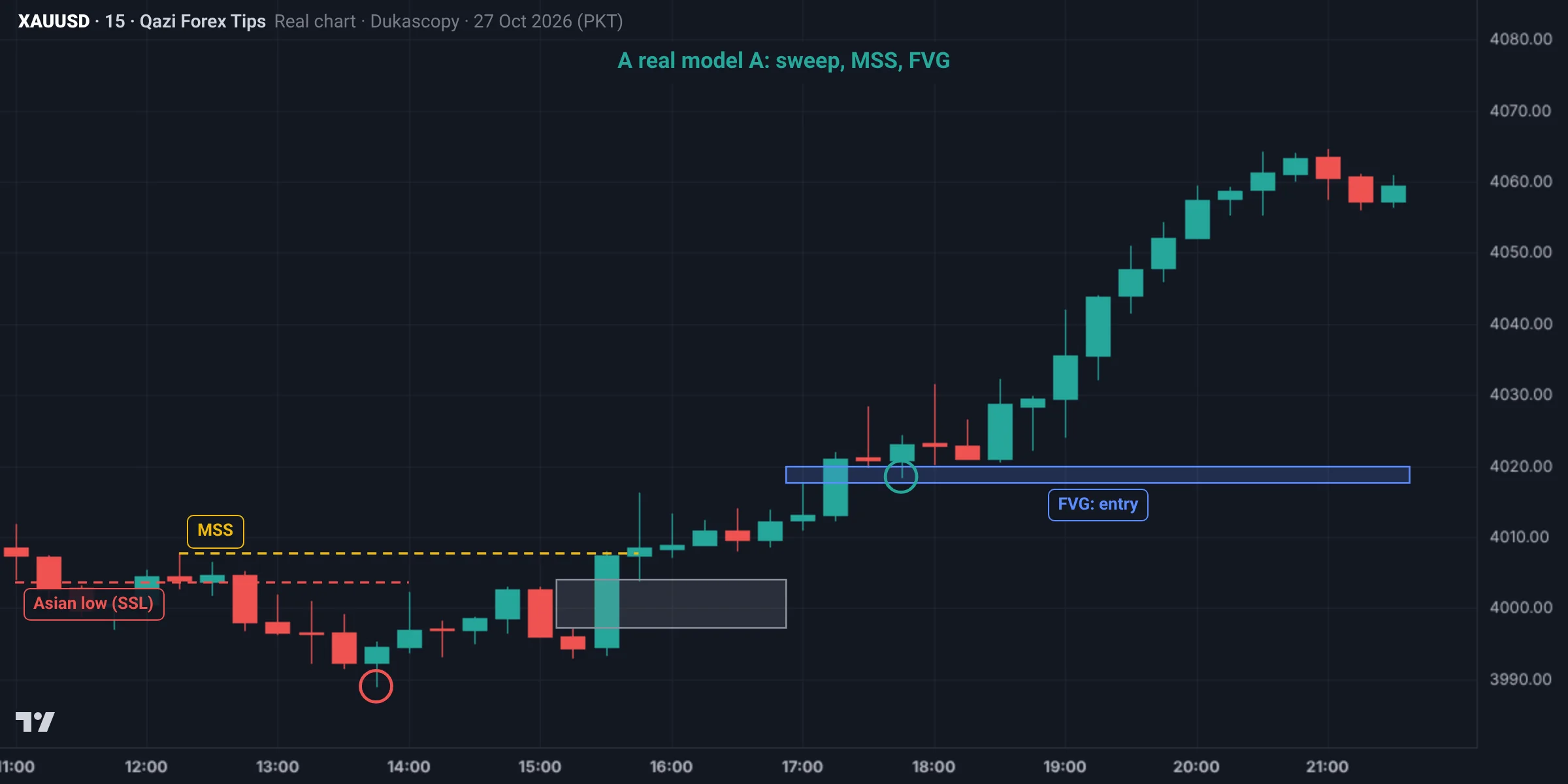
- Sweep: below the Asian low at 4,003.6, to 3,989.0 at 13:45 (next to the PDL at 3,988.5).
- MSS: the last minor high before the sweep was 4,007.7 (12:15). After the big green 15:30 candle, the 15:45 candle closed at 4,008.5: the MSS.
- First FVG (3,997.2 to 4,004.0): price never came back, so there was no entry here. That is normal; do not chase.
- Second FVG (4,017.6 to 4,019.9, 17:15): at 17:45 price came back to 4,018.5: entry at 4,019.9 (the top edge of the FVG).
- SL: below the low of the candle before the FVG (4,011.0), at 4,009.5, risk $10.4.
- TP1: the PDH at 4,029.7 (hit at 18:00). Managing the rest is in lesson 6.2.
Second example: a model A sell (22 Oct)
Gold M15 on 22 Oct 2026 (data: Dukascopy, bid price; Pakistan time). The first example was a buy; this is a model A sell:
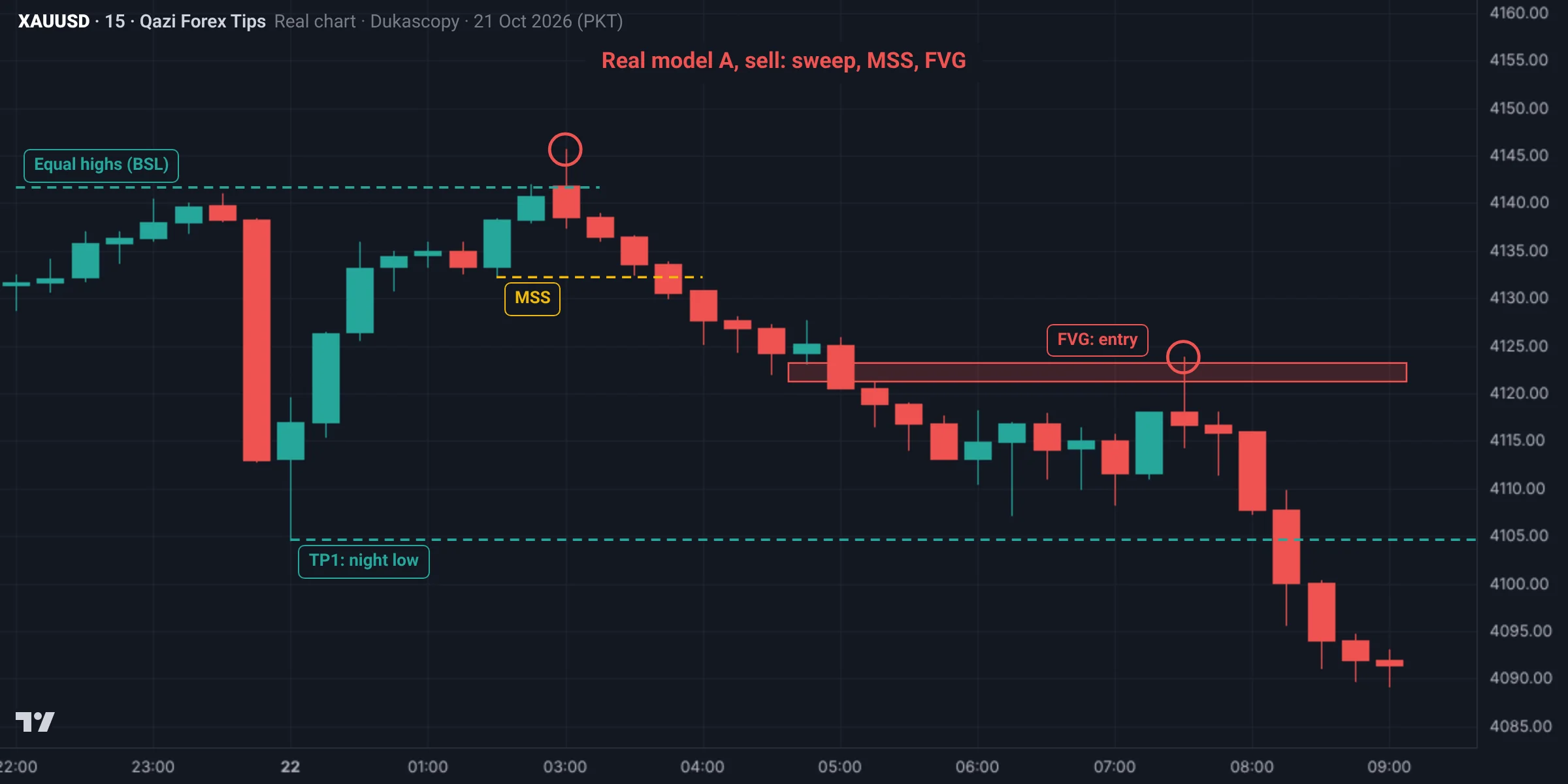
- Sweep: above the 21 Oct equal highs at 4,141.6, to 4,145.6 at 03:00, and the candle closed back down at 4,138.6.
- MSS: the last minor low before the sweep was 4,132.2 (01:30). The 03:45 candle closed below it at 4,130.6, with a run of red displacement candles: the MSS.
- Earlier FVGs: price never came back into the 03:30 to 04:15 FVGs, so there was no entry there. Do not chase.
- The entry FVG (05:00): 4,121.2 to 4,123.2. At 07:30 price came back to 4,123.8: sell at 4,121.2 (the bottom edge of the FVG).
- SL: above the high of the candle before the FVG, at 4,128.5, risk $7.3.
- TP1: the night low at 4,104.6 (hit at 08:15). Managing the rest is in the second example of lesson 6.2.
Common mistakes
Summary
- Model A: a sweep of clear liquidity, an MSS with displacement, an entry in the FVG.
- SL beyond the sweep, TP at opposite liquidity, RR at least 1:2.
- Only with higher timeframe bias and in a killzone.
- If the swept low breaks, the model failed.
Try this lesson on your own chart
Qazi Forex Tips' own tools that make this lesson easier. A tool helps; your rules make the decision.
QFT FVG Pro indicator
100% free · MT5 & MT4Draws FVGs, IFVGs, BPRs and higher timeframe FVGs on your chart automatically, with the 50% (CE) line: everything in this lesson, on your own chart.
Details and downloadQFT Sessions & Killzones indicator
100% free · MT5 & MT4Asia, London and New York sessions, the four ICT killzones and the previous day high and low on your chart, with a Pakistan or India time clock and automatic daylight saving.
Details and downloadSpot it on the chart: practice
This is a real Gold chart (Dukascopy data, Pakistan time). Study it and pick an answer. After you answer, the fully marked chart and the explanation appear.
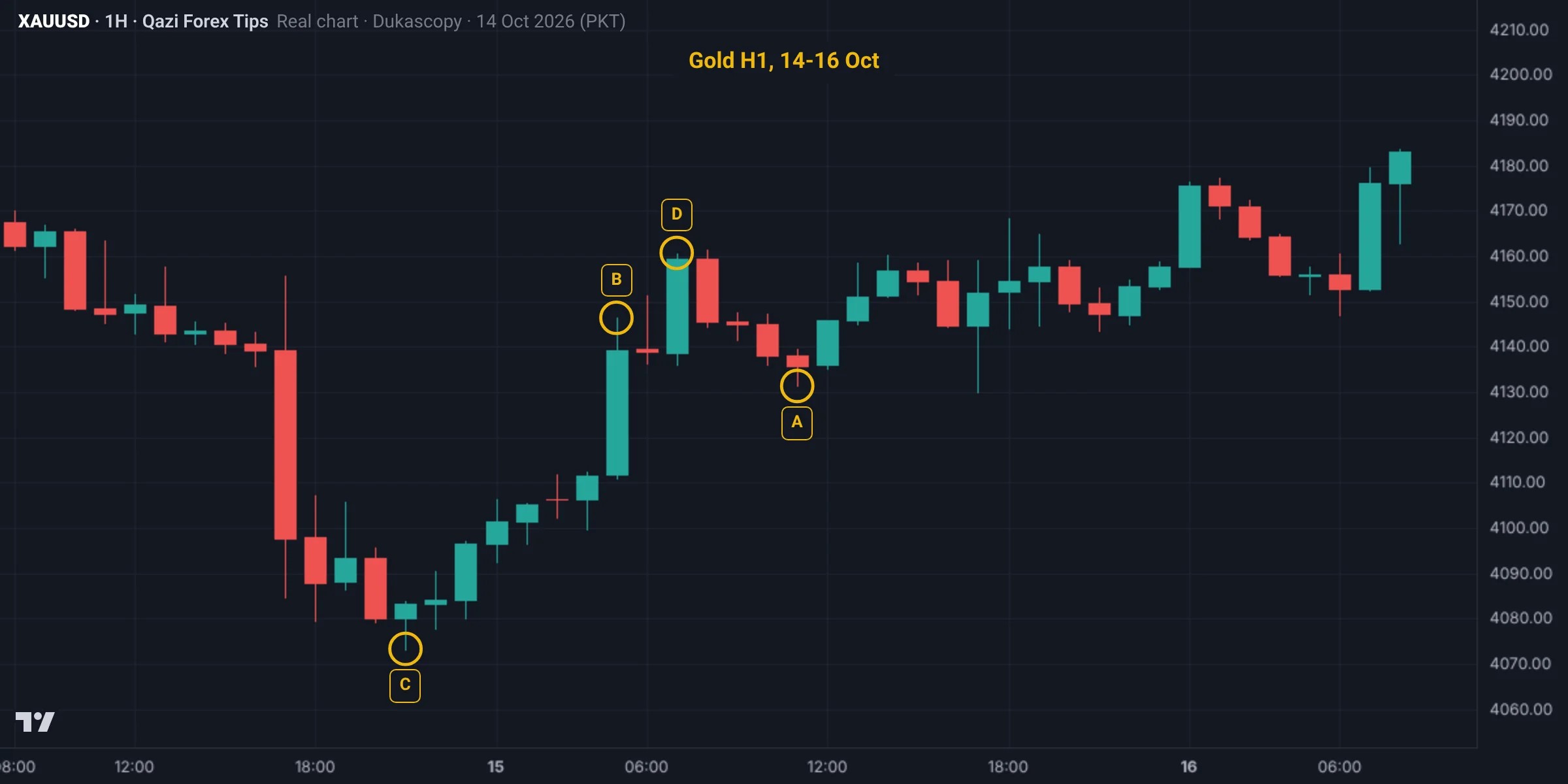
On the night of 14 Oct price swept the equal lows, then made an MSS at 05:00 on 15 Oct. Which is the correct model A entry?
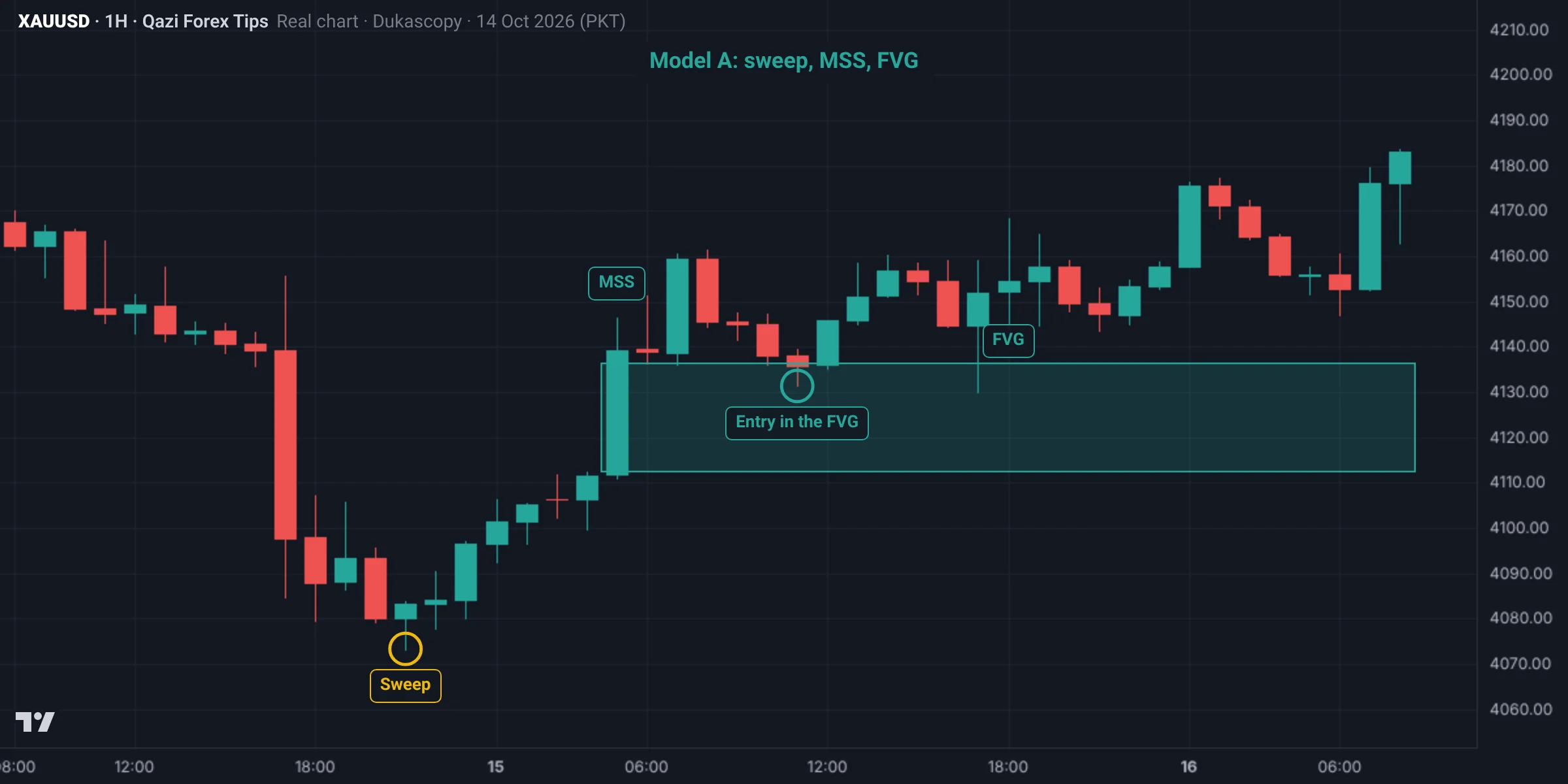
Model A runs: sweep (4,073.3), MSS, FVG (4,112.5 to 4,136.3), and the entry on the return into the FVG: A (11:00 on 15 Oct, low 4,131.4), with the SL below the sweep low. Price reached 4,183.6 on 16 Oct. B chases the MSS candle (an expensive entry), C buys mid-sweep without confirmation, and D buys the top.
The marked chart
Test yourself: Lesson 5.2 quiz
9 questions. Pick one answer for each and you will see at once whether it is right and why. Your score and grade appear at the end. You need 70% to pass.
0 correct · 0 / 9
Question 1What is the sequence of model A?
It is often called the ICT "2022 model".
Question 2What is the MSS condition in model A?
Displacement and an FVG must come with it.
Question 3Where is the SL in model A?
If the swept low breaks too, the sweep failed and the idea is over.
Question 4Below what RR should you not take model A?
The SL comes from logic and RR is the result; if it is too low, skip.
Question 5Which is a sign of a weak model A?
After the trade ask which liquidity the sweep took; if you can't name it, the setup was weak.
Question 6When does model A fail?
A body close below the FVG is weakness; if not filled yet, cancel the limit.
Question 7Why is a market order on the MSS candle wrong?
The return into the FVG gives the cheaper entry.
Question 8Gold example: entry 4,122, SL 4,111 (11 dollars), 1% risk on 1,000 dollars. What is the lot problem?
10 ÷ (11 × 100) = 0.009.
Question 9What about taking model A against the higher timeframe?
A sweep without an MSS, or an MSS without a sweep, is incomplete.
Lesson checklist
Tick each point once you understand it. Your ticks are saved in this browser.
Assignment
- Find model A setups in the London and New York killzones on Gold M5 over the last 20 days.
- For each: swept level, MSS, FVG, entry, SL, TP, RR, result.
- Count those with and against the higher timeframe bias separately.
- Work out the win rate and average R over at least 30 examples.
- Post your results in the group.
Post your assignment screenshots with your reasons in our free Facebook group, where your charts will be checked.
Join the free group
Who wrote this lesson
Dr. Qazi Abdul Basit, Ph.D
Ph.D in Business Administration and a forex and Gold trader since 2013. Founder of Qazi Forex Tips, which teaches traders in Pakistan and India price action, risk management and trading psychology in their own language: 65 student batches so far, free courses on YouTube, and MT5 tools for traders (QFT Replay Simulator, QFT Trade Assistant).
- 2013 trading since
- 75K+ Facebook group members
- 65 student batches
- 15K+ YouTube subscribers
How this lesson was made: the content follows Dr. Qazi's teaching method and years of trading. Real charts are built from Dukascopy Gold (XAUUSD) data, and backtest results are shown as they came out, even when negative. We do not sell signals, manage accounts or take money from any broker. Last updated: 19 November 2026.
Questions
What is the sweep, MSS, FVG model?
A liquidity sweep, then a market structure shift with displacement, then an entry on the retrace into the fair value gap, with the stop beyond the sweep.
Is this the ICT 2022 model?
Yes, it is commonly called the ICT 2022 mentorship model.
Which timeframe is used?
Entries on M1 to M15, bias from H1 or H4.
What does MSS mean in trading?
MSS stands for market structure shift: a structure break with displacement after a liquidity sweep, usually leaving an FVG.
Does this model work for sells too?
Yes, exactly reversed: a sweep of liquidity above, an MSS down, and a sell on the return into the bearish FVG. The second example in this lesson is a real sell.
Read more
Education only, not financial advice. Trading forex, Gold and CFDs carries a high risk of loss. SMC concepts describe tendencies, not guarantees. Lesson 29 of 38.