 Qazi Forex Tips

What is a POI?
POI means Point of Interest: a place on the chart where we expect price to react and where we will look for an entry. In Phase 1 we learned to read bias from structure, and in Phase 2 we learned from liquidity where price is heading. Phase 3 answers the next question: where do we enter? This phase has seven lessons: order block, fair value gap, breaker, mitigation, rejection and propulsion blocks, premium and discount with OTE, and finally the POI checklist. The first and most important is the order block.
Definition
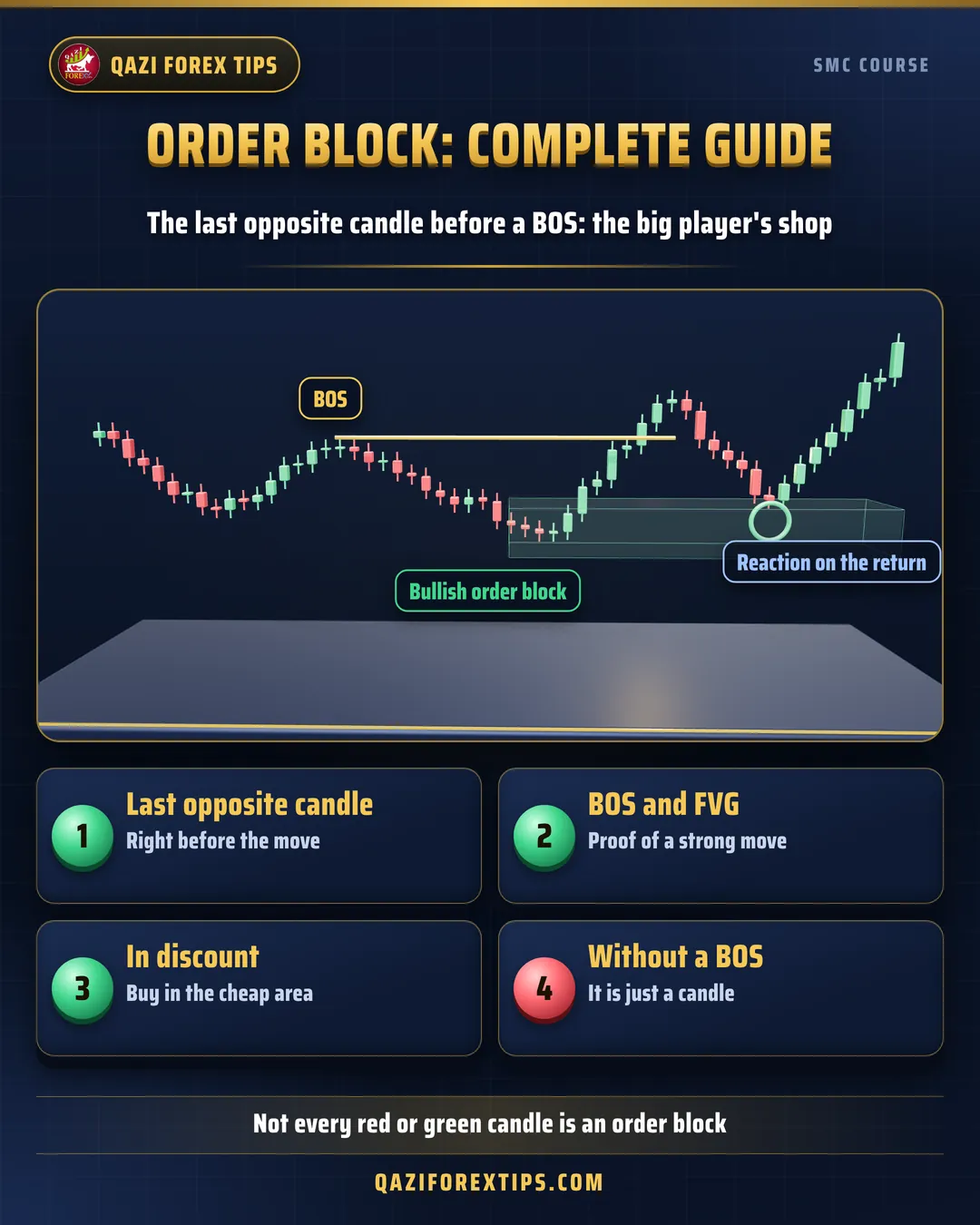
Bullish order block: the last bearish (red) candle right before a strong move up that breaks the previous high (BOS). Bearish order block: the last bullish (green) candle right before a strong move down that breaks the previous low.
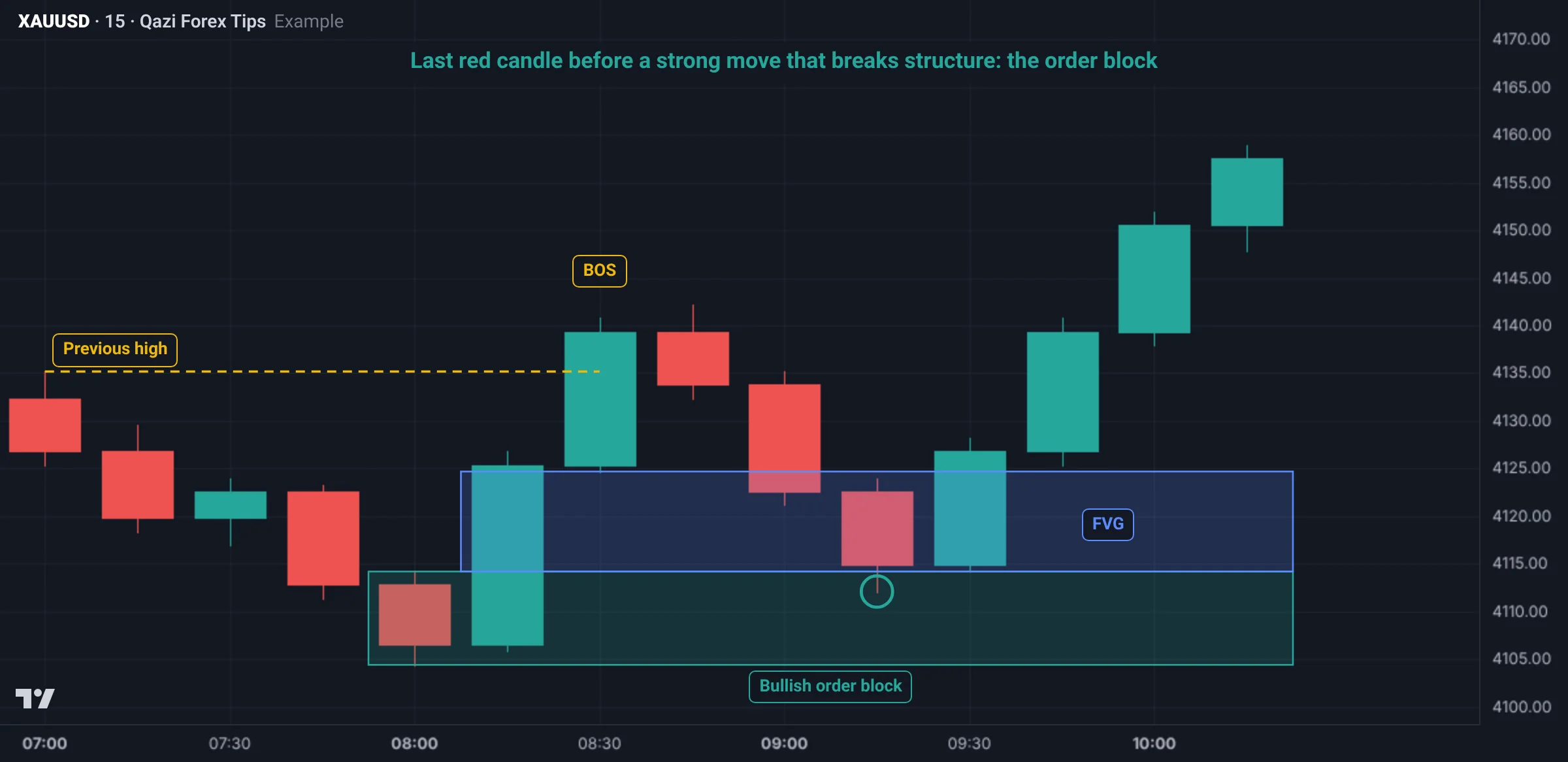
Remember the three parts: the last opposite candle, a strong move (displacement), and a break of structure. If any one is missing, the order block is weak, or not an order block at all.
Why order blocks form
A large player cannot fill a whole order at one price. They start buying around the last red candle, and their buying is so large that price shoots up and breaks the previous high. But part of their order is still unfilled, and the part that did fill they do not want to see go into loss. So when price returns to that zone, the same player buys there again. This is called mitigation: the large player protects the earlier position and fills the rest. That is why order blocks so often produce a reaction.
How to mark an order block
- First find the BOS: a strong candle whose body closes above the previous high.
- Go to the start of that move and find the last red candle before it began.
- Draw the zone from that candle's high to its low (including wicks). Some traders use only the body; see below.
- Extend the zone to the right until price touches it again.
- Add its 50% level (mean threshold). In a strong order block, price usually does not close below the 50% level.
If two or three red candles sit together before the move and form one block, you can treat the whole group as one zone, but the bigger the zone, the bigger the stop loss.
Full candle or body only?
| Method | Advantage | Disadvantage |
|---|---|---|
| Full candle (high to low) | Fewer missed reactions | Bigger stop loss, lower RR |
| Body only (open to close) | Smaller zone, higher RR | Price often turns at the wick and the entry is missed |
| High to 50% | A middle path | Needs a little practice |
Advice for new traders: draw the zone on the full candle, and take the entry from lower timeframe confirmation so the stop loss stays small.
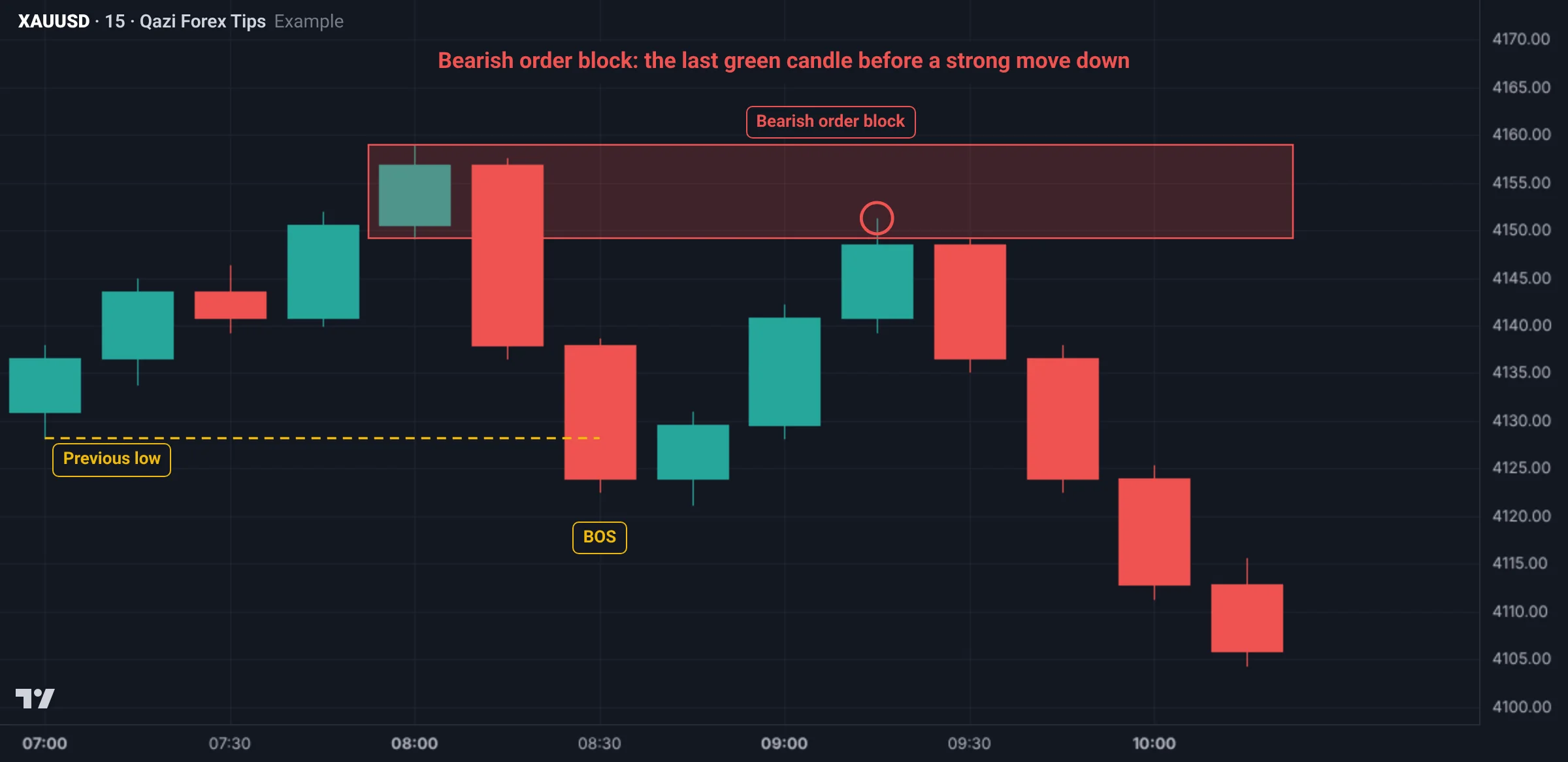
Bearish order block
Exactly the opposite: the last green candle before a strong move down that breaks the previous low. When price returns up into the zone, we look for a sell.
Five signs of a strong order block
- BOS: the move after it broke structure. Without a BOS the order block is weak.
- Displacement and FVG: the move was fast enough to leave a fair value gap behind. The FVG shows a large order really was there.
- Liquidity sweep: before the order block formed, price took a low (SSL) or an inducement.
- Unmitigated: price has not yet come back into the zone. The first touch is the strongest.
- Right location: a bullish order block sits in discount (below 50% of the range) and agrees with the higher timeframe bias.
The more signs, the stronger the POI. If at least three of the five are not present, skip it.
A weak order block that fails
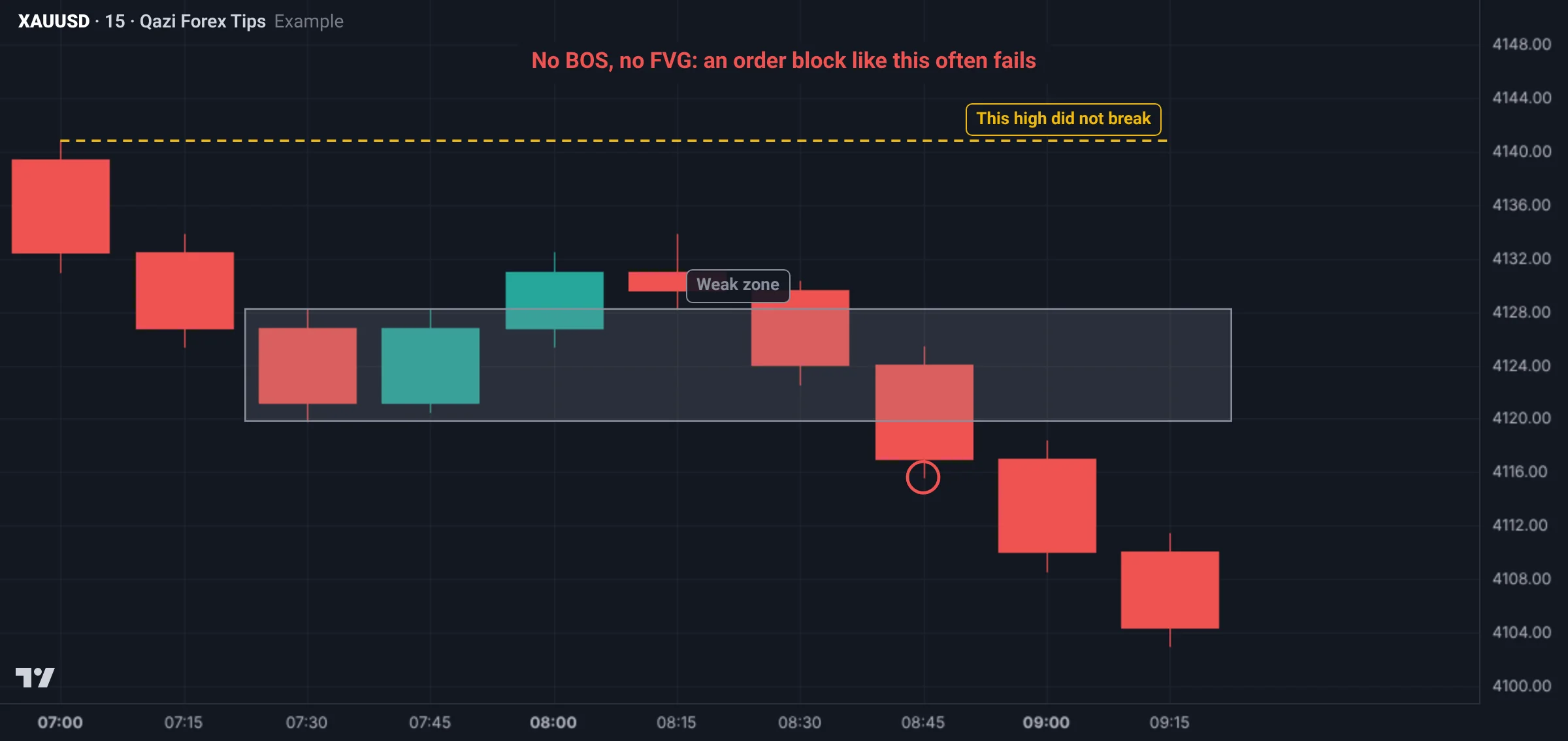
Here price moved up a little after a red candle, but no high broke and the move had no strength. When price came back, the zone broke straight through. Retail traders buy every zone like this, and their stop losses become the liquidity.
Trading an order block step by step
- Bias: H4 and H1 are bullish (Phase 1).
- Draw on liquidity: there is clear buy-side liquidity above to act as a target (Phase 2).
- POI: mark a strong bullish order block in discount on H1 or M15.
- Wait: let price come into the zone. A limit order placed in advance is the aggressive method; confirmation is the conservative one.
- Confirmation: a CHoCH on M1 or M5 inside the zone, then enter from the new lower timeframe order block or FVG.
- Stop loss: a little below the order block low (or below the confirmation low).
- Target: the next liquidity, with the first take profit at the previous high.
Aggressive vs conservative entry
| Entry | How | Advantage | Disadvantage |
|---|---|---|---|
| Aggressive | Limit at the top of the zone or at 50% | Never misses the move, good RR | Full stop loss if the zone fails |
| Conservative | Wait for an M1 or M5 CHoCH in the zone | Avoids bad zones, smaller stop | Sometimes price leaves without confirmation |
Gold example
Suppose Gold on M15 was falling and a red candle reached 4,100. That last red candle has a high of 4,107 and a low of 4,100. Two large green candles then broke the previous high at 4,112 and closed at 4,116, leaving an FVG from 4,107 to 4,114.
- Order block: 4,100 to 4,107, with its 50% at about 4,103.5.
- Price ran to 4,119, then returned and touched 4,105.5.
- An M1 CHoCH gives an entry at 4,107 with the stop loss at 4,099 (below the order block), a risk of $8.
- First target: the previous high at 4,119 ($12, 1:1.5); second: the next buy-side liquidity at 4,128 ($21, about 1:2.6).
- At 0.01 lot, a $1 move in Gold is roughly $1 of profit or loss. If your risk is 2% of a $1,000 account, or $20, then 20 ÷ 8 = 2.5, so 0.02 lot (always round down).
Real Gold chart examples
Gold M15 on 16 Oct 2026 (data: Dukascopy, bid price; Pakistan time):
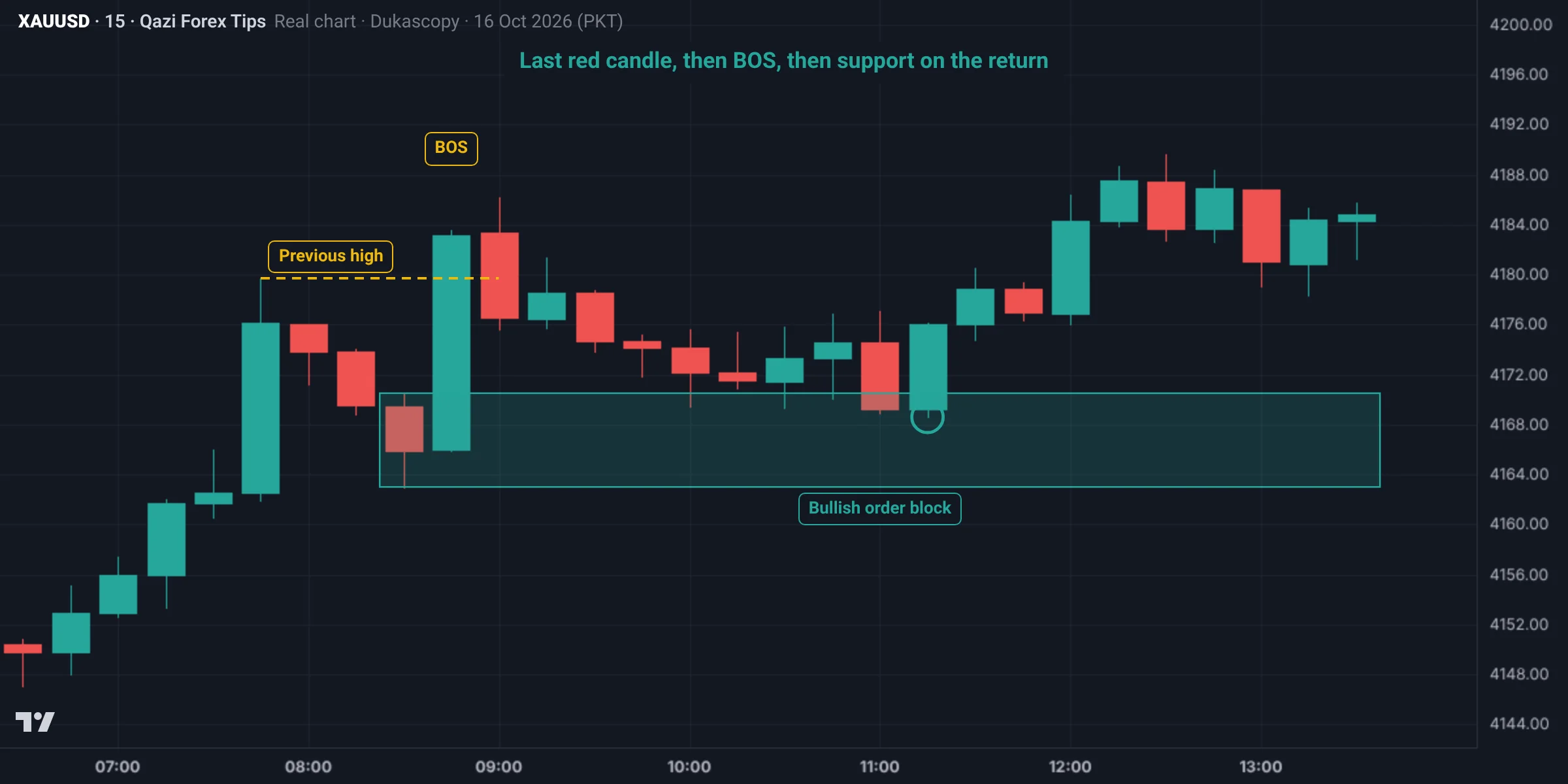
- The 08:30 red candle: high 4,170.5, low 4,163.0. It was the last red candle before the move up.
- The big green 08:45 candle closed at 4,183.1 from 4,166.0 and broke the 07:45 high at 4,179.7: a BOS. It also left an FVG from 4,170.5 to 4,175.6.
- From 10:00 to 11:15 price came back into the top of the order block four times (lows 4,169.5 to 4,168.6), but the OB low at 4,163.0 never broke.
- By 12:00 price was at 4,186.4, and it reached 4,198.8 that day.
Second example: a bearish order block (22 Oct)
Gold M15 on 22 Oct 2026 (data: Dukascopy, bid price; Pakistan time). The first example was a bullish order block; this is a bearish order block:
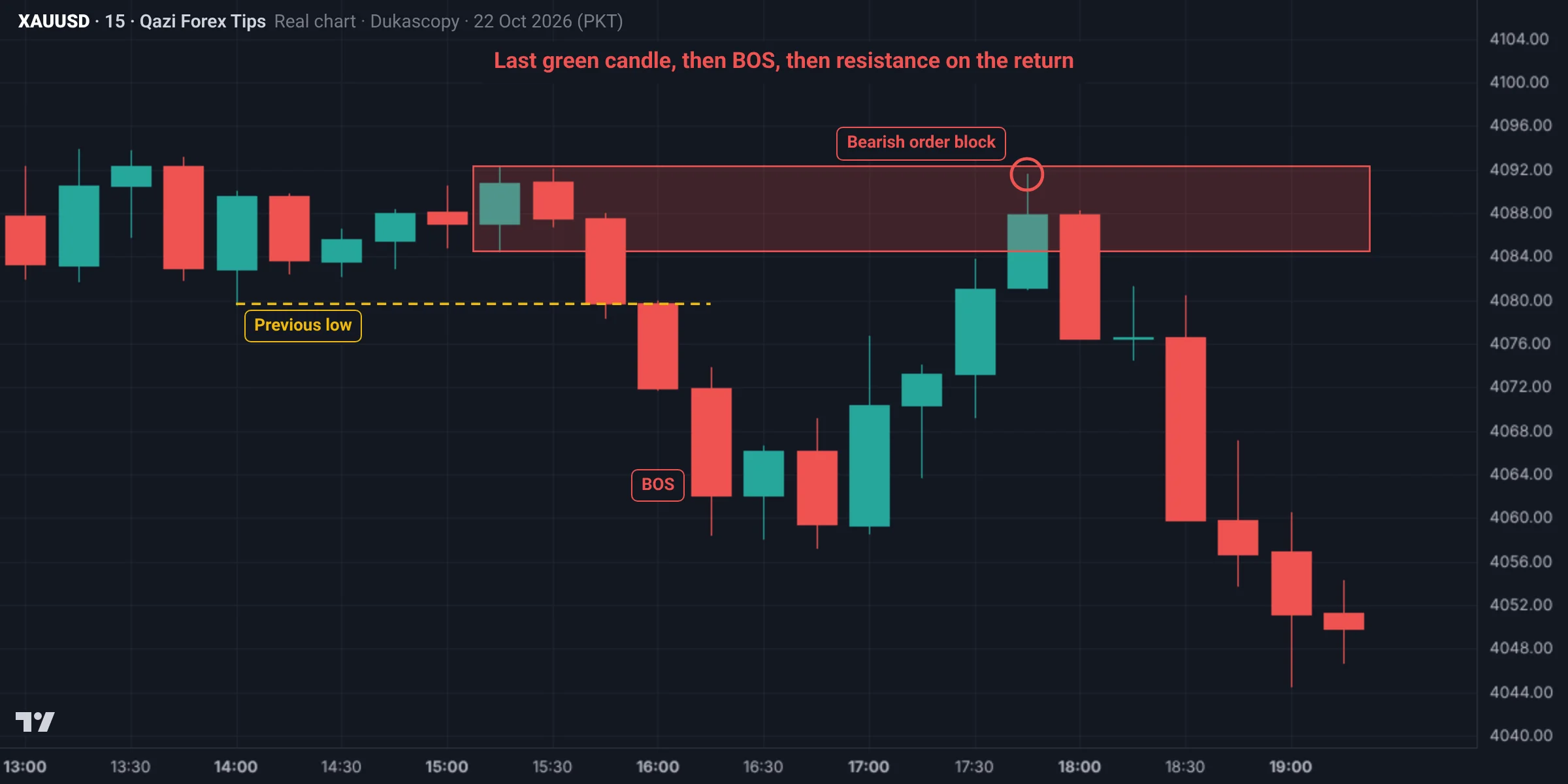
- The 15:15 green candle: high 4,092.3, low 4,084.5. It was the last green candle before the move down.
- Price then fell, and the 16:00 candle closed at 4,072.0, breaking the 14:00 low at 4,079.7: a BOS down.
- At 17:45 price came back to 4,091.6, inside the order block, but the candle closed lower at 4,087.9; the OB high at 4,092.3 never broke.
- Gold then fell to 4,030.1 that night.
In a bullish OB the last red candle becomes support; in a bearish OB the last green candle becomes resistance.
Common mistakes
Summary
- A bullish order block is the last red candle before a strong move that breaks structure; a bearish one is the opposite.
- The large player returns there to protect the position, which is why price reacts.
- Signs of strength: BOS, FVG, a liquidity sweep, unmitigated, and the right side of discount or premium.
- Enter on confirmation, stop loss beyond the zone, target the next liquidity.
Spot it on the chart: practice
This is a real Gold chart (Dukascopy data, Pakistan time). Study it and pick an answer. After you answer, the fully marked chart and the explanation appear.
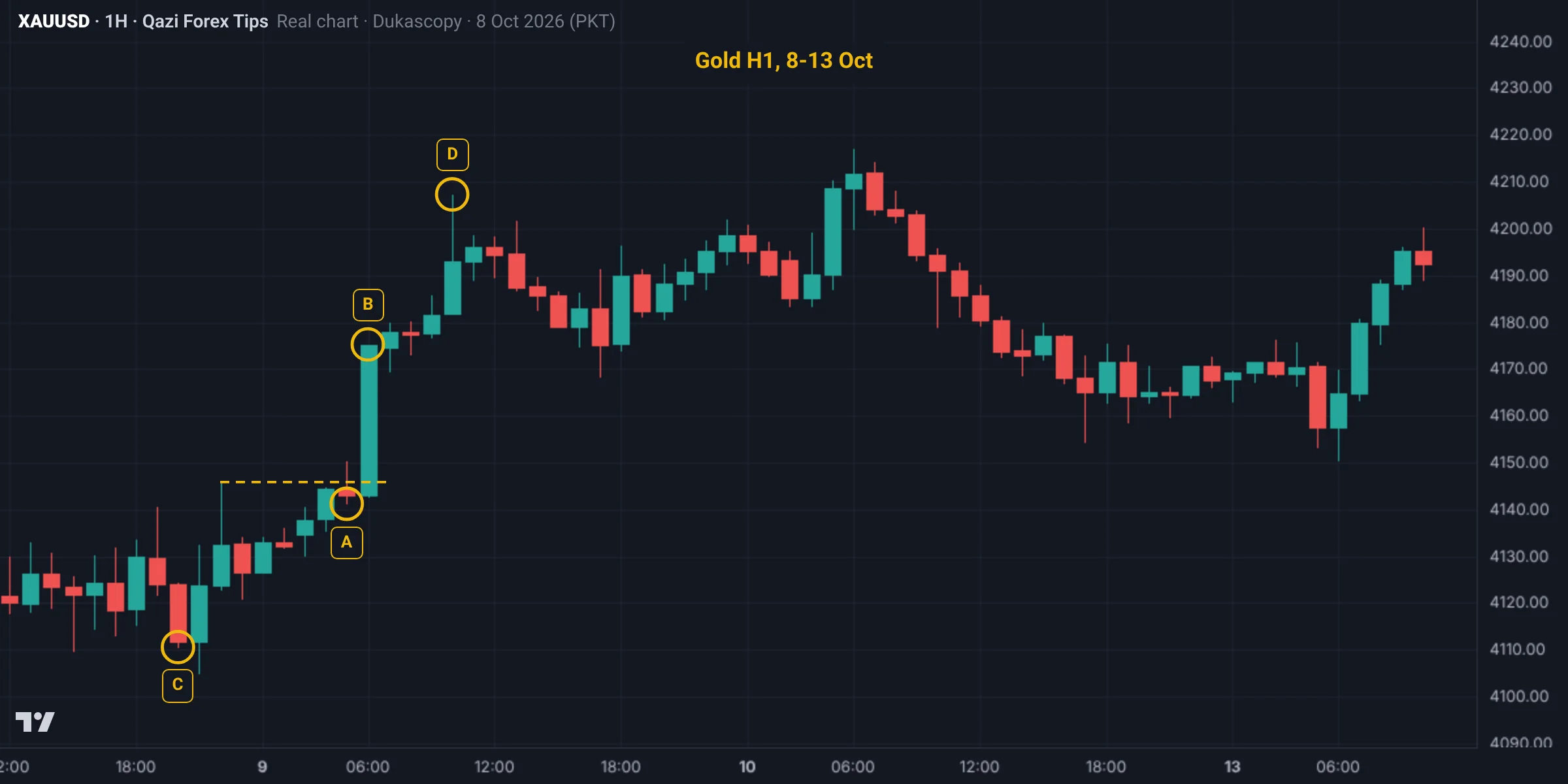
The big green candle at 06:00 on 9 Oct broke the 8 Oct high (a BOS). Which candle is the bullish order block of this move?
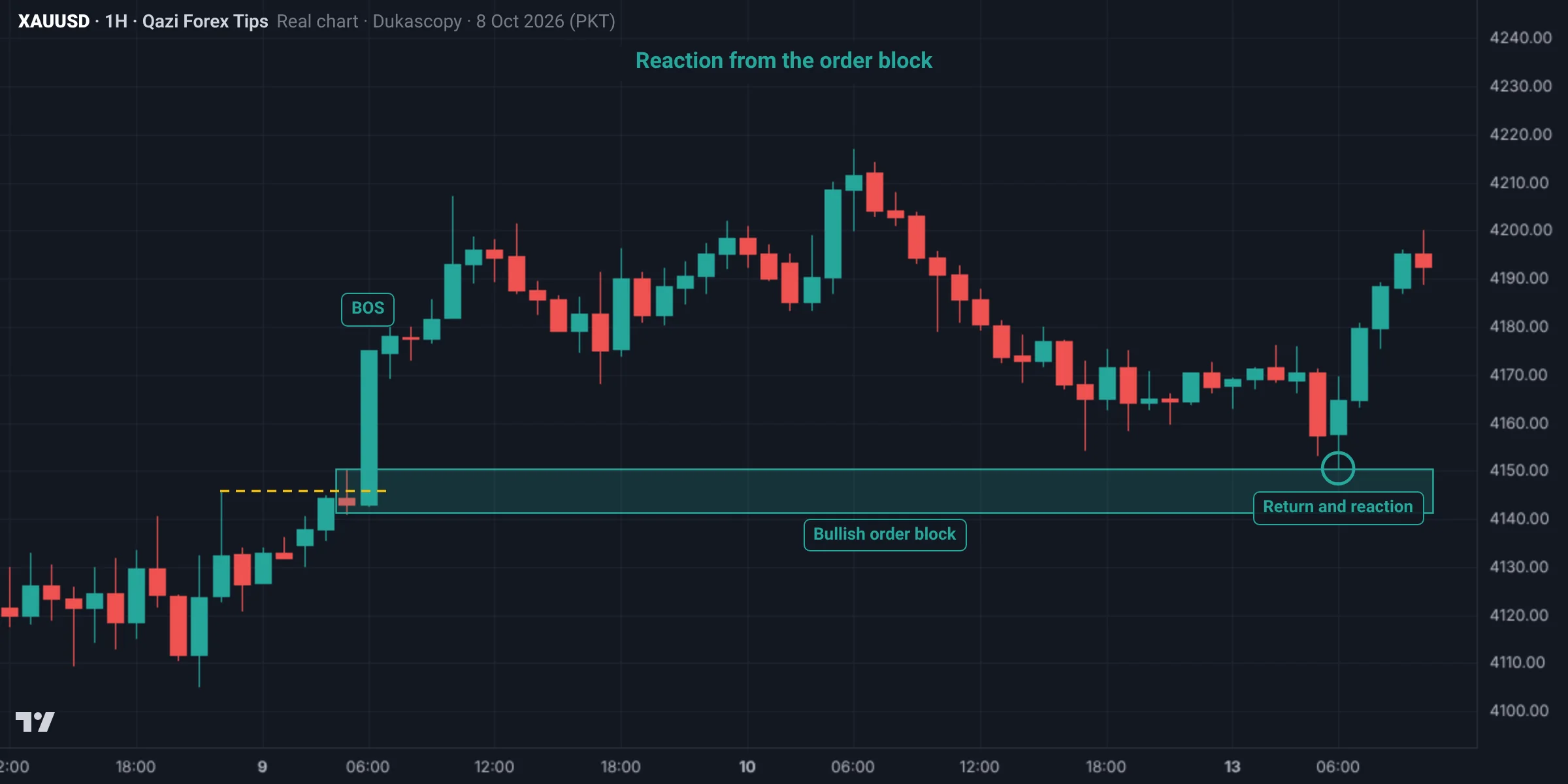
A (05:00 on 9 Oct) is the last red candle before the strong move: a zone from 4,141.2 to 4,150.3. B is the displacement candle itself, C an older low and D a later candle. On 13 Oct price came back to 4,150.5, reacted in the FVG just above the zone and climbed toward 4,200.2.
The marked chart
Test yourself: Lesson 3.1 quiz
10 questions. Pick one answer for each and you will see at once whether it is right and why. Your score and grade appear at the end. You need 70% to pass.
0 correct · 0 / 10
Question 1What does POI mean?
Point of Interest: Phase 3 answers the question of where to enter.
Question 2What is the definition of a bullish order block?
Three parts: the last opposite candle, a strong move (displacement) and a break of structure.
Question 3Why does the big player buy again when price returns to the order block?
The order block is like the big player's shop where it bought stock.
Question 4In a strong order block, below which level does price usually not close?
Always add the 50% line to the zone.
Question 5What is the better way for a new trader to draw the zone?
The full candle misses fewer reactions; confirmation keeps the stop small.
Question 6Which is NOT one of the five signs of a strong order block?
The others are being unmitigated and in the right location; each touch uses up the orders there.
Question 7If fewer than how many of the five signs are present should you skip an order block?
The more signs, the stronger the POI.
Question 8What is the difference between an aggressive and a conservative entry?
Aggressive never misses the move but takes the full stop if the zone fails; conservative sometimes misses the move.
Question 9Gold M15: order block 4,100 to 4,107, entry 4,107, stop 4,099. What lot at 2% risk on a 1,000-dollar account?
Risk 20 dollars, stop 8 dollars: 20 ÷ 8 = 2.5, so 0.02 lot (rounded down).
Question 10What happens if a body closes below the order block?
Staying in the trade after the zone fails is a mistake (lesson 3.3).
Lesson checklist
Tick each point once you understand it. Your ticks are saved in this browser.
Assignment
- Mark 10 bullish and 10 bearish order blocks on the last five days of Gold M15.
- Next to each, note: BOS? FVG? sweep? discount or premium?
- See which zones produced a reaction and which failed, and compare with the signs of strength.
- Write the entry, stop loss and target for the best one and work out the RR.
- Calculate the lot size from your risk (for example 1%) and round down.
- Post your chart in the group and say which order block looked strongest and why.
Post your assignment screenshots with your reasons in our free Facebook group, where your charts will be checked.
Join the free group
Who wrote this lesson
Dr. Qazi Abdul Basit, Ph.D
Ph.D in Business Administration and a forex and Gold trader since 2013. Founder of Qazi Forex Tips, which teaches traders in Pakistan and India price action, risk management and trading psychology in their own language: 65 student batches so far, free courses on YouTube, and MT5 tools for traders (QFT Replay Simulator, QFT Trade Assistant).
- 2013 trading since
- 75K+ Facebook group members
- 65 student batches
- 15K+ YouTube subscribers
How this lesson was made: the content follows Dr. Qazi's teaching method and years of trading. Real charts are built from Dukascopy Gold (XAUUSD) data, and backtest results are shown as they came out, even when negative. We do not sell signals, manage accounts or take money from any broker. Last updated: 19 November 2026.
Questions
What is an order block?
The last opposite candle before a strong move that broke structure; large orders sit there.
What is the difference between an order block and a supply or demand zone?
An order block is a specific candle that needs a BOS and displacement after it, while a supply or demand zone is usually the wider base area.
Which order block is strong?
One followed by a BOS and an FVG, preceded by a liquidity sweep, still untouched, and sitting in discount or premium in the direction of the bias.
Which timeframe should I use for order blocks?
H4, H1 or M15 for the POI, and M5 or M1 for entry confirmation.
What does order block mean?
An order block is where large players placed orders. In SMC it is the last opposite candle before a BOS, where a reaction is expected when price returns.
What is the difference between a bullish and a bearish order block?
A bullish order block is the last red candle before a move up and acts as support; a bearish order block is the last green candle before a move down and acts as resistance.
Read more
Education only, not financial advice. Trading forex, Gold and CFDs carries a high risk of loss. SMC concepts describe tendencies, not guarantees. Lesson 17 of 38.